
Marketing blueprints – a 5 step guide to building your advice practice marketing plan

A blueprint for success: measured progress toward a marketing goal and overall business objective.
Introduction
A common attribute of leading financial practices is their disciplined and formalised approach to planning. For those advisers who are also practice principals, having a documented business plan – and an associated marketing plan – should be regarded as an essential ‘hygiene factor’ which will give the business and its people a sense of purpose and direction, and articulate the metrics and milestones against which progress can be measured.
Despite the benefits of formal planning being obvious and numerous, the majority of financial advice practices in Australia don’t do any formal planning for their business. Whilst there can be many reasons for this, it is likely that many advisers perceive the planning process to be overly theoretical, time consuming and complex. This need not be the case, and in fact shorter, simpler plans can often be easier to understand, easier to stick to, and, as a result, more powerful.
In this article we will explore a framework for developing marketing plans that are both meaningful and practical. We will explore the essential building blocks of a marketing plan, including:
- alignment with the strategic goals of the practice
- metrics
- how to set a marketing budget
- target audiences
- branding and value proposition considerations, and
- the marketing mix.
We will then demonstrate how these elements can be simply distilled into a tactical marketing activity calendar.
Practice owners are an optimistic lot
The financial advice landscape has long been subject to powerful forces of change, and as such can be a challenging market in which to thrive. Notwithstanding this, practice owners have generally been driven by a powerful entrepreneurial spirit and enduring optimism.
A few years ago, a study by practice benchmarking specialists Business Health[1] found that 94% of principals expect to increase their practice revenue over the coming 12 months, and almost nine in ten expected to increase the revenue generated by fees. A similar proportion was expecting to increase their practice profitability, and eight in ten expected to grow their client base.
But are they are dreaming?
Remarkably, the same study found that the vast majority of these advisers with big ambitions had no formal plans on how they were going to achieve these results. (By formal plans, we mean plans that are written down and include clearly defined goals, the actions to be taken, accountability and time frames.)
According to Business Health[2], only one in three (35 per cent) practices analysed had a longer-term strategic plan for their business, only 30 per cent had a succession plan, and just 38 per cent had an operational business plan covering the upcoming 12 months.
A similar picture was found to exist for marketing plans, with a Beddoes Institute benchmarking study[3] finding that more than four in ten practices didn’t have a marketing plan at all, and only 13% had in place a marketing plan they were happy with.
To paraphrase the famous expression, ‘a goal without a plan is just a dream’.
An introduction to marketing planning
There are a number of fundamental points to be made about marketing planning.
The first – and single most important – point is that marketing activities must always be aligned with the overarching goals of the business, as articulated in your business plan. As such, your marketing plan is a supporting or corollary plan, which means you should always create your business plan first. It also means there should be a clear link between any given marketing activity and a business goal.
The second is to ‘keep it simple, stupid’. A one- or two-page plan can be far more powerful than a 20-page tome and is more likely to be adhered to.
Thirdly, it is worth clarifying what we mean by ‘marketing’. For our practical purposes, marketing should be thought of as the various communications tactics that can influence people to move along the following continuum:

In simple terms, the aim of marketing is to take people (in your target audience) from knowing nothing about you, to actively buying your product and shouting your praises to anyone prepared to listen.
Obviously at any given time you will have different people at different stages of this pipeline, from prospects to welded on customers, and keeping them moving between stages requires different tactics, some more externally focused than others.
The other thing noticeable about the continuum is that the last two stages involve existing customers. For this reason many businesses split their marketing into acquisition marketing and retention marketing, with a separate plan and budget for each.
5 step marketing plan process
With the above considerations in mind, we are now ready to follow our five-step marketing planning process. The outcome of this process will be a ‘year at a glance’ marketing activity calendar, where activity is plotted by audience, by channel and by month. Depending on the amount of activity, you may choose to develop a separate ‘plan on a page’ for your acquisition marketing and retention marketing activities.
Step 1 – consider strategic issues
There are some key aspects of your marketing that are strategic in nature. To help keep your marketing plan simple, these aspects should be clarified as part of your business planning process before you get down to the level of marketing tactics.
Examples of strategic level issues to be considered beforehand include your chosen target audience (and any planned changes), your value proposition to those segments, client segmentation strategy, decisions around service offering and pricing, and branding issues.
Niche v generalist
Decisions around target audience are very strategic and lie at the heart of a practice’s business. Selling an intangible service such as financial advice is hard enough itself. It’s a task made even more challenging when you choose to market yourself as an undifferentiated generalist, rather than targeting a specific niche or specialisation. The more narrowly and clearly defined your target audience is (e.g., a particular industry, profession, geography, or life stage), the more focused your marketing efforts can be, resulting in less wastage and a higher return on your marketing investment (ROMI).
Client segmentation
Client segmentation is a proven driver of practice profitability[4], allowing practices to maximise the efficiency of both their retention and acquisition marketing activities. Regardless of the chosen methodology, allocating clients to segments can allow a degree of ‘tailoring at scale’. Understanding the economics of client segments helps you understand which clients you can afford to lose, and which are worth pursuing.
Decisions about brand
There are a number of ways to think about brand from a practical perspective.
The first is to consider whether your brand (and branding) is appealing to your target customer. Does it stand out from the competition, does it convey the right signals about your services, your expertise, and your ideal clients? Whether your target clients be high net worth professionals or blue-collar workers, retirees or millennials, your brand experience (including your processes, your website, your office location, and your attire) needs to be consistent with their expectations.
The second way to view brand is to consider the health of your reputation, and how to protect it. This is particularly important in a world where social media and online reviews (think Google Reviews and Adviser Ratings) increasingly form part of a consumer’s pre-purchase research. Advisers should not only take the time to monitor such reviews; they should also look to address any specific concerns contained within, and ensure that any negative reviews are not driven by systemic issues. And of course, they should encourage satisfied customers to upload their own positive reviews!
Step 2 – audit your marketing foundations
The next crucial step is to take stock of your marketing foundations – the absolute ‘must haves’ on which to build your marketing program.
The first foundation is your digital presence, including your website and social media accounts. Ask yourself:
- Does your website stand out amongst your peers?
- Does it convey your proposition and is it appropriate for your target market (a site for a practice specialising in millennials should look different to one targeting high net worth professionals or retirees)?
- Is it easy to navigate?
- Are there any broken links?
- Does it enable visitors to subscribe for content or request a call back?
- Is the content up to date (or was the last blog post months ago)?
- Similarly, does your presence in chosen social channels convey the right impressions?
The second foundation is your Google presence. This includes:
- your prominence in search rankings
- whether you have claimed your ‘Google My Business’ profile and how it looks, and
- any Google Reviews about your business
The third foundation is your marketing technology stack. Do you have the technology in place to enable you to create, execute and track the effectiveness of your marketing and communications activities efficiently and at scale?
Advisers these days are spoiled for choice in terms of specialised platforms that are affordable and can turbocharge your marketing effectiveness. Examples include platforms/software across these categories:
- customer relationship management (CRM) platforms
- website content management system (CMS)
- video and event platforms (e.g., Zoom, Eventbrite)
- email marketing systems
- digital advertising tools
- analytics tools
- social media systems (e.g., Hootsuite, Buffer), and
- content creation tools (e.g., Canva, stock image library)
Any weakness in your foundations that emerge from your audit should be made an immediate priority. Major gaps should form part of the high-level strategic priorities in your business plan, and minor gaps can be added into your marketing activity plan.
Step 3 – set budgets and metrics
The late great Peter Drucker is credited with saying, “If you can’t measure it, you can’t improve it”, and arguably the most important skill in marketing is the ability to drive a spreadsheet. Marketing is a numbers game, and there are three categories of numbers that will be important to your marketing plan.
Firstly, there are the marketing KPIs or targets that flow out of your business plan. For example, your business plan may include targets around growing client numbers, revenue or profit per client, and/or client retention rates.
In conjunction with known variables such as fee scales and response rates, these numbers should be used to create targets for individual marketing initiatives – for example, newsletter subscribers, event attendees, email open rates and unique views of advertising.
By cross referencing these metrics with your client outcomes, you can start to build a picture of their effectiveness. For example, compare retention rates for clients who open your newsletters versus those who don’t. Or compare uplift in fees generated amongst those who attend your events versus those who don’t.
Together, these data sets give you the means to set your marketing budget.
There are many different methodologies that can be applied when building a marketing budget. The most commonly used are the ‘rule of thumb’ approach, the ‘allowable approach’ and the ‘bottom up’ approach.
The ‘rule of thumb’ or benchmark approach suggests you do what most of your adviser peers do and allocate between 1 and 2% percent of your total annual revenue as a marketing budget (a benchmark that has been validated by studying financial advisers in both Australia5 and the USA6).
The ‘allowable’ approach has its origins in direct marketing and is now particularly appropriate to digital direct response marketing. For example, if you know that you convert leads to your website at 5% and your average profit per new client is $2000, you may well decide you can spend up to $100 per website lead (5% x $2000). If you wanted 50 new clients from this channel, then you may allocate $5,000 per annum (50 x $100).
It should be noted that Google and social platforms such as Facebook, Instagram and LinkedIn can all provide excellent data around search terms, which can help you calculate the budget required for campaigns through these channels.
The most robust – and time consuming – way to build your marketing budget is the bottom-up approach, where you calculate the individual costs of your aspirational marketing program. Of course, this approach can also see your budget exceed expectations, in which case you will need to prioritise your most important objectives and initiatives.
Step 4 – decide your marketing mix
The marketing mix is simply that combination of marketing activities that will be necessary to achieve your marketing objectives. Different marketing activities achieve different outcomes and so it is vital that these outcomes are understood and matched to your specific objectives. Sponsoring a local sports team, for example, is not in itself a good way to build a detailed understanding of your offer (nor is it very targeted). A one-off email blast is not a good way to build your brand presence. And advertising in mass circulation publications can be very expensive and reach a lot of people outside your target audience (and can therefore be wasteful).
An analysis of typical marketing mix elements, and how to apply them, is below.
Advertising
Advertising generally refers to short simple messages about your business, designed to build awareness amongst prospects in your target audience. They can be a valuable part of your acquisition marketing plan. The most effective advertising is visually arresting (allowing it to ‘cut through’ the clutter of other messages), based on a deep understanding of the customer, and highly targeted. Social platforms (and Google) allow you to apply different criteria to narrow down the audience your advertising will be served to. Digital advertising can also be highly flexible, quick to produce, and allows you to test different executions to see which is the most responsive. The most responsive advertising will have a compelling reason for readers to click – examples include time limited special offers such as discounts, or access to relevant content. Google and social platforms generally allow you to set a budget (which could be as low as $50 or $100) and will serve your ad to selected prospects on a cost per view or cost per click basis, continuing to show it until your budget has been exhausted. Many advisers may consider localised mass advertising channels, such as community newspapers or local radio. The mass nature of these channels mean you are paying to advertise to people outside your target audience, and as such can be wasteful (even though the cost may seem affordable). Responses from these channels are also harder to track accurately.
Search (SEO and SEM)
The benefits of being on page 1 of a Google search (compared with the digital Siberia of page 2 onwards) are generally well understood. Improving your search rankings can be done organically through the way you structure your online presence (Search Engine Optimisation) or through paid search (Search Engine Marketing). Almost all appointment requests from new prospects will be preceded by an extensive online search, so it is hard to overstate the importance of this part of the mix.
Sponsorships
Sponsorship is often the most misunderstood element of the marketing mix, and the one where there is the biggest gap between expected and actual outcomes. Sponsorships can also be the most emotionally charged element of the mix, with many sponsorships being selected because of a personal connection with the sponsorship property. Simply putting your logo on the front of a sports jersey, or on ground signage, or in an event program, will not deliver any meaningful results. Any actual results may also be hard to track. For sponsorships to be effective, they need to be targeted, and they also need to be leveraged. Leveraging a sports team sponsorship could include getting access to their member/supporter database and running email campaigns, holding information seminars for players and supporters, or hosting clients and prospects at games. The true cost of a sponsorship should therefore include the cost of the property itself and the associated leverage. Sponsorships should always be considered as one part of a broader marketing program. Basing your entire marketing plan around a sponsorship will almost certainly end in disappointment.
Media/Public Relations (PR)
Gaining media coverage can help raise awareness of your practice and reinforce your specialist expertise. One-off coverage can be gained through issuing media releases to relevant publications. For some advisers, the holy grail might be a regular column where they offer tips on specialist financial topics, or answer readers’ questions. Proactively contacting journalists in response to a big financial story and offering to provide commentary or even just an explanation can sometimes pay dividends and help build a relationship with them. Many journalists will also put out requests through social media for specific expertise. Media/PR is not for everyone, however, and it needs to be remembered that a journalist’s concept of newsworthy may be different to yours. Some community papers like to cover local small business successes and local events, so remember to take some photos of your next client event or awards night.
Emails
Whilst lacking the ‘sexiness’ of social media and advertising, email direct marketing (EDM) remains the foundational element for most successful services marketing programs. Indeed, to the extent that emails can carry a lot more content and information than an advertisement or social post, and be more personalised than other communications, the creation of an email database is often the central objective which other marketing elements feed into. In combination with a segmented approach and appropriate software, emails to your own database (which are free to send) can be tailored at scale. Depending on the circumstances, emailing to a purchased distribution list can be an effective way of launching a new product or service to a broader, but targeted, audience. Emails are also highly trackable, with many platforms able to show metrics such as open rates and engagement with the content.
Content
Content is the marketing workhorse for many an advice practice, whether it be short content (simple tips posted on social media), informative and educational content such as blogs, videos and podcasts, or long form content such as articles, whitepapers, and eBooks. Downloadable content can help you build an email database. Content hosted on your website can enhance its searchability. Thought leadership content can help build your reputation in a specialised topic or with a specific audience. Newsletters are the mainstay of many successful client retention programs. Longer content can be ‘chunked down’ into bite-size pieces and used across multiple channels. Every successful advice practice needs a content strategy that considers the marketing objectives and capabilities of the practice and the interests of the target audience. Not every adviser is a budding journalist or copywriter, and many choose to work with external specialists (or employ in-house experts). Printed items such as collateral (‘Introducing XYZ Financial Planning) or more educational materials are other examples of content. And remember, your content is valuable, so give it away wisely. This could mean requiring an email address to facilitate a download or keeping some content exclusively for your existing clients.
Events and hospitality
‘One to many’ events, where you bring together groups of clients or prospects, can be an important part of a practice marketing program, and they offer substantial scale benefits. They may include virtual or in-person webinars which are educational in nature and targeted more at prospects, or client events where the focus can be a mix of educational (the year in review, Federal Budget update) and hospitality (client dinners, race days, golf days, theatre visits etc). The most successful events and hospitality programs are well organised and highly tracked – in other words, you should have a clear idea of the value of running such events. Understanding the economics of your client segments is obviously crucial to understanding how much you should be investing in such activities, and the outcomes you need to achieve.
Client surveys
Many people don’t even consider client surveys as part of the marketing mix and yet seeking client feedback is a proven driver of client retention and practice sustainability. Despite the gold that can exist in customer feedback, and despite the fact that merely asking for comments can improve customer satisfaction, many advisers assign a low priority to client surveys. Indeed, Australian research suggests less than one third of advisers formally seek feedback from their clients7. (Would you rather your clients told you about their experience with your firm or went straight to Google Reviews?) The advent of simple, free platforms such as Survey Monkey leave very few excuses for not including regular, formal client feedback initiatives in your annual marketing plan.

Step 5 – distil everything into an annual activity plan
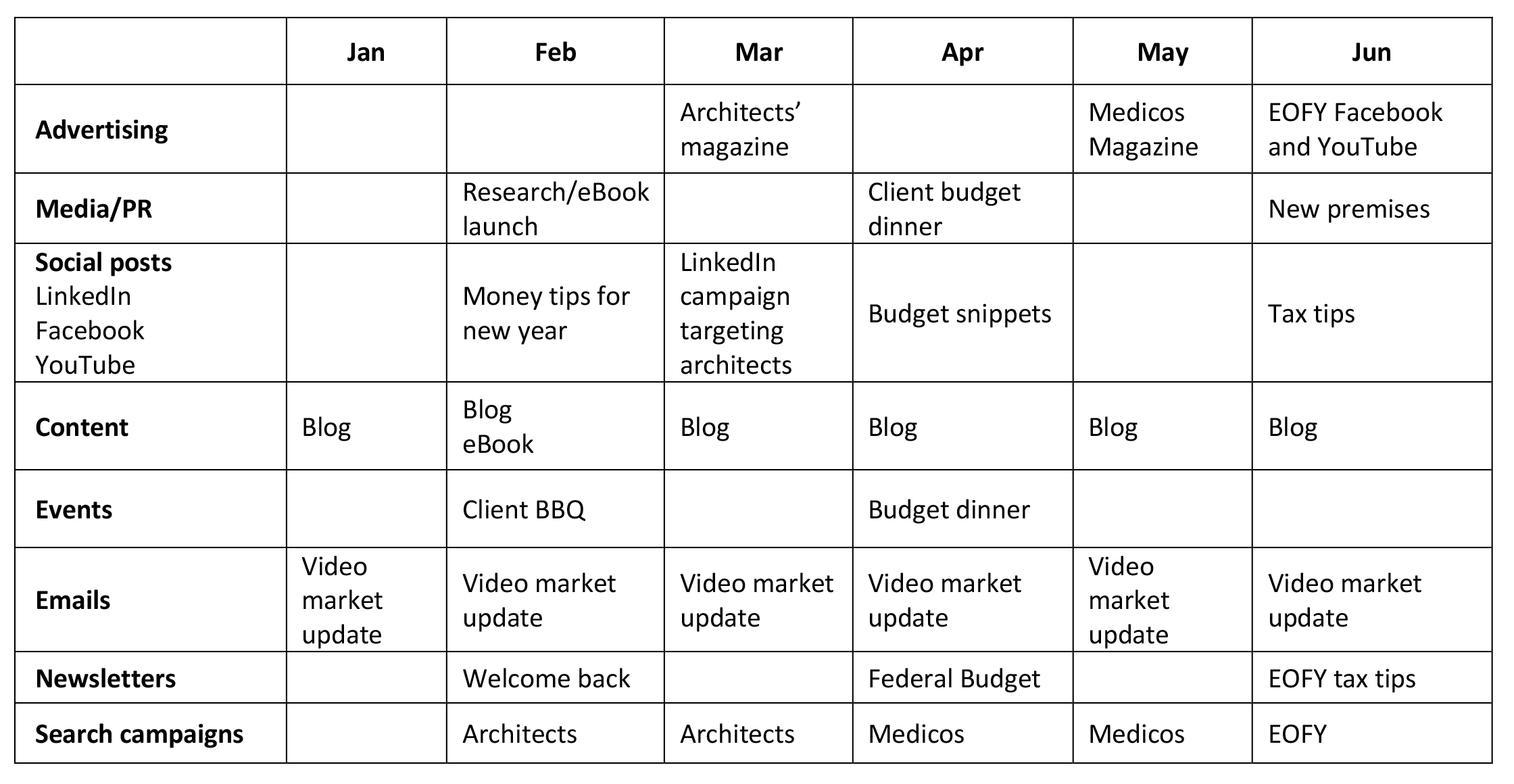
Having decided what activities to include in your plan, the easiest and most practical way to document that plan is in a one page ‘year at a glance’ activity calendar. (Depending how comprehensive your program is, you may wish to allocate separate pages to the acquisition and retention components of your plan.)
There are many ways to organise your calendar; one of the easiest is to use the columns for months, and rows for channels, as per the example below (based on a 6-month view for a practice specialising in doctors and architects).
Summary
Financial advice practices of all sizes should consider a documented marketing plan an essential companion to their operational business plan.
A simple plan on a page approach is recommended, both to overcome the reluctance many advisers have to producing such plans and to ensure the plan is easily understood, easily shared, and easily updated (it needs to be thought of as a living document).
Critical to the success of any marketing plan is its alignment with the overall business objectives contained in the practice’s business plan, and the inclusion of clear actions, metrics, and accountabilities.

———


