Retail Trade; Job ads; Weekly energy market update
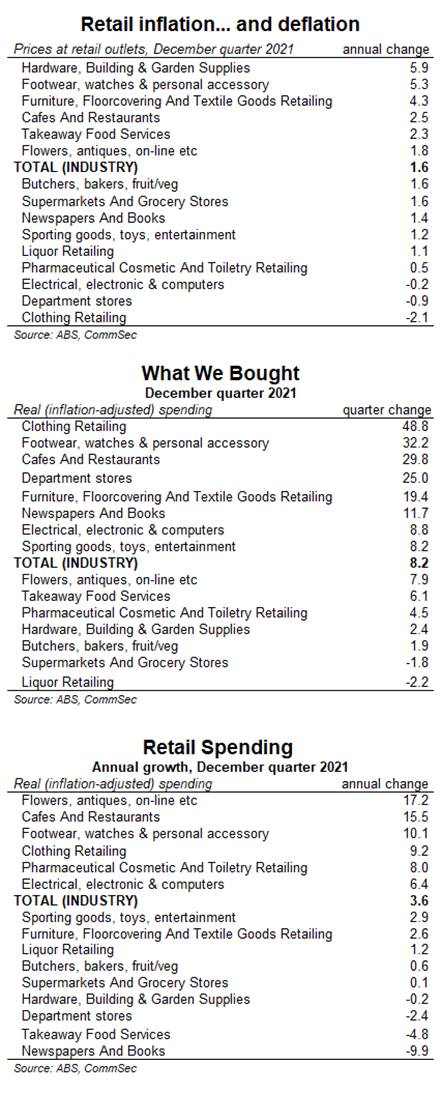
Retail trade fell by 4.4 per cent in December after rising 13.6 per cent in the three previous months. Retail trade rose by a record 8.2 per cent in the December quarter after falling 4.4 per cent in the September quarter.
Retail prices rose by 0.5 per cent in the December quarter to be up 1.6 per cent on the year (15-year average 1.5 per cent).
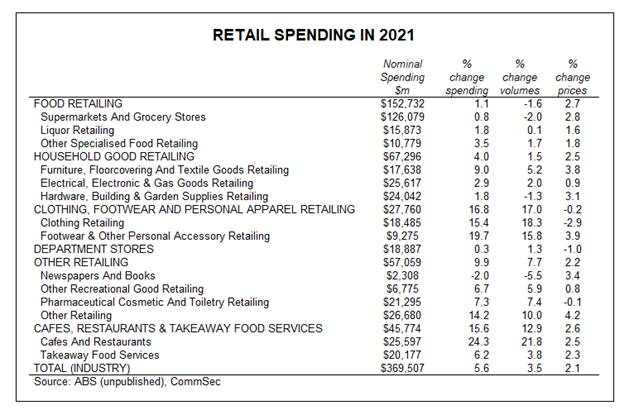
Commissioned data obtained from CommSec from the Australian Bureau of Statistics (ABS) shows that cafes and restaurants, and clothing retailing were the surprise winners over the 2021 calendar year with real spending up 21.8 per cent and 18.3 per cent respectively over the year.
Job advertisements (as tracked by ANZ) fell by 0.3 per cent in January.
According to the Australian Institute of Petroleum (AIP), the national average unleaded petrol price rose by 2.3 cents to a record 171.9 cents a litre (c/l) last week.
What does it all mean?
Global oil prices posted a seventh successive weekly gain, with prices trading near 7-year highs. Brent crude rose 3.6 per cent while Nymex crude rose 6.3 per cent. A raft of factors is working to constrain oil supplies while demand for oil and oil products is lifting as people across the globe get back to work, school and the shops.
The oil price that matters for motorists in Australia is the Singapore gasoline 95 price. That price sits at lofty 13½-year highs courtesy of global crude prices and a weaker Australian dollar. Put those two together and Australian motorists are paying the most for petrol that they have ever paid.
While high oil prices are positive for Australian producers, and the energy sector generally, the higher cost for petrol reduces spending power for consumers and adds to inflationary pressures.
Filling up the car with petrol is the single biggest weekly purchase for consumers. CommSec calculates that the average household spent a near record $240.66 on petrol last week.
Unfortunately there are no signs of relief for motorists. OPEC+ oil producers have agreed to lift production quotas, but a number of producers are finding it hard to meet the quotas. Then you overlay the Ukraine-Russia tensions, cold weather in the US and drone attacks by foreign militants on oil facilities in the United Arab Emirates. Oil supplies will continue to struggle to keep up with demand.
The retail trade data continues to reflect the cycling of lockdowns and easing of restrictions. We won’t get a true picture on consumer spending for a few months. But looking over the entire 2021 year, retail trade rose by a healthy 5.6 per cent with volumes up 3.5 per cent.
Spending rebounded at both cafes & restaurants by 24.3 per cent after falling by 25.4 per cent the previous year. And spending on clothing lifted 15.4 per cent after falling 8.0 per cent in 2020. The only category to record a fall in sales was books & newspapers, down 2 per cent in 2021 after falling 12.2 per cent in 2020.
Over the full year, prices rose by 2.1 per cent – so hardly a price explosion. In fact three sub-industries recorded price declines – clothing (-2.9 per cent); chemist goods (‑0.1 per cent) and department stores (-1.0 per cent). In contrast, prices at “Other retailing” stores (flowers, antiques, on-line etc.) rose by 4.2 per cent in 2021.
What do you need to know?
Retail Trade – December & December quarter
Retail trade fell by 4.4 per cent in December after rising 13.6 per cent in the three previous months. Retail trade was up by 4.8 per cent on a year ago.
In the December quarter, retail trade rose by a record 8.2 per cent after falling 4.4 per cent in the September quarter.
Retail prices rose 0.5 per cent in the December quarter. The annual rate rose slightly from 1.5 per cent to 1.6 per cent.
The ABS noted: “The quarterly rise was driven by the spending in the discretionary industries, all of which saw a sharp fall in the September quarter. Clothing, footwear and personal accessory retailing had the largest rise (+43.1 per cent), followed by cafes, restaurants and takeaway food services (+18.8 per cent), household goods retailing (+9.0 per cent), department stores (+25.0 per cent), and other retailing (+6.8 per cent), in seasonally adjusted volume terms.
Food retailing (-1.6 per cent) was the only industry, discretionary or non-discretionary, to fall, with consumers reducing their grocery spending and returning to hospitality venues and dining out.
The release of constrained consumer demand post-lockdown saw New South Wales (+15.3 per cent), and Victoria (+10.2 per cent) record the largest volume rises of all the states and territories. The Australian Capital Territory recorded a 12.4 per cent rise, having also been significantly impacted by lockdowns in the previous quarter.
There also continues to be underlying strength in states and territories that were largely able to avoid extended Delta lockdowns, with rises in the December quarter for all except Tasmania (-1.2 per cent). Queensland rose 3.0 per cent, followed by Western Australia (+1.6 per cent), South Australia (+1.1 per cent), and the Northern Territory (+0.9 per cent).”
Retail trade – Calendar 2021
In real terms in calendar 2021, spending rose 3.5 per cent with nominal spending up 5.6 per cent. Real spending at cafes & restaurants rose by 21.8 per cent with clothing up 18.3 per cent and footwear up 15.8 per cent. At the other end of the scale, real spending on books & newspapers fell 5.5 per cent with hardware, building & garden supplies retailing down 1.3 per cent and supermarkets and grocery stores (down 2.0 per cent).
Weekly energy market update
Oil rose for a seventh straight week, with the Brent crude price up by US$3.24 or 3.6 per cent while Nymex was up US$5.49 or 6.3 per cent. On Friday, the Brent crude price rose by US$2.16 or 2.4 per cent to US$93.27 a barrel. The US Nymex crude price rose by US$2.04 or 2.3 per cent to US$92.31 a barrel.
Last week, the benchmark Singapore gasoline price rose by US$4.03 or 3.9 per cent to a 3-month high of US$107.35 a barrel (US$107.64 on October 27, 2021). In Aussie dollar terms, the Singapore gasoline price lifted by $3.13 or 2.1 per cent to a 13½-year high of $150.14 a barrel or 94.43 cents a litre.
According to the Australian Institute of Petroleum (AIP), the national average unleaded petrol price rose by 2.3 cents per litre to a record 171.9c/l in the week to February 6.
The smoothed gross retail margin eased from 14.63 c/l to an 11-week low of 12.00 c/l last week.
The national average wholesale (TGP) petrol price rose by 5.4 cents last week to 162.7 cents per litre. Today, the TGP price sits at a record 165.1 c/l, up by 5.2 cents from the previous week. Since the low on December 8, the wholesale petrol price has risen by almost 24 cents a litre.
MotorMouth records the following average retail prices for unleaded fuel today: Sydney 168.5c/l; Melbourne 185.7c/l (record high); Brisbane 169.6c/l; Adelaide 179.4c/l; Perth 165.8c/l; Hobart 184.0c/l (record high); Darwin 179.3c/l (record high) and Canberra 174.5c/l (near record high).
ANZ job advertisements – January
Job advertisements (as tracked by ANZ) fell by 0.3 per cent in January after falling 5.8 per cent in December and rising 16.2 per cent the two prior months. In seasonally adjusted terms, there were 208,522 job ads in January. Ads are up 27.3 per cent on a year ago.
Economic outlook: Structural forces, cyclical implications Longer-term secular forces are driving the six- to 12-month cyclical outlook. Our June 2026 Secular Outlook, “Rupture and Resilience[1],” explored the fraying of traditional [...]
Picture this: an Enduring Power of Attorney (EPOA) has sat in a filing cabinet for years. Then a sudden health event means an adult daughter is called on to act [...]
Key takeaways A large, diverse and fast-growing opportunity set: local currency EMD spans economies at very different points in the cycle, offering income, growth and genuine diversification. Structure, not just [...]
Introduction As the advice profession continues to evolve, so too do client expectations and perceptions of the value of advice. Perhaps nothing sums up this shift as perfectly as this [...]
Move over, Google The expression “a little knowledge is a dangerous thing” seems particularly appropriate to financial decisions, where the amounts at stake and the inherent complexity make the risk [...]

 What do you need to know?