
Top mark for fees but Australia lags on regulation and disclosure: Report

Australian fund investors also suffer from a below average regulation and taxation framework when compared to global peers.
Fees in the managed funds industry continue to fall, yet there is room for improvement, according to Morningstar’s Global Investor Experience Study.
The published first chapter, Fees and Expenses of the biannual GIE report evaluates an investor’s ongoing cost to own managed funds compared to investors across the globe.
The report, now in its seventh edition, assesses the experiences of managed fund investors in 26 markets across North America, Europe, Asia, and Africa
Morningstar’s manager research team uses a grading scale of Top, Above Average, Average, Below Average, and Bottom to assign a grade to each market. Morningstar gave Top grades to Australia, the Netherlands, and the U.S., denoting these as the most investor-friendly markets in terms of fees and expenses.
This is the fourth study in a row that these three countries have received the highest grade in this area.
Conversely, Morningstar again assigned Bottom grades to Italy and Taiwan indicating these fund markets have amongst the highest fees and expenses.
Exhibit 1 of the Global Investor Experience report on Fees and Expenses shows the scorecard for the markets covered in the study. The arrows indicate whether a market experienced a change in grade since the last study in 2019.
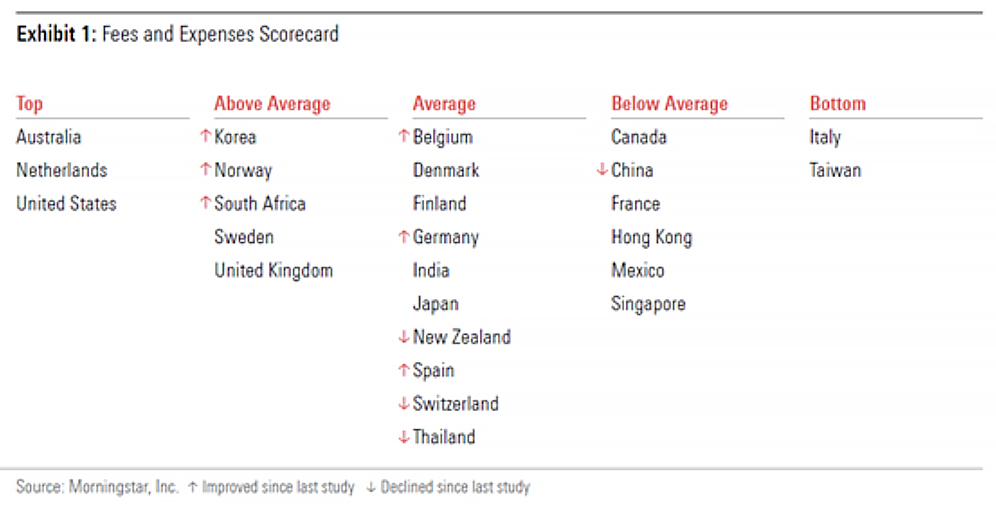
Australia earnt a Top grade for Fees and Expenses, based on investor-friendly practices such as investors paying for advice outside of commissions, banned front loads and low asset-weighted median expenses, according to said Grant Kennaway, head of manager selection at Morningstar and a co-author of the study.
“Australia’s fee-based financial advice and the dominance of the Independent Financial Adviser has spurred demand for lower cost funds like passives as advisers have increasingly opted against costlier fund vehicles,” Grant says.
“Australian investors benefit from the effect of economies of scale and competition that is prevalent in a fund market underpinned by an ecosystem buoyed by compulsory superannuation savings,” he added.
According to Grant, however, outside low fees, the Australian retail investor experience is poor, when compared with global peers.
Regulatory failures
Grant again highlighted Australia’s current disclosure laws as outdated, and do not serve the interests of investors, a view highlighted in a previous Morningstar report on Australia’s portfolio holding disclosure laws[1].
“Until recently, Australia was the only major fund market with no implemented portfolio holdings disclosure regime,” he said.
“Put simply, Australian retail investors had no regulated right to know what securities (stocks and bonds) their investment and superannuation funds held in their portfolios.
“Unfortunately, the government has recently introduced regulation that is a watered-down asset-allocation requirement, not true portfolio holdings disclosure that is prevalent globally.”
Grant highlights that the only asset class where portfolio disclosure really occurs is in the listed equity section.
“Listed equities holds many of the most well-regulated (lowest risk from a disclosure sense) assets on Earth and is the least problematic area for these regulations to focus upon,” he said.
“There is no way Australian investors can use the now required data for portfolio comparison, nor is there a way you could use this data to understand the true risks of a portfolio. Important, basic information, like does my managed fund have exposure to Russian bonds, is not required under the government’s current regulations”.
“Australia’s portfolios holdings disclosure regulations are retrograde and do not serve Australian investors’ best interest.”
He added that Australian fund investors also suffer from a below average regulation and taxation framework when compared to global peers.
“While the Australian regulators have a long legacy of running well-functioning and efficient markets, that is not enough to get even an Average mark in an environment where many markets have made great strides in delivering regulation that encourages investors and adds more protections for them.”
———-


