

Piers Bolger
As we begin the new year, it’s customary to reflect on the previous year – what went well, what did not work out as expected, what could be better and what will the year ahead bring? These same reflections often also ring true for financial market participants.
After a difficult 2022, many investors felt that 2023 would bring increased stability across markets with the potential to put many of the challenges of the year behind them; 2023 was going to provide the springboard for improving investment opportunities. However, as we begin the new year, 2023 was indeed another year of living dangerously.
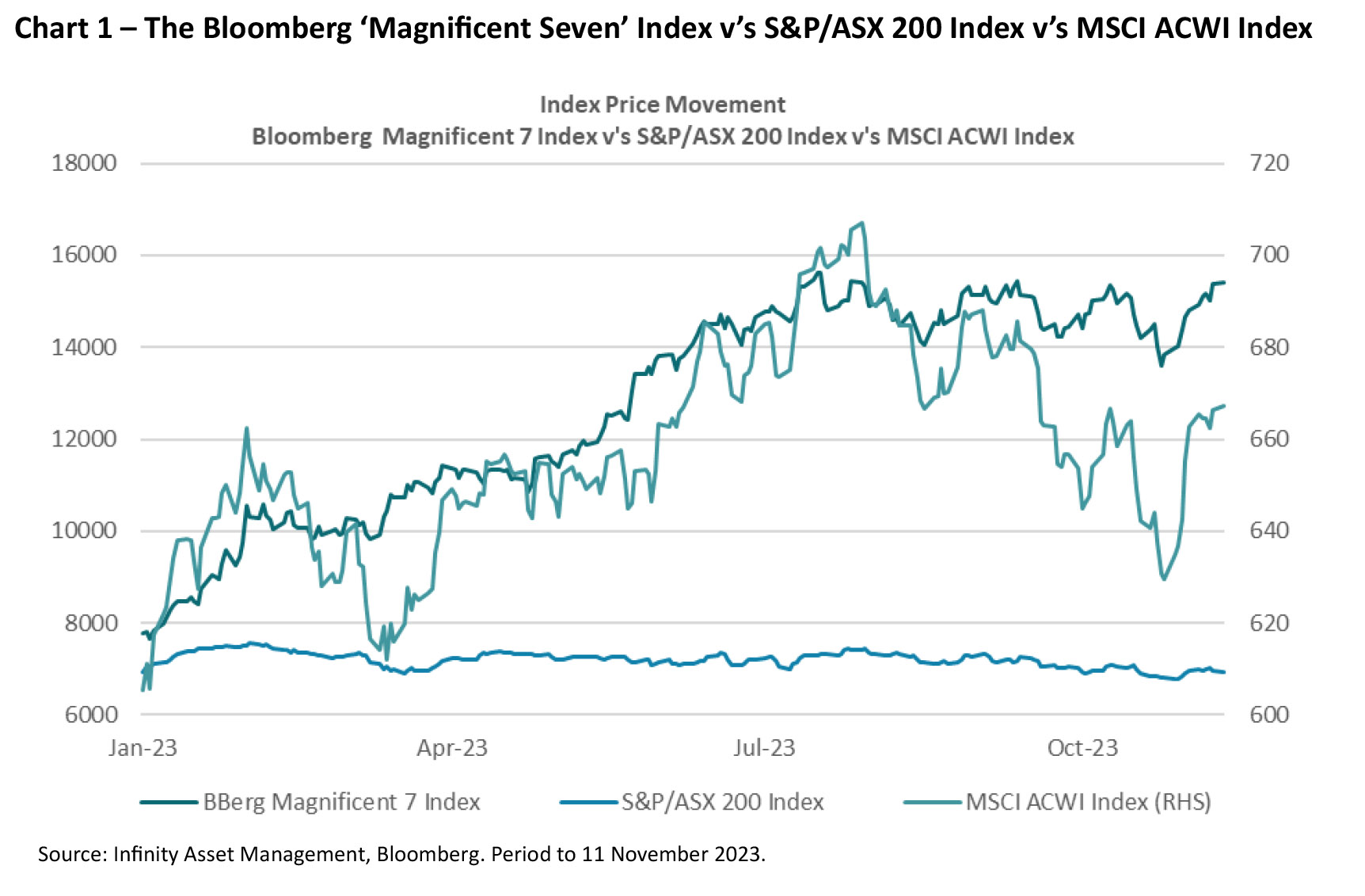
And while market performance, particularly global markets (led by the ‘Magnificent Seven’ of Microsoft, Meta, Amazon, Nvidia, Apple, Alphabet and Tesla) have shown to be resilient in the face of higher cash rates, rising bond yields, political turmoil, sticky inflation, geopolitical and trade risks and as we write, an increasing military conflict, not all asset classes have fared as well.
The Australian equity market (S&P/ASX 200 Index) is slightly lower (-0.2%) over 2023, while domestic small caps (S&P/ASX Small Ordinaries Index) and publicly traded REITs (S&P/ASX 200 AREIT Index) are down -6.1% and -5.0% respectively year to date. Even bond markets have failed to deliver a positive return with both Australian and global bond indices (in A$ terms) down around -0.7 to -1.0% over the year, while the A$ has declined by -7.0% (v’s US$).
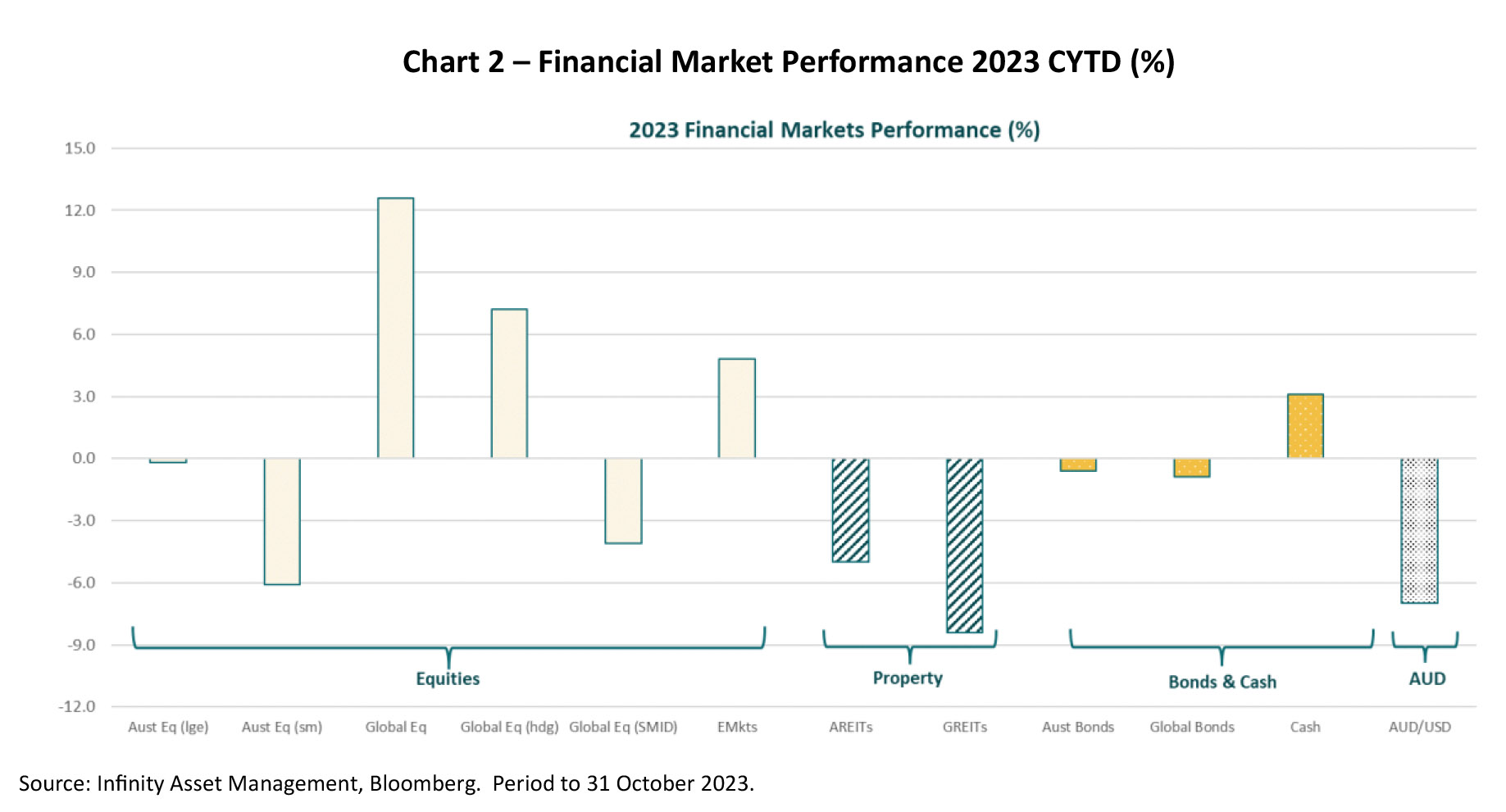
While these performance returns are ‘better’ than what occurred through 2022 (for example, the Australian bond market was down -9.7% over the year), it has resulted in some investors questioning the value of diversification across portfolios. Are ‘traditional’ defensive investments still worth consideration? Can growth assets rebound with a global economic backdrop that in part looks fragile and uncertain? So, as we begin the new year, the question we now ask ourselves, is 2024 going to be nice to investors or will we be faced with another period of market and economic consternation.
While geopolitical risks along with ongoing military conflict will continue to impact financial markets, our key focus and the one that we believe will have the most significant impact will be the outlook for cash rates and by association inflationary expectations and the direction of bond yields. The moves by central banks over the last 18 months to curb inflationary pressures have resulted in the most substantial uplift in cash rate history across many markets.
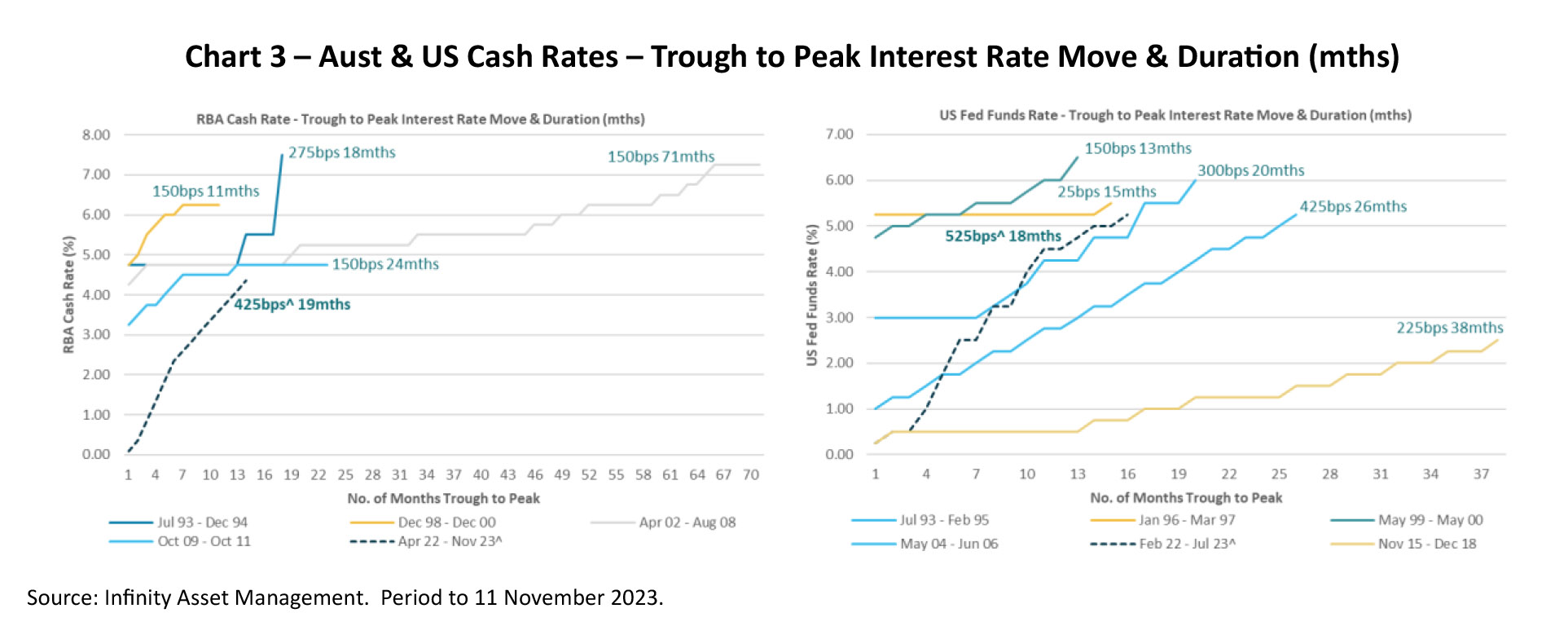
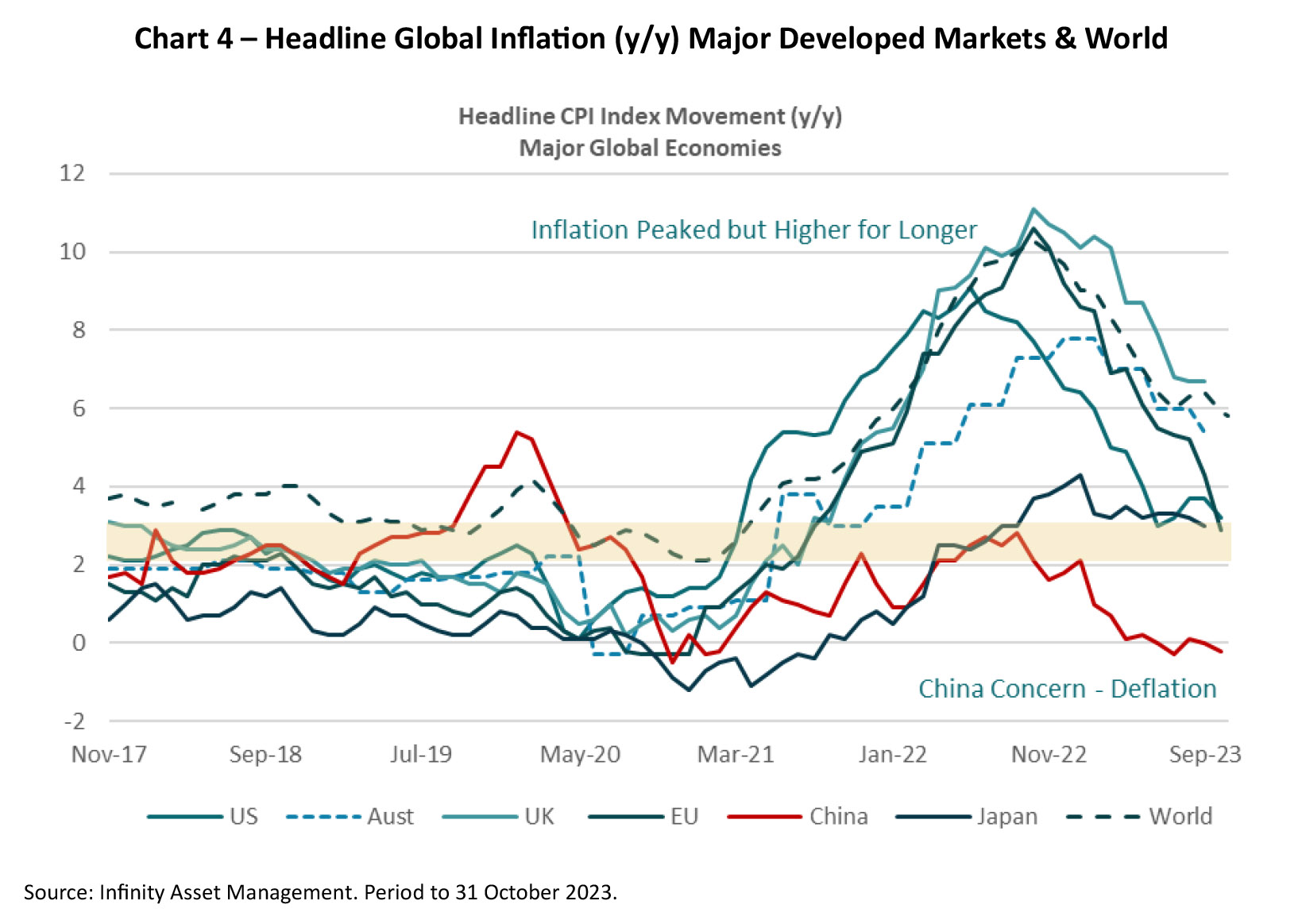
However, while inflationary pressures across many developed economies remain above central banks’ target bands, inflation has moderated. And while it does not mean that cash rates have peaked, it is clear central banks are now closer to finishing with rate tightening than they were at the beginning of 2023. This is fundamentally positive for multiple asset classes – equites, bonds, property, real assets – in our view, and we believe this will translate into higher, more synchronised investment performance across financial markets through 2024. In Australia, while inflation remains above that of many other developed economies as well as the RBA’s target band, the potential for further rate hikes remains.
However, with the current level of household indebtedness and the lack of flexibility in the economy we do not see Australian cash rates peaking much above 4.50%. This is in-line with the average cash rate (of 4.3%) since 1989.
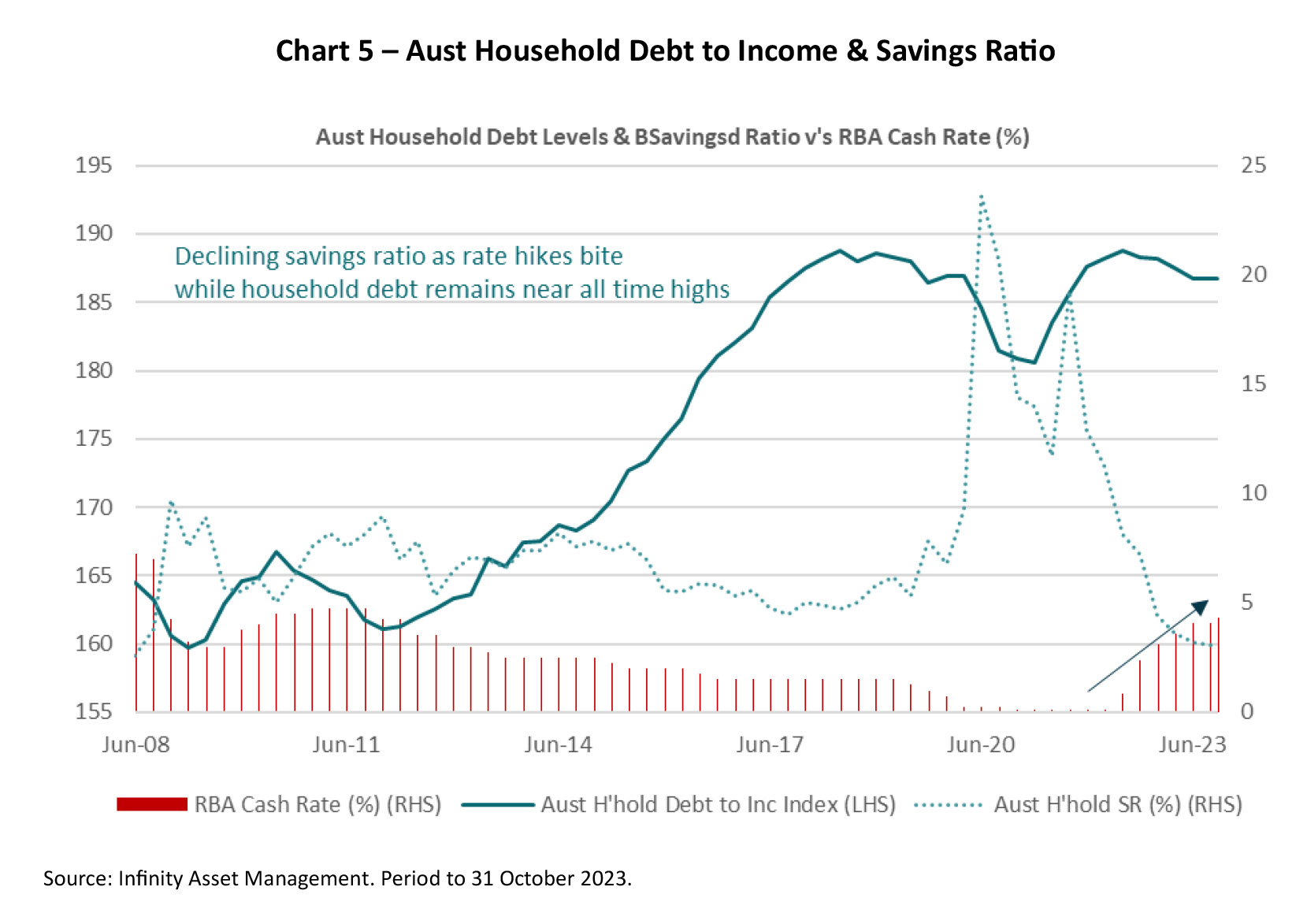
Yet, with the likelihood that inflation will remain higher for longer, we do not see cash rates moving lower at all through the 1H24 and potentially not across some economies for the full year. And while a big jump in the unemployment rate and any major economic slowdown through 2024 may lead to a speedy reversal of the central banks’ policies, this is not our base case. So, while we believe that 2024 could provide investors with several ‘treats’, we are not so naïve to think it will not be a tricky environment. Risks continue to abound on multiple levels and with a US election thrown into the mix in November, it will bring its own set of challenges for investors to navigate.
Nevertheless, while the broader global growth outlook is set to moderate further through 2024, history shows that it is not always an impediment for markets to move higher. In addition, given that cash rates have moved higher it does afford increased policy flexibility for central banks should they look to reduce rates at some stage through 2024 and beyond given that cash rates are no longer negative or at multi year lows.
And should inflationary pressures continue to moderate, financial markets will begin to look through the cycle with the expectation that bond yields will retrace from current multi-year highs. In this environment, we see that broad-based investment portfolios can once again deliver sound investment performance with less risk than through previous investment cycles. Financial markets have dealt with much adversity over the last few years, and we look forward to a more constructive outlook for 2024.
By Piers Bolger, Chief Investment Officer


