
What’s next for markets? While there have been a few surprises, core Europe and the US are now in recovery mode
US economic growth has surprised so far in 2023 via fiscal stimulus, inventories and net exports; despite underlying domestic demand growth being relatively subdued.
Non-China EM was the driving force of the initial recovery. Albeit China’s own recovery has well and truly arrived. While Chinese economic sentiment and financial market sentiment remain poor their factories are bustling along.
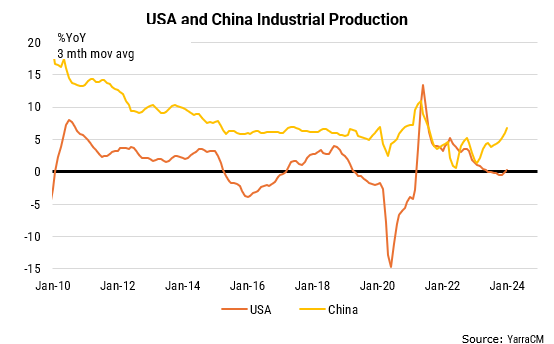
It might surprise some to learn that Chinese industrial production is expanding at 6.7%yoy – the best out come since Covid and above the 5 year average prior to Covid.
In contrast US industrial production remains near zero.
The good news is that China’s modest bout of deflation and strong production growth will continue to assist in driving down inflation in the West and as the industrial cycle in the US and Europe builds momentum the encouraging broadening of equity market returns beyond just Mega Cap Tech can continue.
But the question of whether markets have suddenly become too hot to too quickly is now a key focus.
Asset divergence
With gold prices surging, the Australia equity market significantly out performing EM equity markets, and the AUD underperforming safe haven currencies are not consistent with broad based excess risk taking. Credit spreads are tight and cyclicals have certainly run much harder than defensives inside of equity markets but that is what you expect to see in a world of better than expected growth and the prospect of monetary stimulus arriving from mid-2024.
Indeed, the easing in financial conditions that has occurred via strong equity markets and narrower credit spreads should be held in the context that the surprising fiscal stimulus delivered globally in 2023 is in the process of retreating to a more neutral stance. That is the growth baton is being passed from fiscal to monetary policy rather than the idea that some modest monetary easing will equate to significantly stronger economic growth that threatens future inflation.
Australia, and its peer group, are no longer operating above their productive capacity. Ultimately this is the single best indicator that inflation will normalise.
For most people it seems that ongoing labour market strength in the US and Australia is challenging the notion that any easing is required at all, however, we would make several points here:
- Most of the job growth in the US and Australia is coming via Government, Government sponsored infrastructure and Government funded healthcare. In Australia the NDIS is a force unto itself.
- US labour market indicators are not universally suggesting inflation risk.
i. The NFIB labour hiring intension data suggests payroll strength will soon weaken materially – and this indicator has been quite a reliable future guide in recent years to employment gains.
ii. The JOLTs data suggests wages growth will continue to ebb in coming months – with the quits rate having been an excellent future guide to wages growth.
iii. Measure of services inflation such as the prices paid component of the PMI continues to fall sharply – suggesting that wage pressures are not spilling into excess price pressures in the all important services sector in the US.
Real income growth remains key
The appropriate response to monetary policy to a robust labour market is not just to look backwards, but to look at what the more reliable forward indicators of labour demand are telling us about labour costs and to make an assessment of the impact of current government policies on demand. The best way to achieve this is to look at underlying income real growth. In many ways this is the most important chart for 2024 for four reasons.
Firstly, it shows why everyone was so upset in 2023 – real income growth declined massively in 2023 easily eclipsing the declines we saw in the 91-92 recession.
Secondly, it shows that the end of 2023 posted some particularly robust wage growth and much better inflation outcomes that drove real income growth positive in the final quarter of the year. This was welcome and surprising.
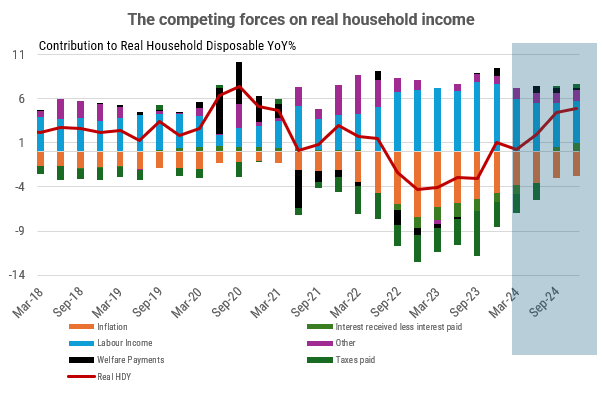
Thirdly it highlights that despite the laser like focus on RBA interest rate adjustments the prospect of a couple of rate cuts is not such an important driver of a recovery in real income growth. It helps, and it certainly helps younger and more indebted households to a greater extent, but in a world where asset-based income is broadly equivalent to mortgage interest payments the net impact of interest rate rises is diluted in the aggregate.
Fourthly, the much debated income tax cuts will indeed help, removing the drag that tax paid imparts on real income growth temporarily in 2H24, until bracket creep again commences its recapture in 2025.
Persistent labour income (in part due to the persistence embedded in the EBA system and ongoing labour shortages in service based sectors of the economy) in concert with moderating inflation is what is doing the vast majority of the work in driving a recovery in real household income growth. This is what ends up delivering happier households and sustainable economic recoveries. It just happens to be the exact same dynamic being played out across most major economies in the coming year and that is a key reason to remain on the optimistic side of financial market positioning.
What’s ahead for investors
We started the year with a 10% target gain in large cap equities and a 15% target gain in small cap equities for 2024.
Markets are certainly moving in that direction and while we are alert to signs of excessive risk taking and signs of an imminent pullback, we expect the June quarter to remain another positive gain for the Australian equity market.
The bigger risk is that bond yield yields need to also recalibrate for a stronger growth environment and shallower interest rate easing cycles, however, that may be more a risk for later in 2024.


