
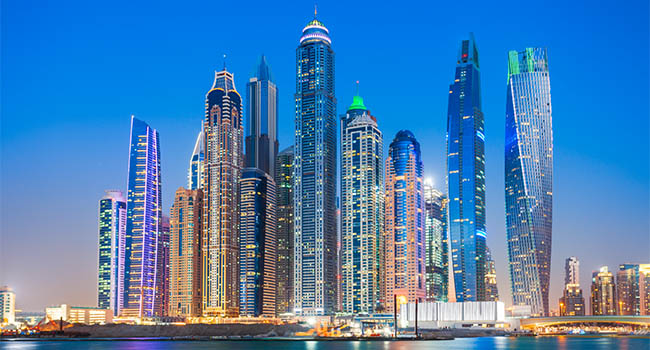
The United Arab Emirates and Saudi Arabia are poised to become influential economic centres
Key takeaways
- Emerging markets in the Gulf region and Turkey are attracting investors seeking new opportunities beyond the traditional Western economies
- The United Arab Emirates and Saudi Arabia are poised to become influential economic centres while Turkey also presents potential due to its strategic location and growing sectors
- While these markets are young and still carry risks, particularly from oil price dependency, their growth offers investors the chance for early-mover advantages in broadening their investment portfolios
New York, London, and Hong Kong have been the global financial, trade, and cultural hubs of the last century. That paradigm is widening to now include Abu Dhabi, and Riyadh, as well as Ankara as spheres of influence evolve.
We believe capital markets investors are increasingly looking at once unlikely new territories for the next generation of global investing opportunities since catalysts for growth in most western economies appear to be more limited.
The Gulf countries, once solely reliant on their oil exports for income, are now participating in sectors that were typically dominated by the Global North.
The United Arab Emirates is leading economic diversification by expanding into tourism, trade, real estate, banking, and finance. This process has been hyper-accelerated by a dual-track strategy based on strong property rights, safety and security of assets, and robust human capital due to its multiculturalism.
The new spheres of influence
Turkey and the GCC countries
Saudi Arabia, which has been perceived by the West as one of the most socially conservative countries in the world, is undergoing a social change the pace of which is remarkable. With a young population of 37 million operating in a digitally connected world, the Arab kingdom is increasingly opening its society, fostering entrepreneurship, and diversifying its economy.
These Arab countries, as well as Turkey, possess massive growth potential and have increasingly important roles to play in the geopolitical sphere, in our opinion. Indeed, we believe they have been setting the stage to become the world’s new influential centers of economic and geopolitical gravity. Investors with the foresight and openness towards participating in these countries’ growth potentially have an early-mover advantage.
To be sure, the Gulf region has broadly dollar-pegged economies where fluctuations in oil prices can make or break national coffers. Growth is nascent and markets are young.
In our view, these emerging economies aren’t likely to replace traditional financial hubs but rather broaden the scope of investment opportunities.
Multilateralism prevails
Given current geopolitical challenges—the US and Europe have frozen some national assets, most notably Russia’s—the race is on to explore new areas of relative safety, stability, and potential growth stories outside of traditionally western avenues. In this context, the UAE has been an obvious beneficiary of the global shift towards multilateralism, especially due to its solid financial sector, evidenced by banking assets.[1]
It’s not surprising that by the end of 2023 a total of 102 asset management firms were operating in Abu Dhabi’s financial centre and another 125 firms including hedge funds and asset managers are expected to open their doors this year.[2]
Saudi Arabia and the UAE are leveraging their location and wealth of resources not only to raise capital, but also to bolster their roles as important partners to global investors and governments alike.
India’s relationship with the Gulf states has evolved from one focused on trade and migration into a more ambitious, strategic, and deeper political, economic, and defense partnership. In fact, UAE and Saudi Arabia are India’s third and fourth largest trading partners behind the US and China.
Turkey is also playing a role as a NATO member, an intermediary in regional conflicts, and gate keeper of the critical Black Sea.
Most recently, amid the unintended economic consequences of Russia’s invasion of Ukraine, Saudi Arabia and UAE have stepped in to ease shortages of energy in Europe and food in Africa. Meanwhile, Turkey plays a balancing act of maintaining relations with both Russia and the West.
On the one hand, Ankara supplies military support to Ukraine and secures Kiev seaborne exports while adeptly blocking Russia from beefing up its Black Sea fleet from outside, or from moving warships in the Black Sea back into the Mediterranean.
On the other hand, Turkey never went along with the West in imposing sanctions on Russia. On the contrary, it’s now the third largest buyer of Russian crude, behind China and India, and has thrown Russia an economic lifeline by being a hub for their oil and gas exports to Europe and beyond.
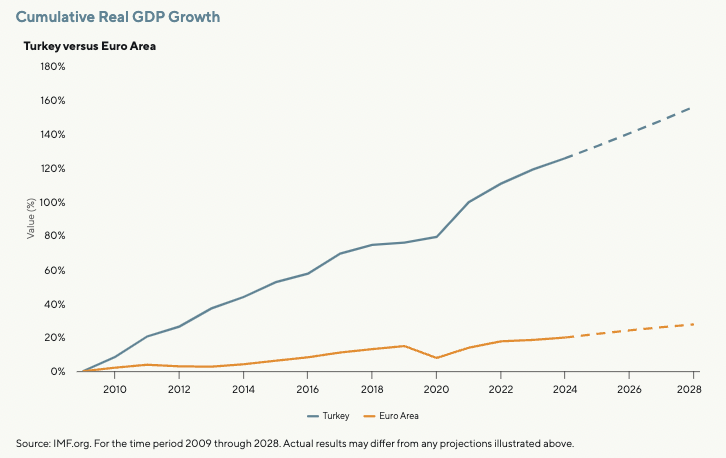
What’s more, a USD $1 trillion economy, Turkey has been growing at a faster pace than the Euro Zone. It’s GDP (on an inflation adjusted basis) will have risen by over 150% through the end of 2028 based off IMF estimates versus where GDP levels stood at the end of the 2000s decade. That compares to the Euro Area which will have grown by a fifth of that amount, or roughly 30%, over the same time period.
In this environment, as the world’s geopolitical and economic order expands from West to East, we believe it’s more important than ever to own equities where the interests of strong corporates and stable public policymakers are aligned.
Investments rise
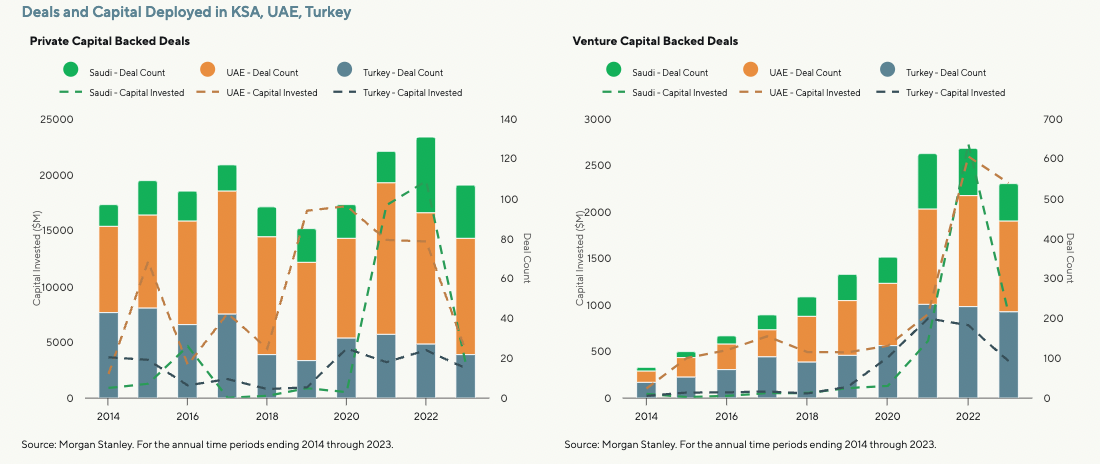
Both the UAE and Saudi have seen a rise in foreign flows into the financial services sector on the back of heavy investments in technology, tourism, renewable energy, real estate, and infrastructure. The region has also increased investments in private equity and venture capital to help existing local businesses expand in a move towards diversification.
Qatar, one of the world’s three largest liquified natural gas exporters along with the US and Australia, has also been playing a strategic role by offering a lifeline to European and Asian countries that were cut-off from Russia’s gas.
Saudi Arabia’s influence has evolved and strengthened. Once an oil-dependent closed economy, the kingdom embarked on a decades-long reform program starting during the reign of the late King Abdullah. The pace of reform accelerated significantly with the ascent of King Salman to the throne in 2015, the year the country ran a record budget deficit due to a global oil supply glut. Soon after, the nation launched a vigorous and highly ambitious social and economic reform program with a vision not only to wean its dependency from oil exports, but also to transform the Kingdom and to propel it into the future with a renewed sense of self-confidence.
The UAE, with only 1.1 million Emiratis, has benefited from hosting the other 9 million or 88 per cent of its population, the majority from South Asia and having participated in much of the country’s growth. Most recently around half a million Russians have landed in Dubai and Abu Dhabi—especially after that country’s conscription—filling shops, hotels, restaurants and becoming foreign buyers of real estate.
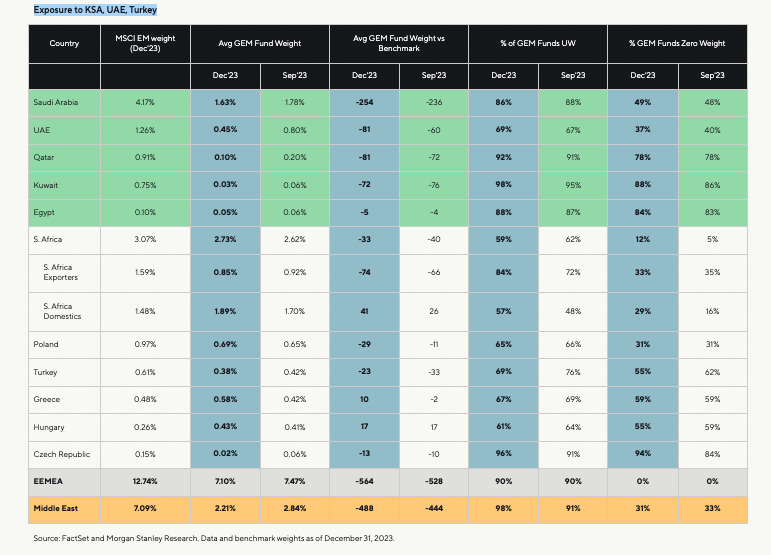
And yet, so far 40 per cent of global emerging market funds don’t have exposure to UAE equities, and half don’t have exposure to Saudi Arabia or to Turkey. These countries have what we consider to be quality businesses at reasonable valuations.
Global emerging market funds positioning
Conclusion
As spheres of influence evolve and the face of global investment shifts at a more rapid pace, we need to keep our eyes wide open to the positive potential and new dynamics in an increasingly relevant part of the investment world.
As investors seeking growth opportunities outside of developed markets, we believe non-traditional emerging economies, such as the UAE, Saudi Arabia, and Turkey, are fertile areas of exploration.
———-


