
FY24 in review – Australian Equities and the struggle for Active Managers

Liam O’Reilly
Over the last 12 months, the S&P ASX 200 delivered +12.1% returns (as at 30/06/2024), lagging global markets by over 8%.
While that divergence in returns is disappointing at an index level, those investors who looked to utilise active management generally experienced even worse outcomes. The Australian equity manager peer group (based on FE’s AMI Equity – Australia index) underperformed the ASX 200 by 3.04%, the 2nd worst relative return result of the last 10 years. This article will look to identify some of the common themes that have led to such an outcome and what that means for investors going forward.
For comparison’s sake, it is often valuable to examine Australia within the international context. Over the last 12 months, much has been made about the concentration of global equities’ stellar performance, with the ‘Magnificent 7’ (which consists of NVIDIA, Microsoft, Amazon, Meta, Alphabet, Apple and Tesla) leading the charge. This phenomenon has been discussed ad nauseam, but for good reason, with nearly 50% of the S&P 500’s +24.09% return being generated by the Magnificent 7. This is remarkable when you factor in that Tesla was the index’s worst contributor, subtracting -0.56% from overall returns.
While mega-cap technology with exposure to the AI thematic was the lead story among investors, it can also not be discounted how enamoured market participants were with the development in GLP-1 drugs, which are being touted as the solution for the global obesity epidemic.
Both thematics could warrant their own article on whether the performance leadership and valuations are justified. However, a clear argument can be made that the potential for structural change as a result of these companies’ underlying products and services can justify, at least in part, what we’ve seen from global markets over the last 12 months.
Looking to Australia, the concentration of performance has been far worse, yet the same underlying themes are (almost) nowhere to be seen. While global investors have been piling into potentially society-changing technology and medicine, domestic investors have been predominantly loading up on cyclical giants. Of the ASX 200’s total return over the year, 70% of it can be attributed to the Index’s 8 largest companies by average market capitalisation over the 2024 financial year (iBHP, Commonwealth Bank, CSL, NAB, ANZ, Westpac, Wesfarmers and Macquarie).
Doing a similar exercise as with global equities by substituting BHP (which detracted from index performance) for the data centre exposed Goodman Group, the narrowness becomes even more pronounced. From this comes several important questions: what’s driving this, can it be sustained and what does it mean for active management looking forward?
Of the Australian companies previously mentioned, perhaps the strongest example of the disconnect between active and passive management has been the exposure to the Big 4 Banks. In the last 18 months, we have seen the most aggressive interest rate hiking cycle in decades, rampant inflation and anaemic economic growth. You could be forgiven for thinking that this would not be a conducive environment for the banks, which are so heavily leveraged to the health of the Australian economy. Instead, we have seen relatively flat earnings, historically low levels of bad debts and investors looking to add risk back to their portfolios after a challenging 2022. Consequently, the average returns for the Big 4 Banks has been in excess of 20% over FY24.
Bank exposure has been a sore spot for many active strategies, with the vast majority of fund managers Evergreen has met with holding an underweight position. While many funds took positions when rates initially began rising to capture the benefits of expanding net-interest margins, these positions were exited or reduced long before the full extent of the returns were captured.
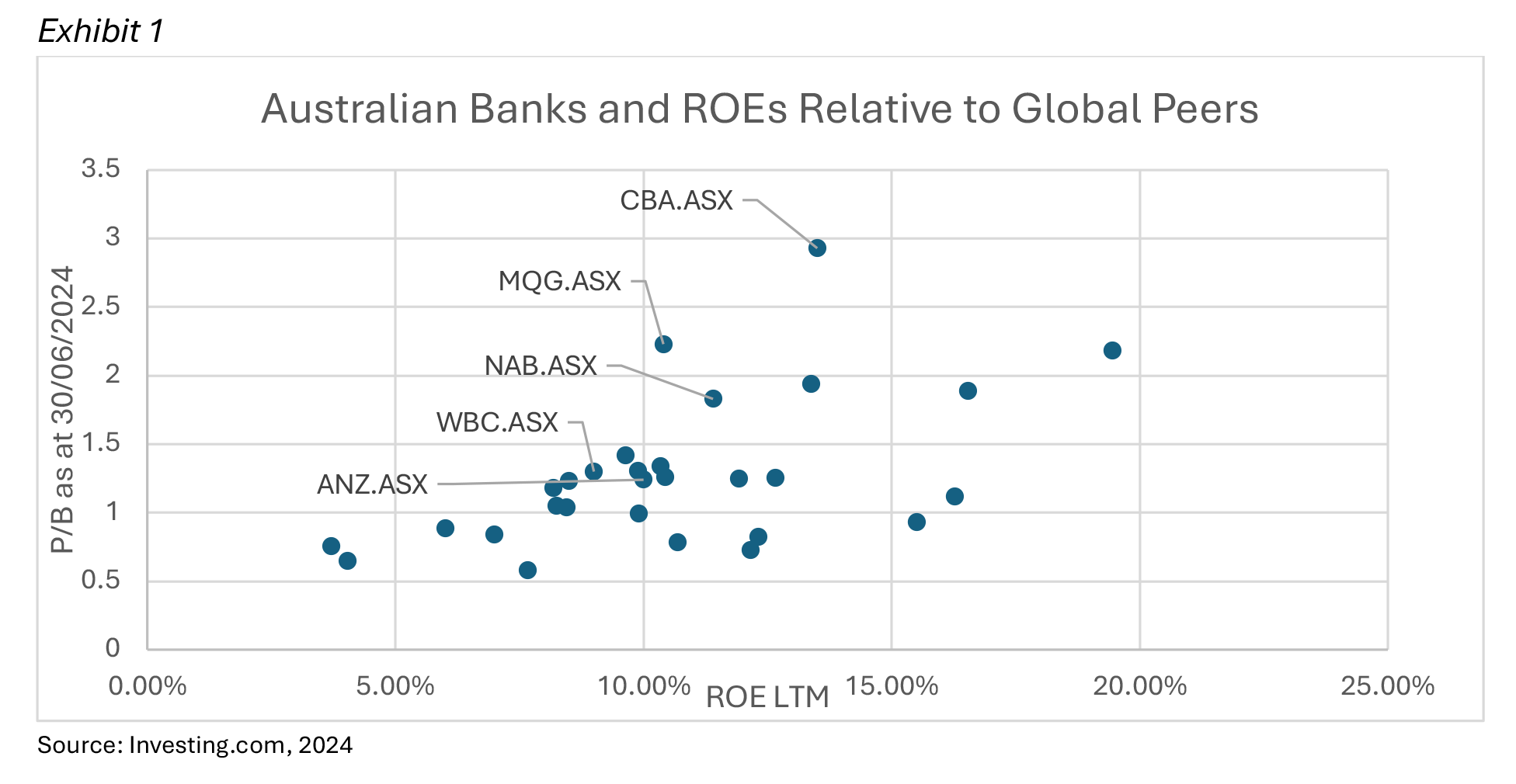
Talking to a number of managers with varying approaches, the general logic has been the same: these institutions are trading on excessively stretched valuations, both relative to their own historical averages as well as global peers (see Exhibit 1). Pair this with a fairly cautious outlook for the underlying fundamentals like net interest margins and loan provisioning, which has underpinned a number of sell-side institutions downgrading their ratings[1],[2] in recent times, and you’re left pondering how these stocks have continued to outperform the market.
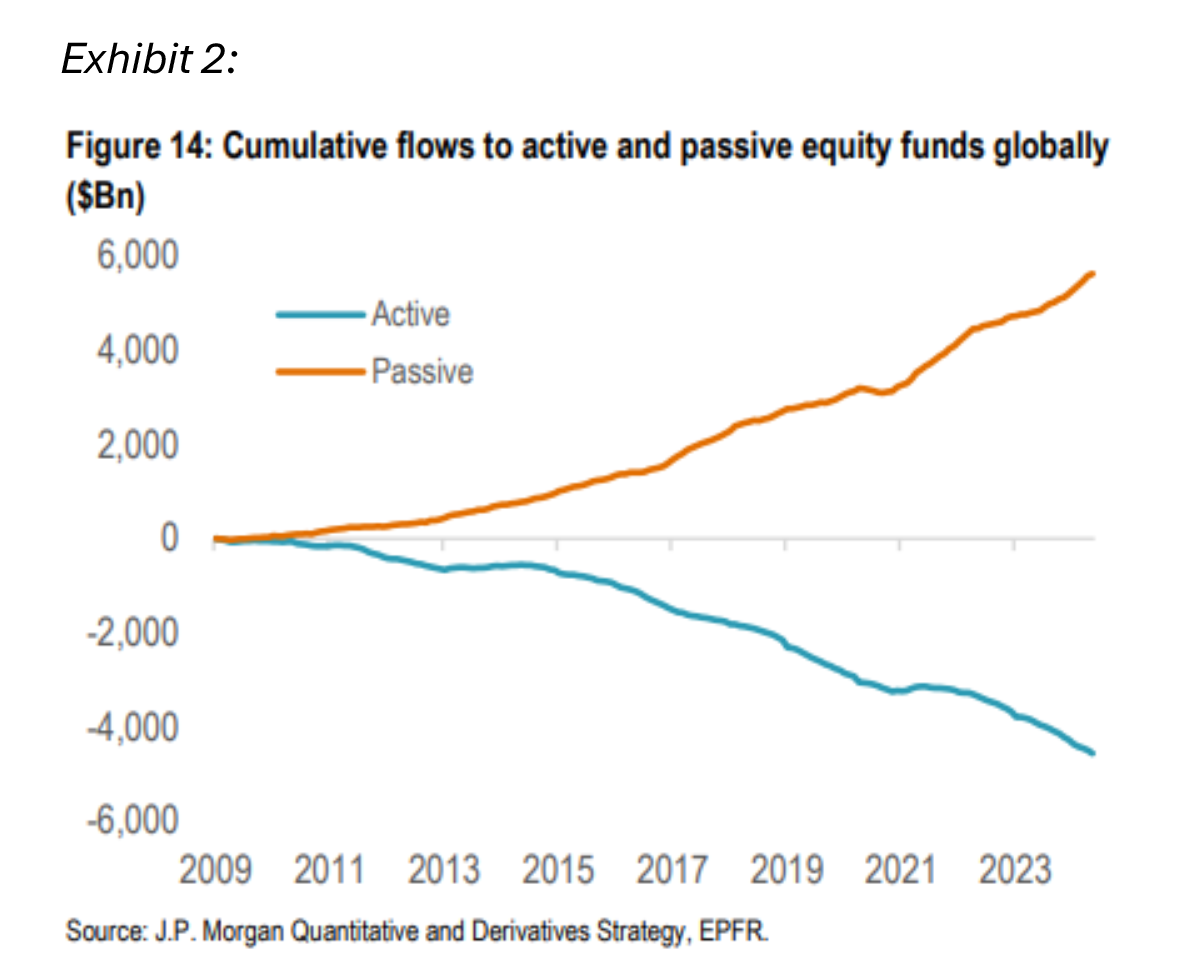
One potential source of stock price appreciation has been the sheer scale of inflows into passive index products. As shown in Exhibit 2, this shift from active to passive has been a trend for the last decade which has continued to gather pace. In Australia, the dynamic is the same. In the year following the onset of the Covid-19 pandemic (31/03/2020), passive investments saw inflows in excess of $24billion in Australia. Over the same time period, active funds saw outflows close to $7billion[3]. While more up-to-date data is not readily available, it is fair to assume that based on global data the trend has continued.
Such aggressive flows into passive products creates somewhat of a self-perpetuating loop. An argument has been made that as the market’s largest companies continued to rally, many active managers that held the names on a fundamental and valuation basis began to sell into market strength. As the number of sellers reduced (due to fewer active managers holding these names) the liquidity in these stocks has somewhat declined, at least in terms of there being willing sellers. As passive investment inflows continued to build, the impact of these funds having to buy these names results in further upwards price pressure. Additionally, institutional ownership (which is a mix of passive and active investors) on the share registry of the Big 4 Banks has seen a roughly 2%-4% increase from relatively stable long-term averages[4]. This demonstrates the high degree to which large institutions have been purchasing these names, with the large superannuation funds constrained to where they can gain exposure to the market given their increasing scale and liquidity needs.
It has also been reported that a number of Asia-based managers have been seeking exposure to the Australian banks as a way of diversifying away from China[5]. While it is difficult to quantify the exact impact this offshore interest has had on the Index, it certainly raises doubts as to how sustainable this level of concentrated performance is going forward given that any sign of economic recovery in China could see recent flows into our financial sector reverse.
There have also been a number of other themes that have challenged active managers over the year. The first of these is the idea that the market will pay any price for quality. A good way to examine this is by looking at the multiple expansion seen in some of the market’s top performers for the year, particularly in the consumer discretionary space. Quality attributes common amongst these companies are low leverage relative to peers and a strong market share in their respective industry segment. While the below companies all have quite broad and different customer bases, it is interesting to consider how these stocks have re-rated, despite a challenging economic and earnings outlook.
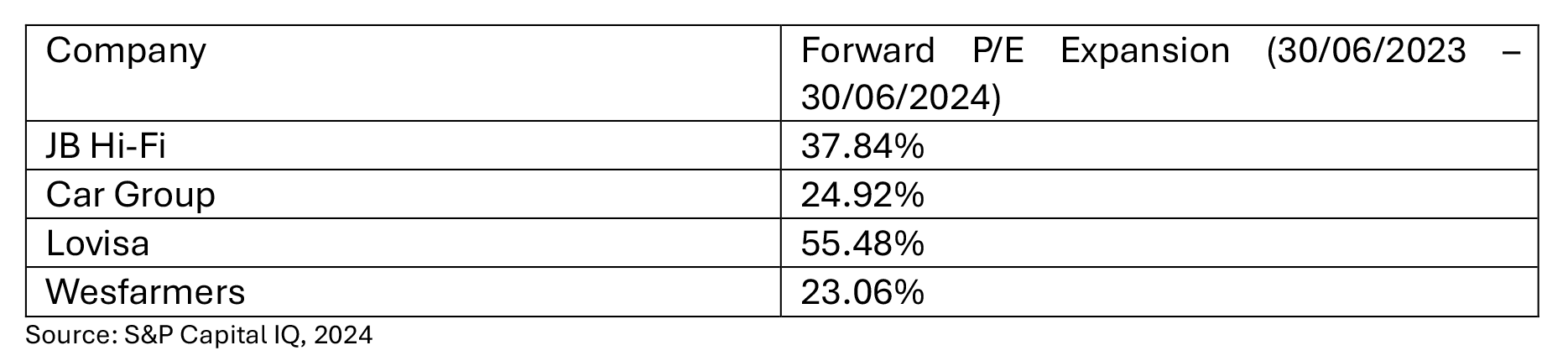
This multiple expansion supports the idea that markets may be getting ahead of themselves. It appears investors have sought out those names with the perceived highest quality that look best positioned to benefit from a cutting of interest rates and an improving economy. When you compare this expansion to several more defensive quality cyclicals names, it reinforces the idea that momentum has well and truly taken over market dynamics. This is due to the fact that these more defensive companies’ underlying demand should, in theory, be less sensitive to the constant delay in rate cuts which the market has been so desperate for. While these loftier valuations may be justifiable on the idea that the economic recovery will occur as the market expects, it should also then support the idea of performance broadening out. Such an environment should provide active managers with greater opportunities for alpha generation.
Following on from that is the notion that we have also seen a ‘junk rally’ in select parts of the market. The market psychology observed is perhaps one where investors would rather own a lower-quality company with short-term positive catalysts rather than higher quality companies with temporary blemishes. This was particularly evident in the November/December rally of 2023, where these lower-quality companies (defined by higher leverage, greater earnings variability and a lack of pricing power, evident by their typically lower margins) rallying hard off the back of renewed expectations that the RBA would begin an aggressive rate cutting cycle. This phenomenon is not a new one with markets historically showing characteristics of over-extrapolating both good and bad news in the short-term. So, while there’s no question that the market has genuine concerns over some of the most notable index laggards, it can be argued that the degree to which the market is willing to look past headwinds for some but not others is somewhat inconsistent.
In summary, there’s no doubt it has been a difficult period for active management. Momentum led markets, a shift to passive investment and a turbulent economic outlook have led to valuations in parts of the market looking increasingly stretched. Meanwhile several more unloved parts of the market continue to trade at depressed valuations, particularly among some of the ASX’s more defensive names. Such divergence in markets means any form of mean-reversion would likely provide an environment where active management could once again prove its worth, by delivering outsized returns and/or deliver capital protection in the event of an unexpected market shock.
In recent weeks, we have already potentially seen this theme begin to playout in the US with markets beginning to rotate out of many of the winners of the past 12 months. This gives credence to the idea that we may see the same thing in August domestically, as the Australian reporting season gets under way. In times like this we must remind ourselves to stay disciplined in our investment approach and ensure we don’t succumb to short-term biases like the fear of missing out.
By Liam O’Reilly
———


