Investing risks are in plain sight as global markets bet on falling bond yields
 Global investors are exhibiting a high level of complacency by betting on falling US bond yields and are overlooking fundamental risks to inflation and ignoring the potential for other financial shocks, Hugh Selby-Smith, co-chief investment officer at Talaria Capital says.
“It’s not what happens that matters but what’s priced in,” Mr Selby-Smith says.
“The overwhelming bet on falling US long bond yields, despite considerable economic uncertainty and still-high S&P 500 valuations, is historically aligned with low or negative long-term returns from equities. This contrasts with consensus forecasts that assume double-digit earnings growth, indicating a market perhaps too sanguine about the future.”
According to Mr Selby-Smith, since 2020, the proportion of global equities positively correlated to falling US long bond yields has ballooned from just over 10 per cent to around 70 per cent today. The growing weight of the US equity market, and within that, the increasing dominance of technology securities, which derives so much of their value from future years, has made bond duration an ever more significant factor in investors’ portfolios and equity valuations.
“In outlining arguments for lower long bond yields, we suggest that market pricing assumes a lot of directional certainty where none exists. Most investors in global equities have positioned themselves for falling yields. There is little contingency planning in that and a great deal of confidence,” Mr Selby-Smith says.
“In the bond yield discussion, the US remains fundamentally reliant on large-scale foreign capital inflows to balance its external accounts, US$1.9 trillion last year. That reliance is now under pressure from both shifting policy priorities from the Trump Administration and growing economic nationalism, which we have seen rampant examples of in recent days, as trade policies threaten both global growth and falling inflation.
“A range of governments are looking to retain capital for domestic projects, with initiatives in Europe, the UK, Australia and elsewhere aiming to redirect savings away from US assets. If foreign appetite softens, the consequences could extend beyond US long bonds, challenging the broader US asset and currency superstructure.”
Mr Selby-Smith says the conditions that allowed equity valuation to become a sideshow for investors no longer apply in 2025 and the recent fall in global share markets reflect that.
“The investment landscape has decisively changed in 2025 as the globalisation in evidence over the last 30 years is in reverse, making capital scarcer. In terms of first principles, nominal growth and the cost of capital are no longer diverging; dismissing equity valuations and adopting a set-and-forget mindset is no longer likely to be the answer,” he says.
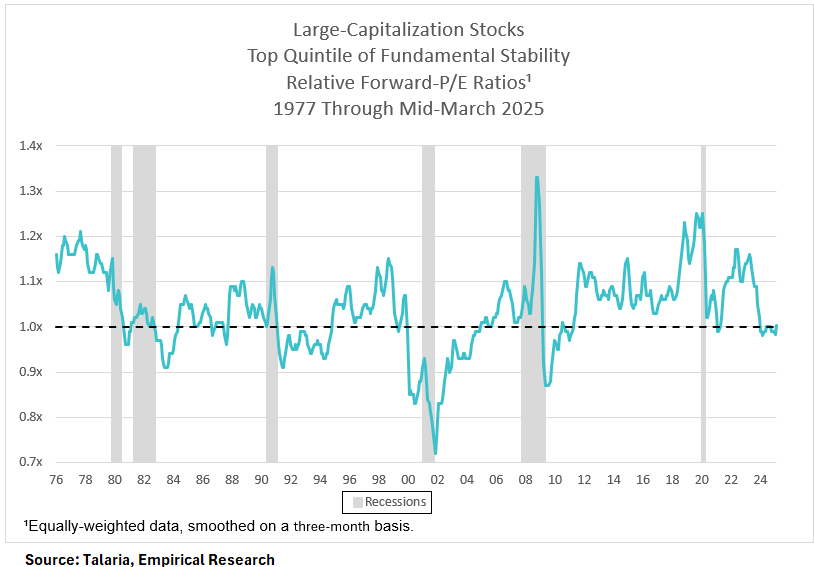
“The market is always a ‘two-handed engine’, what it takes away with one it gives with the other. There are still opportunities for investors to reap from the recent sharp moves in global equities. For example, stocks that have the stability desirable in challenging times are trading at a rare discount to the market outside of recessions (see the chart below).
“Taking advantage of these opportunities requires a willingness to engage with areas of the market that have been out of fashion, and to use levers of return that actually benefit from volatility.”