
 The conditions that allowed equity prices to gain over the last 30 years are shifting.
“On the nominal cash flow growth side, forces that once supported cash flows, such as deep global integration, free trade, free movement of capital and access to low-cost production, are reversing,” Talaria Co-CIO Hugh Selby-Smith said.
“Supply chains are reshoring, trade barriers are rising and labour costs are climbing up, all which slow the rate of cashflow growth.”
“For investors, we believe this marks the end of the golden era, in which nominal cash flow growth and the cost of funding diverged to drive up asset prices. In an environment where this dynamic is, at best, no longer a tailwind, rising valuations over time can no longer be relied upon – bringing a renewed focus on what investors are paying for assets,” Mr Selby-Smith said, pointing to the chart below that highlights this divergence.
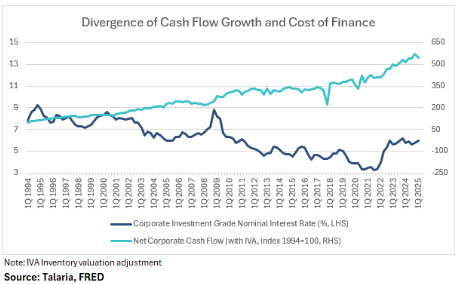
“Funding rates have risen sharply and may remain high. The headlines have been about trade wars, but at heart this is a fight for capital. We feel that the ear of the near free movement of capital is coming to an end with implications for the US currency, stock and bond markets.”
For investors seeking to build more resilient portfolios in such an environment, asset allocation will be crucial.
“In a world where the cost of funding matters again, the timing and certainty of cash flows will enjoy renewed focus. Duration captures how exposed an investment is to changes in interest rates, and shorter duration assets are less vulnerable when interest rates are rising,” Mr Selby-Smith said.
“We also advocate investing in companies with strong balance sheets. Companies with low leverage and strong cash flows are better positioned to manage higher refinancing costs and economic volatility. They also have more flexibility where other companies could be more constrained to protect their revenues.
“In addition, exposure to physical or inflation-linked assets like commodities and infrastructure can help preserve purchasing power if inflation is persistent.
“Diversification too remains important. In a regime defined by fragmentation, higher volatility and less predictability, a portfolio that draws from uncorrelated sources of return and has exposure to ‘under-owned’ assets is more resilient.”
According to Mr Selby-Smith, capital has earned disproportionate returns over labour for decades, with the resulting inequality behind the recent rise in populism.
“Geopolitics has played its part as, for example, economic nationalism has asserted itself. The pandemic also had a huge impact as did the shock of resurgent inflation. In combination these and other elements have exposed fragilities and forced a re-evaluation of capital, risk and global interdependence,” Mr Selby-Smith said.
“This era of globalisation which we identify as starting in the early 1990’s brought many significant benefits but also gave rise to vast levels of non-financial debt to GDP, enormous US twin deficits reliant on foreign funding, a distorted global manufacturing map and much higher returns to capital than to labour. Now, as these imbalances unwind, we believe the free flow of capital can no longer be taken for granted.
“We believe investors should prioritise short duration, strong balance sheets, real assets, and diversification. Underlying this view is our premise that while valuation has always mattered, it hasn’t always mattered to everyone. This ought to change.”


