Rising US debt demands investors seek more resilience in portfolios

Chad Padowitz
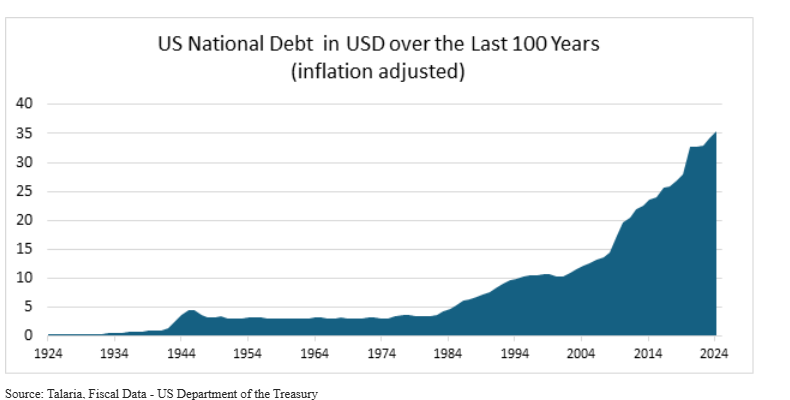
Rising US debt and greater volatility in global markets demands that investors seek more resilient assets such as companies with strong balance sheets that can better weather economic uncertainty, according to Chad Padowitz, co-chief investment officer at Talaria Capital.
Padowitz notes that the nonpartisan Congressional Budget Office predicts US debt will increase at a rate more than twice as fast as the growth of the US economy, potentially reaching 200 per cent of GDP by 2047. This trajectory reflects underlying demographic and economic trends, including an aging population requiring increased healthcare and social security spending.
“To be forewarned is to be forearmed, and perhaps this time US debt is a signal that things are changing in a way that will have more profound effects on the way people invest their money,” Mr Padowitz said.
“Each year, the US is borrowing more and more money just to pay its interest bill. The country required US$1.9 trillion in foreign capital inflows last year to balance its external accounts, with foreign investors holding around US$62 trillion in US assets. To maintain current financing patterns, foreign investors would need to add roughly US$2 trillion annually to their holdings.
“In addition, interest rates are significantly higher now than when the US last borrowed heavily after the GFC, and during the COVID pandemic. The interest payments on existing debt have become a major budget category, exceeding federal spending on Medicare and national defence in fiscal year 2024.
“With higher interest rates prevalent in the current economic environment, the debt service burden compounds rapidly.”
In such an environment of rapidly rising US government debt, Padowitz said the playbook for investors should include short duration fixed income assets, real assets and companies with strong balance sheets and cash flows that are better able to survive economic downturns.
“In a world where the cost of capital matters again, paying attention to the timing and certainty of cash flows becomes critical,” Mr Padowitz said.
“Financial markets are now characterised by higher volatility and less predictability, so a portfolio that draws from uncorrelated sources of return and has exposure to ‘under-owned’ assets will be more resilient and Important for investors to achieve.
“To that end, companies with low leverage and strong cash flows are better positioned to manage higher refinancing costs and economic volatility and should be a core inclusion to investors’ portfolio.
“Real assets will also be key. Exposure to physical or inflation-linked assets like commodities, and infrastructure assets can help preserve purchasing power if inflation is persistent and diversification will remain important.”
According to Padowitz, without substantial policy changes from the US government, the world’s largest economy faces a future of either dramatically higher interest costs, forced fiscal consolidation, or potential financial instability as financial markets and investors question the rising US government debt.
“The combination of increased debt issuance and potentially reduced foreign demand creates significant market risks. If foreign appetite for US assets weakens, pressure could mount on bond, currency and equity markets. Higher yields on US long-term bonds would increase borrowing costs across the economy, affecting everything from mortgage rates to corporate financing,” Mr Padowitz said.
“In such an environment, shorter duration assets are less vulnerable to capital losses when interest rates are rising, and are another important addition for portfolios.”