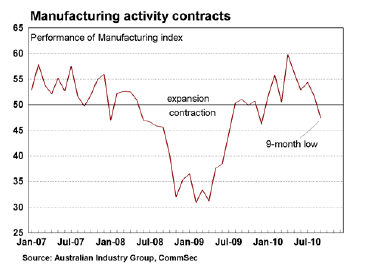
Performance of Manufacturing
- The Performance of Manufacturing index fell by 4.4 points in September to a nine-month low of 47.3. Any
reading below 50 means the manufacturing sector is contracting. - Of more concern, the production sub-index fell to a nine-month low, employment is now at 11 month lows and new orders have slumped to 14 month lows. Eight of the 12 sectors weakened in September.
What does it all mean?
- The decline in the latest manufacturing gauge highlights just how patchy the Australian economy is at present. Not only is manufacturing activity once again contracting, but the key sub indices such as new orders, employment and production have turned sharply lower – a worrisome trend that does not bode well for coming months. Even selling prices are still falling, while input costs and wages rising – pointing to pressure on profits.
- As we have highlighted over the past couple of weeks, there are clear signs that the economy has lost momentum and looking forward activity is likely to be less robust – especially given that the recent strength of the Australian dollar will continue to make Aussie exports less competitive. The strong Aussie is likely to depress not just the manufacturing sector but tourism, and agricultural exports.
- Fundamentally the economy is still in good shape but near term rate hikes are likely to curb the activity and growth at a time when inflation is still well contained.
What do the figures show?
Performance of Manufacturing index
- The Performance of Manufacturing index hit a nine-month low in September, falling by 4.4 points to 47.3. A reading below 50 suggests that the manufacturing sector is contracting.
- Key activity components of the PMI were sharply lower in September. Production, new orders, employment and exports fell sharply. The production sub index dropped 5.3 points to 46.2. And new orders fell by 4.1 points to 46.5. And the employment index lost 6.5 points to 44.8. And exports fell by 1.9 points to 51.2. The index of selling
prices eased modestly to 47.4 while input prices and wages recorded a slight increase. - In seasonally adjusted terms eight of the 12 sectors recorded a decline in activity in September.
What is the importance of the economic data?
- The monthly Performance of Manufacturing Index is the Australian equivalent of the US ISM manufacturing gauge. The PMI is one of the timeliest economic indicators released in Australia. The PMI is useful not just in showing how the manufacturing sector is performing but in providing some sense about where it is heading. The key ‘forward looking’ components are orders and employment.
What are the implications for interest rates and investors?
- The softening in manufacturing conditions would be negative for material suppliers and resources companies and could end up having knock-on effects for other businesses.