
Chinese economic data
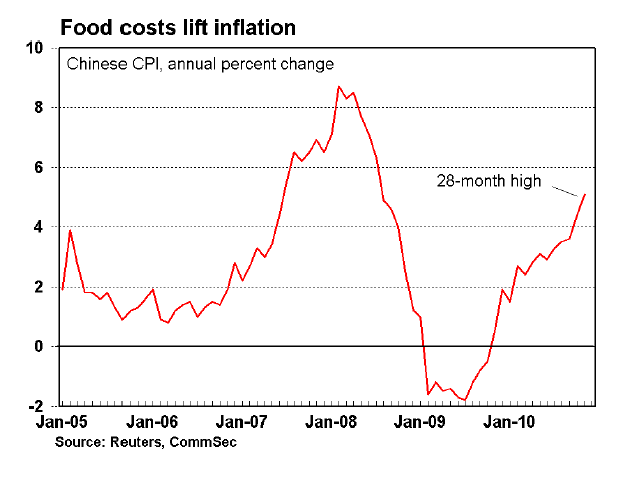
- Chinese consumer prices rose at a 5.1 per cent annual pace in November – the fastest pace in over two years but driven by higher food prices. Non-food inflation was just 1.9 per cent in November. China is using sales of state food reserves in an effort to cap food prices.
- Annual growth rates for industrial production and investment were slightly above market expectations but the latest data on retail sales was broadly in line with the consensus view. Chinese authorities are continuing to achieve success in controlling property prices.
- Ahead of the release of the data, the Peoples Bank of China increased bank reserve requirements for the third time in a month, with ratios lifted by 50 basis points, effective December 20.
What does it all mean?
- In Australia the Government and Reserve Bank would largely be powerless to address a sharp lift in food prices. They would conclude that the vagaries of weather are outside their control and lifting interest rates would be largely pointless given that inflation wasn’t generated by the strength of the economy. But in China, authorities take a different view. Food represents a bigger share of the household budget and authorities are also keen to prevent consumers becoming disaffected by higher living costs.
- So Chinese authorities are releasing state food reserves to keep a cap on food prices. And it is reported that the State Council is boosting efforts to increase the production of vegetables and other basic goods. The central bank is also determined to keep the broader economy in check, increasing bank reserve requirements for the third time in a space of a month. A lift in interest rates over the next few weeks also can’t be ruled out, but arguably production and retail sales are growing at sustainable rates and property inflation continues to moderate.
- Contrary to the belief of many investors, the fact that Chinese authorities are determined to restrain inflationary pressures is a positive, not a negative development. A much more negative development would be if inflation was allowed to grow unchecked. The main concern is if the authorities overdo the efforts to tighten the economy.
- Chinese authorities are continuing to achieve success in controlling property prices. Prices lifted just 0.3 per cent in November and the annual rate slowed to 7.7 per cent in November.
- China is Australia’s major trading partner. And we have reached the point where if China sneezes then Australia would be at the risk of developing a cold. Clearly the Chinese economy remains in strong shape but the battle over inflation is the main issue to watch.
What do the figures show?
- The annual rate of consumer price Inflation lifted from 4.4 per cent in October to a 28-month high of 5.1 per cent in November due to higher food costs (consensus 4.7 per cent). Food prices rose by 11.7 per cent over the year while non-food prices rose by just 1.9 per cent.
- The annual rate of producer price inflation rose from 5.0 per cent to 6.1 per cent in November (consensus 5.1 per cent) in response to higher costs for raw materials like cotton, fuel and cement.
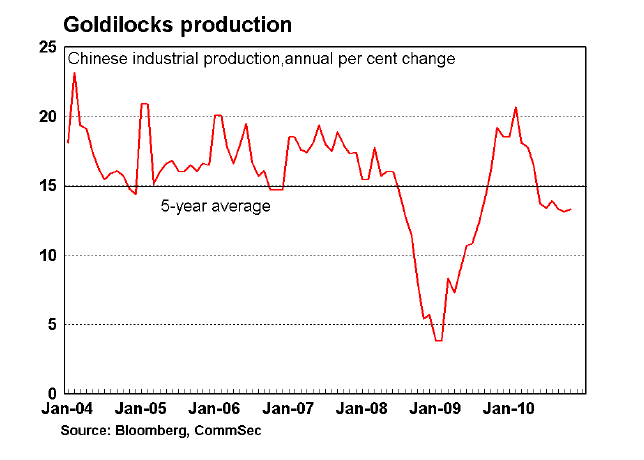
- Industrial output expanded at a 13.3 per cent annual pace in November, up from the 13-month low of 13.1 per cent in October (consensus 13.0 per cent). Production is still well off the highs of 20.7 per cent annual growth in January/February.
- China’s urban fixed asset investment, such as spending on roads and power plants, grew at a 24.9 per cent annual pace in the 11 months to November (consensus 24.3 per cent), and up from 24.4 per cent over the 10 months to October.
- Retail sales grew at an 18.7 per cent annual rate in November (consensus 18.8 per cent), up from the 18.7 per cent annual pace in the year to October.
- Broad money supply (M2) rose at a 19.5 per cent annual rate in November, the fastest pace in six months.
- Chinese property prices slowed again in November. Urban property prices rose by 7.7 per cent in the year to November, down from 8.6 per cent in the year to October, and the 12.8 per cent peak in April.
- In November alone, property prices rose by 0.3 per cent after a 0.2 per cent lift in October.
- In the first 11 months of 2010, new property sales were up 9.8 per cent, up from 9.1 per cent in the first 10 months of the year.

What is the importance of the economic data?
- China’s National Bureau of Statistics releases its monthly economic statistics around the middle of each month. Quarterly GDP data is released around the 16th of January, April, July and October. China is Australia’s largest trading partner and changes in the Chinese economic have major implications for the Aussie economy.
What are the implications for interest rates and investors?
- Investors are worried about rising inflation in China. While the main issue is higher food prices – a temporary situation and outside central bank control – investors are worried that higher inflation may become entrenched. There also is the concern that authorities may make policy mistakes – either tightening policy too much or not enough.
- The Chinese economy continues to expand at a firm clip but growth rates of investment, retail sales and production are well off highs earlier in the year. Australia’s Reserve Bank will certainly keep a close eye on developments in China but there are no major concerns at present. The main focus is the efforts to keep inflation in check.

Produced by Commonwealth Research based on information available at the time of publishing. We believe that the information in this report is correct and any opinions, conclusions or recommendations are reasonably held or made as at the time of its compilation, but no warranty is made as to accuracy, reliability or completeness. To the extent permitted by law, neither Commonwealth Bank of Australia ABN 48 123 123 124 nor any of its subsidiaries accept liability to any person for loss or damage arising from the use of this report
The report has been prepared without taking account of the objectives, financial situation or needs of any particular individual. For this reason, any individual should, before acting on the information in this report, consider the appropriateness of the information, having regard to the individual’s objectives, financial situation and needs and, if necessary, seek appropriate professional advice. In the case of certain securities Commonwealth Bank of Australia is or may be the only market maker.
This report is approved and distributed in Australia by Commonwealth Securities Limited ABN 60 067 254 399 a wholly owned but not guaranteed subsidiary of Commonwealth Bank of Australia. This report is approved and distributed in the UK by Commonwealth Bank of Australia incorporated in Australia with limited liability. Registered in England No. BR250 and regulated in the UK by the Financial Services Authority (FSA). This report does not purport to be a complete statement or summary. For the purpose of the FSA rules, this report and related services are not intended for private customers and are not available to them.
Commonwealth Bank of Australia and its subsidiaries have effected or may effect transactions for their own account in any investments or related investments referred to in this report.


