
The big picture
- China is now the second largest economy in the world. Australia ranks as 13th biggest. But Australia is regarded as an advanced economy whereas China is defined by the IMF as an “Emerging and Developing” economy. So what defines the level of advancement?
- Certainly there are many ways that can economies can be distinguished. The traditional way is to look at GDP per capita – that is, the size of the economy divided by the number of people in it. And on this measure the gap between Australia and China is huge. GDP per capita in Australia is estimated at US$54,869, compared with China at US$4,283. And that gap isn’t going to close any time soon.
- Other ways of distinguishing economies include social measures like education advancement. And comparisons can be made on consumer measures like the number of vehicles per head of population.
- In Australia, the latest motor vehicle census was published just a few days ago. The figures showed that Australia had 16.06 million motor vehicles as at March 2010, up 2.5 per cent over the previous year and a gain of just over 15 per cent over the past five years. The actual number of cars or passenger vehicles stood at 12.27 million while the remainder of vehicles included trucks, buses, motor cycles and vans.
- Interestingly, while population growth in Australia has been solid in recent years, the car population has actually increased at a faster rate. The Bureau of Statistics estimated that there were 721.1 motor vehicles per 1,000 people in Australia as at March 31 2010, up from 686.3 vehicles per 1,000 residents five years ago.
- The data on cars per head of population doesn’t get updated regularly across the globe. But the latest data showed the US out in front with 842 motor vehicles per 1,000 people. Based on the latest data, Australia would now be in second spot, up from fourth in the last survey.
- So where does China stand? Figures published for the 2008 year indicated that there were just 128 motor vehicles per 1,000 in China, which puts it level with countries such as Fiji and the Seychelles. But China is no doubt quickly moving up the league table.
- In 2010, a record 13.8 million cars were sold in China. When combined with trucks, buses etc, total vehicle purchases totalled 18.1 million units, up 32.4 per cent on a year ago. By comparison, there were 11.6 million vehicles sold in the US over 2010. While Chinese vehicle sales are tipped to slow in 2011, it will still retain its position as the biggest car buying nation.
- While China has passed the US as the largest car buying nation, it would need to purchase 50 million vehicles a year to be on level terms on a per capita basis. Clearly another reason to be positive on resource stocks.
The week ahead
- The job market and Aussie consumers will both feature in Australian economic data in the coming week. But in the US the economic cupboard is almost bare with the only data of note being released late in the coming week.
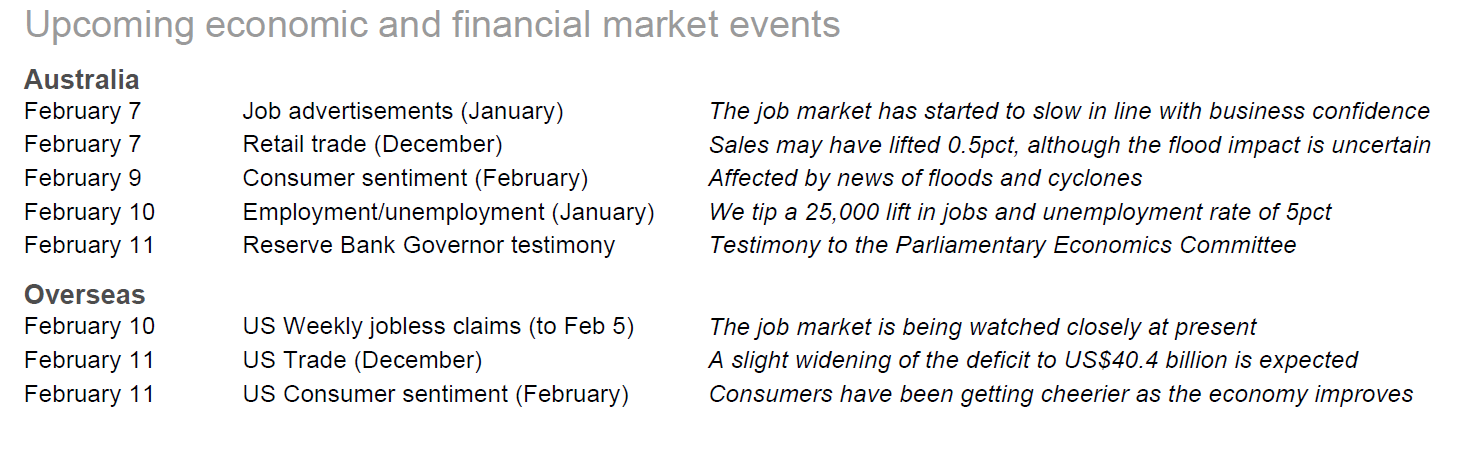
- The week kicks off with job advertisements, retail trade and the Performance of Construction index all to be released on Monday. In terms of job ads, the interesting result in December was the fact that the ANZ series rose but the Advantage internet index actually recorded the biggest drop since July 2009. The difference may prove more of a timing issue, but certainly business conditions have softened in recent months.
- Also on Monday we will finally see how retailers performed during the all-important Christmas trading period. We expect that retail trade rose by 0.5 per cent in December after a weak 0.3 per cent increase in November. But key complications to the forecast are the flooding across NSW and wet weather in Queensland which could lead to a softer result than currently expected. Over the December quarter retail sales may have fallen 0.5 per cent in inflation-adjusted terms, thus setting up a weak reading for economic growth (GDP).
- On Wednesday the Melbourne Institute and Westpac release the February consumer sentiment report. In January, confidence levels plunged almost six per cent as people dissected the latest news on the Queensland floods. Given that Cyclone Yasi is now in focus, there may not be too much short-term improvement in sentiment.
- On Thursday, the monthly employment data is released. The December figures were soft with only 2,300 new jobs created. But after solid gains in the previous six months, it may have just been a pause for breath. Certainly we believe that employment lifted again in January, rising by 25,000. And that should be enough to keep the unemployment rate around 5.0 per cent.
- And on Friday the Reserve Bank Governor will face his quarterly grilling by members of the Parliamentary Economics Committee. No doubt Glenn Stevens will get plenty of questions on the floods and how the Reserve Bank works out the impact on economic activity and inflation. There aren’t too many other ‘hot button’ issues that members will be looking to explore, but perhaps some will challenge the Reserve Bank’s constant focus on the terms of trade and its influence on the economy.
- In the US, a quiet week is in prospect. Figures on consumer credit are released on Monday together with the employment index. The usual weekly indicators will be issued – department store sales on Tuesday, mortgage refinancing on Wednesday and claims for unemployment insurance (jobless claims) on Thursday. Data on wholesale inventories and the Federal Budget are also released on Thursday with trade and consumer sentiment on Friday. Economists tip a modest widening of the trade deficit in December, up from US$38.3 billion to US$40.4 billion.
- A number of Federal Reserve presidents will also deliver speeches over the week. Richmond President, Jeffrey Lacker, fronts the podium on Tuesday together with Atlanta President Dennis Lockhart and Dallas President, Richard Fisher. On Wednesday and Thursday, Dennis Lockhart will also deliver speeches.
Sharemarket
- The Australian profit-reporting season gets into full swing in the coming week. Amongst those to report on Tuesday are Reckon, Cochlear, and JB Hi-Fi. Commonwealth Bank reports its half-year earnings on Wednesday together with Bradken, Stockland, OZ Minerals, Boral and Ansell. On Thursday Rio Tinto, Telstra, Transurban. Fosters, Cochlear and Alumina are scheduled to report, with Newcrest slated for Friday.
- It’s not hard to see why the Australian sharemarket has been treading water over the past few weeks – investors are nervous ahead of earnings season. A raft of companies have been lining up to downgrade profit expectations from consumer-focussed businesses, affected by weak consumer spending, to mining companies, affected by floods. Guidance is likely to be super-cautious and many investors are content to sit on the sidelines for now.
Interest rates, currencies & commodities
- The Aussie dollar has clawed its way back up to parity with the greenback. Interestingly the Aussie is also near parity with the Canadian dollar, suggesting that there is a “Super Dollar’ relationship now between Australian, US and Canadian dollars. Our currency strategists continue to believe that the Aussie will climb its way back to around US$1.02 by the end of the March quarter before easing through to the end of the year. The US economy is expected to gather momentum throughout 2011 with talk of higher interest rates in the second half providing support to the greenback. By the end of 2011, our strategists believe that the Aussie will be around US92c.
- The Reserve Bank Board meeting has come and gone and interest rate expectations have not shifted. Financial markets still believe there is an outside chance of a rate cut in the next three months with a rate hike gradually being priced in to the second half of the year. And remarkably, while economists tip two or three 25 basis point rate hikes by end year, financial markets still don’t have one move fully priced in.
- The CRB futures commodities index hit 28-month highs on Tuesday, fully reversing all the weakness that accompanied the global financial crisis. In July 2008 the CRB futures index hit a record high of 473.52. From there, it was basically all down-hill, retreating to 200.34 in early March 2009. Since those lows, the CRB has rebounded by 70 per cent.
Produced by Commonwealth Research based on information available at the time of publishing. We believe that the information in this report is correct and any opinions, conclusions or recommendations are reasonably held or made as at the time of its compilation, but no warranty is made as to accuracy, reliability or completeness. To the extent permitted by law, neither Commonwealth Bank of Australia ABN 48 123 123 124 nor any of its subsidiaries accept liability to any person for loss or damage arising from the use of this report.
The report has been prepared without taking account of the objectives, financial situation or needs of any particular individual. For this reason, any individual should, before acting on the information in this report, consider the appropriateness of the information, having regard to the individual’s objectives, financial situation and needs and, if necessary, seek appropriate professional advice. In the case of certain securities Commonwealth Bank of Australia is or may be the only market maker.
This report is approved and distributed in Australia by Commonwealth Securities Limited ABN 60 067 254 399 a wholly owned but not guaranteed subsidiary of Commonwealth Bank of Australia. This report is approved and distributed in the UK by Commonwealth Bank of Australia incorporated in Australia with limited liability. Registered in England No. BR250 and regulated in the UK by the Financial Services Authority (FSA). This report does not purport to be a complete statement or summary. For the purpose of the FSA rules, this report and related services are not intended for private customers and are not available to them.
Commonwealth Bank of Australia and its subsidiaries have effected or may effect transactions for their own account in any investments or related investments referred to in this report.


