
Weekly Petrol Price
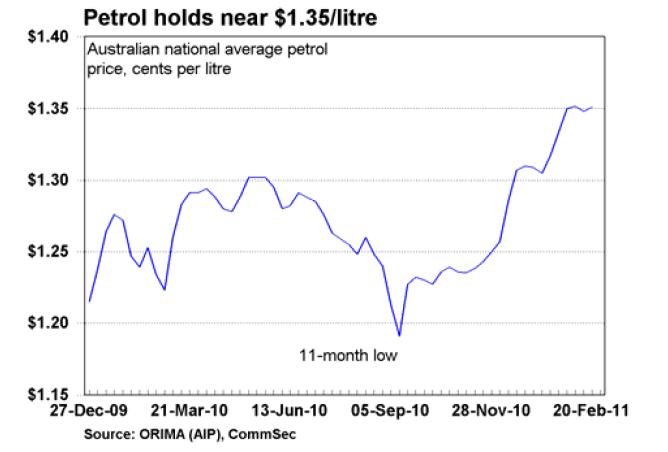
- Petrol prices continue to tracking sideways. According to the Australian Institute of Petroleum, the national average Australian price of unleaded petrol rose by 0.3 cents a litre to 135.1 cents a litre in the
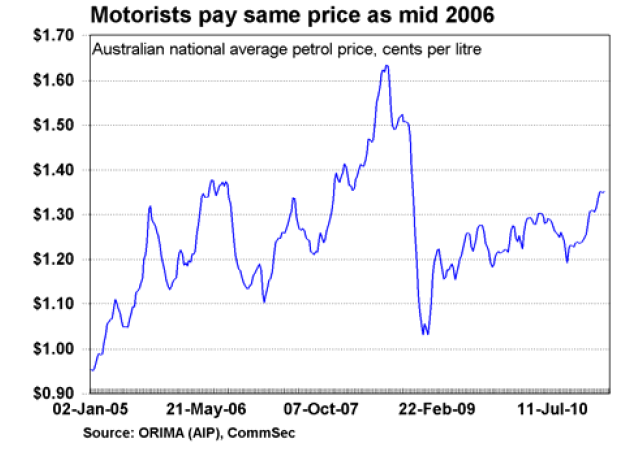
week to February 20. The wholesale (terminal gate price) stands at a 28-month high of 127.1 cents a litre today. Remarkably though, motorists are paying similar prices for petrol as back in mid 2006. - Regional gasoline price at 28-month highs. In Australian dollar terms, the Singapore gasoline price hit a fresh 28-month high of US$108.73 a barrel on Friday. When the gasoline price was last near the levels existing today, the Aussie dollar was near US83c and the domestic petrol price was around 150 cents per litre. In other words we can thank a higher Australian dollar for insulating us from higher world oil prices.
- Watch the Middle East. If there is one factor likely to send global oil prices higher it is the spreading instability through the Middle East and North Africa.
- Caltex reports profit. In 2010 Caltex reported a 1 per cent lift in profit to $318 million. The Caltex Refiner Margin averaged US$8.39 per barrel or 5.77 Australian cents per litre during 2010, compared with an average of US$5.95 per barrel or 5.05 Australian cents per litre during 2009.
What does it all mean?
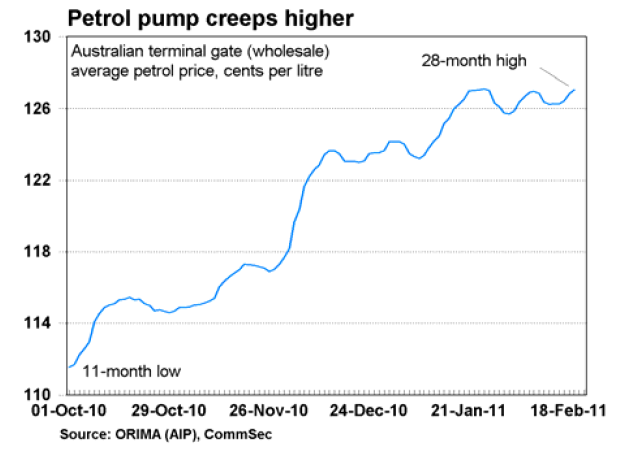
- Since late January, the wholesale petrol price has been holding near 28-month highs, hovering between $1.26 and $1.27 a litre. And not surprisingly the pump price has been hovering near $1.35 a litre. That relationship looks set to hold for now with regional gasoline prices little changed over the past week.
- Some motorists may feel that we are being hard done by at the petrol pump. But the simple fact is that when regional oil prices were similarly around current levels in September 2008, the Aussie dollar was around US17 cents lower and our petrol price was around US17 cents a litre higher. In short in makes sense that we are paying around $1.30-$1.35 at the petrol bowser. The gap between the wholesale and retail price has lifted over time, but only modestly, up from 5-6 cents a litre to 7-8 cents a litre.
- The perception is that the Aussie dollar was much lower back in 2008 but that isn’t the case, in fact it was near US98c in July 2008 before the global financial crisis dragged it lower. And the interesting point about the current petrol price is that over 4½ years ago motorists were paying similar prices for petrol. We may wish prices were lower, but few can complain too loudly about current petrol prices.
- The main worry for motorists is the spreading turmoil in the Middle East. If the instability continues, investors will get increasingly worried that oil supplies may be disrupted, sending global oil prices high. Fortunately for motorists our lofty currency in keeping petrol price pain to a minimum.
What do the figures show?
Petrol prices:
- According to the Australian Institute of Petroleum, the national average Australian price of unleaded petrol rose by 0.3 cents a litre to 135.1 cents a litre in the week to February 20 (range from 132.9c to 137.5c). The metropolitan price rose by 0.4 c/l to 135.1 c/l, while the regional average price rose by 0.3 c/l to 135.3 c/l.
- Average petrol prices across states over the past week were: Sydney (up 1.0 cents to 134.5 c/l), Melbourne (unchanged at 134.3 c/l), Brisbane (down 1.1 cents to 137.6 c/l), Adelaide (up 0.9 cents to 133.6 c/l), Perth (up 0.9 cents to 135.4 c/l), Darwin (down 0.4 cents to 137.7 c/l), Canberra (up 0.3 cents to 135.4 c/l) and Hobart (unchanged at 140.7 c/l).
- Today, the national average wholesale (terminal gate) stands at a 28-month high of 127.1 cents a litre, up 0.8 cents a litre over the past week. The wholesale price has been hovering around 126-127 cents a litre since late January 2011.
- Last week, the key Singapore unleaded petrol price rose by US$1.86 (1.7 per cent) to US$110.10 a barrel. And in Australian dollar terms the Singapore gasoline price rose by 35c (0.3 per cent) over the week to $108.73 a barrel.
What is the importance of the economic data?
- Weekly figures on petrol prices are compiled by ORIMA Research on behalf of the Australian Institute of Petroleum. National average retail prices are calculated as the weighted average of each State/Territory’s metropolitan and non-metropolitan retail petrol prices, with the weights based on the number of registered petrol vehicles in each of these regions.
What are the implications for interest rates and investors?
- Petrol is not a major influence at present on consumer psychology or household budgets. While the petrol price can lift as high as $1.45 a litre during the week in major capital cities, it also gets down to $1.25-1.30, so it is not causing heartache at present. Still the concern in the back of many minds is that the petrol price may continue to creep higher and that risk is preventing consumers from opening their wallets a little wider.
- The stability of the petrol price neither represents good news or bad news for retailers. For many motorists it remains a watching brief.
- Filling up the car with petrol is the single biggest purchase that most people make each week. While a 1-2 cent per litre lift in pump prices only adds up to an extra $1-2, the fact is that motorists watch every penny when around $80 of petrol is being put in the tank.
- Caltex reported 2010 earnings today with net profit up 1 per cent to $318 million. The Caltex Refiner Margin averaged US$8.39 per barrel or 5.77 Australian cents per litre during 2010, compared with an average of US$5.95 per barrel or 5.05 Australian cents per litre during 2009. Shareholders have done well with total dividends of 60c a share in 2010, up from 25c a share in 2009.
Produced by Commonwealth Research based on information available at the time of publishing. We believe that the information in this report is correct and any opinions, conclusions or recommendations are reasonably held or made as at the time of its compilation, but no warranty is made as to accuracy, reliability or completeness. To the extent permitted by law, neither Commonwealth Bank of Australia ABN 48 123 123 124 nor any of its subsidiaries accept liability to any person for loss or damage arising from the use of this report.
The report has been prepared without taking account of the objectives, financial situation or needs of any particular individual. For this reason, any individual should, before acting on the information in this report, consider the appropriateness of the information, having regard to the individual’s objectives, financial situation and needs and, if necessary, seek appropriate professional advice. In the case of certain securities Commonwealth Bank of Australia is or may be the only market maker.
This report is approved and distributed in Australia by Commonwealth Securities Limited ABN 60 067 254 399 a wholly owned but not guaranteed subsidiary of Commonwealth Bank of Australia. This report is approved and distributed in the UK by Commonwealth Bank of Australia incorporated in Australia with limited liability. Registered in England No. BR250 and regulated in the UK by the Financial Services Authority (FSA). This report does not purport to be a complete statement or summary. For the purpose of the FSA rules, this report and related services are not intended for private customers and are not available to them.
Commonwealth Bank of Australia and its subsidiaries have effected or may affect transactions for their own account in any investments or related investments referred to in this report.


