
Quarterly Labour force data;
- Over the three months to February, employment across Australia grew by just 0.1 per cent or 16,200 – marking the slowest pace of jobs growth in 18 months.
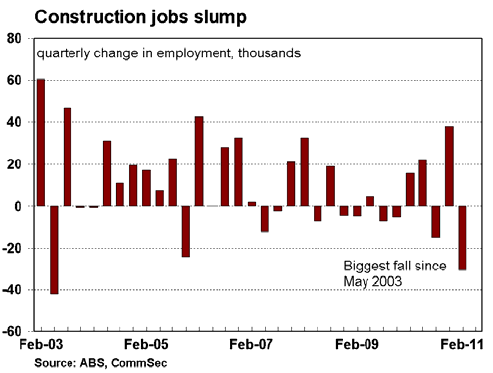
- The weakness in housing activity resulted in the construction sector shedding 30,600 jobs in the three months to February – marking the biggest fall in 8 years. Almost all construction jobs lost were in NSW. Overall the data shows a much more mixed picture of the job market with 8 of 19 industry sectors having less jobs than three months ago.
- Across the states NSW (+26,700) led the job gains in the three months to February, followed by Victoria (+22,200). The bulk of the job losses occurred in Queensland (-39,400), and Western Australia (-14,600).
- Domestic airfares generally rose in March with business fares up 4.8 per cent, full economy fares up 0.3 per cent and restricted economy fares up 1.4 per cent.
- The discount airfare index rose by 0.9 per cent in March, easing further away from the record lows reached in January.
What do the figures show and what does it all mean?
- There is a perception that the jobs growth continues to be robust. However the latest round of quarterly labour data has clearly highlighted that employment growth is slowing. In fact over the three months to February employment grew by just 0.1 per cent, marking the slowest pace of jobs growth in 18 months. At this stage the slowdown in new labour hiring is not overly concerning especially given the strength in employment throughout 2010. However the slower pace of hiring is yet another sign that the domestic economy has lost some momentum.
- Across the sectors, the construction sector bore the brunt of the job losses with most of the weakness centred on NSW. In fact Jobs growth in the construction sector fell by over 30,000, marking the biggest fall in eight years. There is no doubt that the weakness in housing activity and slowdown in overall new building has played a significant part in slide in construction jobs. And looking forward the outlook is likely to remain weak – especially given that loans to build new homes (a timely forward looking indicator) is at the lowest levels in two years.
- Interestingly there may be more of us with jobs, but we are working far fewer hours. In fact the latest reading is just shy of record lows. On average over the past year Australians worked on average 34 hours a week. That is around 90 minutes less than a decade ago.
- The figures go a long way in explaining Australia’s poor productivity. More of us have jobs but on average we are working fewer hours. In part there are more part time workers but also more married women and seniors in the workforce on flexible hours.
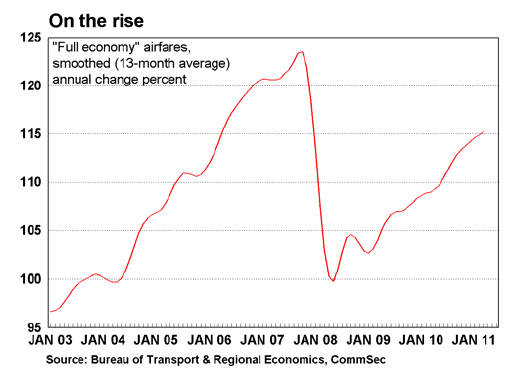
- Just like anything else, when it comes to airfares it pays to shop around. According to the Government’s monitoring group, BITRE, all classes of airfares are now rising.
- Discount airfares hit rock bottom in January, and have since recorded modest gains. Interestingly the increase in prices is more a function of the increase in fuel surcharges that have taken place over the last couple of months rather than a change in consumer behaviour. The BITRE notes that fares include all taxes and charges, i.e. they reflect actual total price payable by passengers for a particular journey.
- Interestingly the gains in discount airfares have been more modest when compared with the price rise in business and full economy fares. Business class fares rose by a sizeable 4.8 per cent in March compared with discount fares which were up just 0.9 per cent in the month. Even full economy fares are now almost 6 per cent higher than a year ago while discount fares are still down 13 per cent in annual terms. Clearly the advice to shop around doesn’t just go for consumers, but also companies
- With the cost of jet fuel on the rise and upward pressure on wage costs, airlines will continue to attempt to lift fares to cover costs. At the same time airlines are testing the waters – lifting some airfares and seeing what the response is. Any smart business operator will clearly be shopping around for the best deal and trying to avoid any slug in travel costs. As to how successful they will be remains to be seen. Certainly other businesses are facing a lot of difficulties in trying to raise prices in the current environment.
What do the figures show?
Labour Industry Data
- Over the three months to February, employment across Australia grew by 16,200 or 0.1 per cent – well below the 10-year average job growth of 57,000.
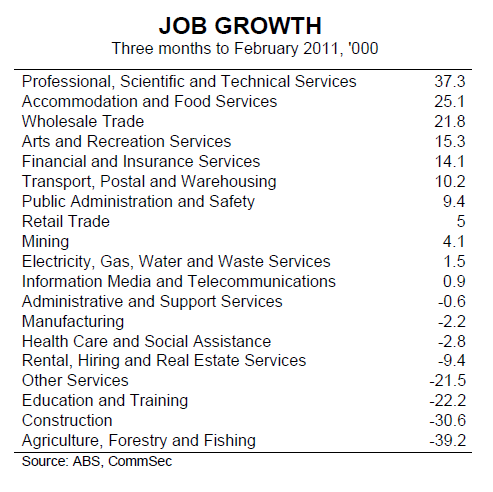
- Professional, Scientific and Technical Services led the the job gains, with employment lifting by 37,300. Next strongest was Accommodation and Food Services up 44,000, with Accomodation & food service up 25,100.
- At the other end of the scale, Agriculture, Forestry and Fishing down by 39,200 in the past three months with Construction down 30,600.
- Over the past year employment has grown by 306,000 jobs or 2.8 per cent. .
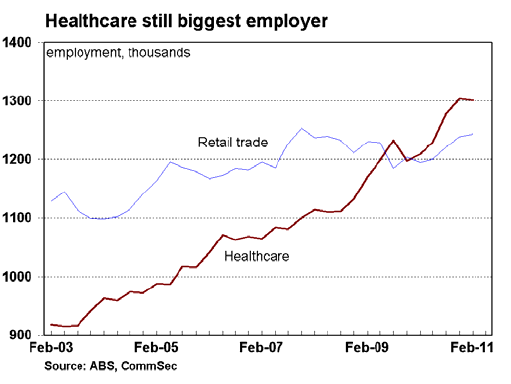
- Over the year to February, Healthcare and Social Assistance (up 91,500) led the job gains, followed by Accommodation and Food Services (up 58,000) and Retail Trade (up 49,300).
- The biggest industry sector – heath care and social assistance – has been a consistent job creator over the past two years with employment only dropping once in the period. And the 91,500 jobs created over the past year was the third best result in records going back 25 years.
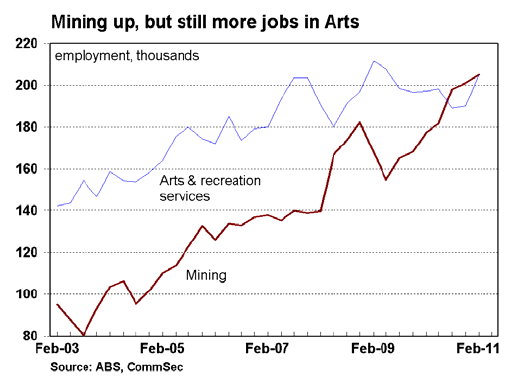
- Employment in the mining sector has grown sharply over the past year. Total mining employment rose by 2 per cent over the three months to February and a staggering 15.6 per cent over the year. Similarly annual growth in Electricity, Gas & Water rose by 13.6 per cent over the past year.
- Across the states in original terms NSW (+26,700) led the job gains in the three months to February, followed by Victoria (+22,200), Northern Territory (1,100) and Tasmania (700). Job losses occurred in Queensland (-39,400), followed by Western Australia (-14,600), ACT (-3,200), and South Australia (-300).
Domestic airfares:
- According to the Bureau of Infrastructure, Transport and Regional Economics, the discount airfare index rose from 64.2 to 64.8 in March (July 2003=100). In January 2011 discount airfares hit record lows of 59.4. While the index is volatile on a monthly basis, it is notable that the index has been in operation for 18 years.
- The smoothed (13-month average) index of discount airfares stood at 64.6 in March, down 6.1 per cent on a year ago. Discount airfares have been consistently falling in annual terms for over three years.
- While discount fares are falling in annual terms, business class fares are rising. The index of business class fares rose by 4.8 per cent in March. And business class fares are 3.3 per cent higher than a year ago.
- The index of full-economy fares rose by 0.3 per cent in March. Full economy airfares are up 5.7 per cent on a year ago.
- The index of restricted-economy airfares rose by 1.4 per cent in March, the tenth increase in eleven months. Restricted economy fares are up 3.6 per cent on a year ago – the fastest pace of growth in two years.
What is the importance of the economic data?
- Detailed Labour Force estimates are released the Bureau of Statistics each month with quarterly industry estimates published each quarter. The data assists in highlighting the industries which are expanding and contracting, thus providing additional insights into the current performance of the economy.
- The Bureau of Infrastructure, Transport and Regional Economics (BITRE) release data on airfares on a monthly basis. The figures are useful in getting a gauge on airline profitability. The data is also useful in monitoring consumer spending trends.
What are the implications for interest rates and investors?
- At present the Reserve Bank would not be overly concerned by the slowdown in jobs growth. In fact the central bank has also been anticipating a softening of conditions in the labour market for some months – in line with the weak growth forecasts for the first half of 2011.
- Looking forward the Reserve Bank expects the unemployment rate to only slide by 0.5 per cent over the coming two years. No doubt in the longer term an improvement in productivity and a pickup in skilled migration is what is needed to ensure that these forecasts are met. The
jobs data gives the Reserve Bank further reason to stay on the interest rate sidelines added to which a sustained slowdown in jobs growth should ensure that wage growth doesn’t spiral out of control in the midterm. - The latest data on airfares highlights the pressures that Corporate Australia is facing at present. Businesses will make every effort to push up prices and recoup costs. But they need to be mindful about the backlash on sales and market share. If consumers quickly shift affections when prices go up, businesses must be quick to review or reverse their decisions.
Produced by Commonwealth Research based on information available at the time of publishing. We believe that the information in this report is correct and any opinions, conclusions or recommendations are reasonably held or made as at the time of its compilation, but no warranty is made as to accuracy, reliability or completeness. To the extent permitted by law, neither Commonwealth Bank of Australia ABN 48 123 123 124 nor any of its subsidiaries accept liability to any person for loss or damage arising from the use of this report.
The report has been prepared without taking account of the objectives, financial situation or needs of any particular individual. For this reason, any individual should, before acting on the information in this report, consider the appropriateness of the information, having regard to the individual’s objectives, financial situation and needs and, if necessary, seek appropriate professional advice. In the case of certain securities Commonwealth Bank of Australia is or may be the only market maker.
This report is approved and distributed in Australia by Commonwealth Securities Limited ABN 60 067 254 399 a wholly owned but not guaranteed subsidiary of Commonwealth Bank of Australia. This report is approved and distributed in the UK by Commonwealth Bank of Australia incorporated in Australia with limited liability. Registered in England No. BR250 and regulated in the UK by the Financial Services Authority (FSA). This report does not purport to be a complete statement or summary. For the purpose of the FSA rules, this report and related services are not intended for private customers and are not available to them.
Commonwealth Bank of Australia and its subsidiaries have effected or may effect transactions for their own account in any investments or related investments referred to in this report.


