
Upcoming economic and financial market events
x
The big picture
- Aussie businesses have to cope with a lot. The global environment has been far from stable in recent years, what with the financial crisis, geopolitical problems in North Africa and the Middle East and rising cost pressures, such as the lift in oil prices. Then there has been the string of natural disasters and the soaring Australian dollar. But by far one of the biggest changes in the domestic business environment is the extent of conservatism by Aussie consumers.
- Some economists believe that nothing has really changed – that consumers are still spending, but in different ways. Clearly these economists have spent too long in their marbled office towers. The Reserve Bank has regularly highlighted the changed behaviour of consumers; our retail clients across the country are constantly noting the tough environment; and certainly listed retailers haven’t been shy in indicating the challenges they are facing.
- So have there been any changes of note in recent times? The Reserve Bank is certainly watching carefully for any subtle shifts, because if consumers do start spending again, then interest rate hikes will be back on the agenda.
- Well there hasn’t been any improvement in retail spending. Over the past six months retail trade has grown at a 1.0 per cent annual rate. And in February alone, spending went backwards in four of the states & territories with only flood-induced buying in Queensland holding up the national growth rate.
- Then there is the latest credit and debit card data. In February, the average credit card balance was up just 1.4 per cent on a year ago. That is actually the fourth straight month that growth in credit card debt has gone backwards in real terms.
- Aussie consumers are still using their credit cards to make purchases, but the clear preference is to use their own money – buy goods with their debit cards – than add purchases to the credit card bill. In February, credit card transactions were up just over 7 per cent on a year ago but debit card transactions were up by almost 23 per cent – the fastest annual growth rate recorded.
- And the old stand-by of the past – the credit card cash advance – has almost become a relic of history. In February the number of credit card cash advances fell to the lowest levels recorded in almost 14 years.
- Add in the fact that personal lending has fallen to the lowest levels seen in two years and it becomes blindingly apparent that Aussie consumers won’t spend or borrow and still very much prefer to live within their means.x
The week ahead
- Didn’t we just celebrate Christmas? It seems like it was just yesterday, but now Easter is almost here. Fortunately for investors there is just a spattering of domestic and global economic events before the Easter break with inflation in focus at home and housing dominating the US economic releases.
- In Australia CommSec releases its quarterly “State of the States” report on Monday and a few surprises have shown up in the relative performances of the state and territory economies over the last three months.
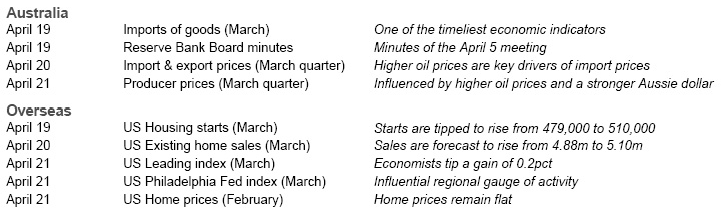
- On Tuesday, the Bureau of Statistics releases March data on imports – one of the timeliest readings on the economy. And on the same day the Reserve Bank publishes minutes of the last Board meeting held on April 5. Given that the statement following the meeting was almost a carbon copy of the previous month, investors and analysts alike will be scouring the Board minutes for fresh views on the state of the economy.
- On Wednesday the “inflation reporting” season begins with March quarter data on international trade prices – that is, export and import prices. The Commonwealth Bank Business Sales index is also released on Wednesday. And this is followed up on Thursday with readings on business inflation – the producer price indexes.
- The main influences on both inflation publications are a modestly stronger currency, higher coal and iron ore prices and a near 17 per cent lift in the US dollar price of crude oil. Analysts will also closely assess the data on producer prices for evidence that businesses are trimming prices in response to competition. Alternatively some sectors may have sought to lift prices in response to increased wage costs, and that bears watching. There is certainly a mix of pressures acting on prices at present.
- While inflation dominates the indicators in Australia, in the US it is housing that is centre-stage. On Monday the National Association of Home Builders releases the April activity index while data on housing starts and building permits is released on Tuesday with existing home sales on Wednesday. And on Thursday the Federal Housing Finance Agency releases home price data for February.
- Overall economists are tipping firmer readings, especially for housing starts and existing home sales. Starts may have rebounded by 6.5 per cent in March according to consensus forecasts after a slide of 22 per cent in February. Admittedly the weather has played a big role on the results and the truth on new starts lies in between. And economists expect a 2.5 per cent lift in home sales in March after the 9.6 per cent slump in February (the first drop in four months).
- Of the other data, economists tip a modest 0.2 per cent lift in the leading indicators series in March after a solid 0.8 per cent rise in February. And most analysts tip an easing of the influential Philadelphia Fed index for April.
Sharemarket
- The US profit reporting season has begun. And while it doesn’t get into full swing until after Easter, there are a number of household names issuing results in the coming week. On Monday Citigroup and Texas Instruments are amongst 25 companies to report. On Tuesday there are 50 companies to report and the notables include Goldman Sachs, Johnson & Johnson, State Street, US Bankcorp, IBM, Intel and Yahoo!. Amongst the 103 companies reporting on Wednesday are AT & T, Delta Airlines, Morgan Stanley, Wells Fargo, American Express, Apple, E*TRADE, Qualcomm and YUM! Brands. And of the 161 companies to report on Thursday, included are DuPont, Ford, General Electric, McDonalds, Nokia, Southwest Air, Advanced Micro, Amazon.com and Verizon.
- Overall the consensus amongst analysts is that earnings per share in the first quarter of 2011 will be up 13 per cent on a year ago with sales up 8 per cent. TheStreet.com expects EPS for S&P 500 companies at $23 a share, which would be the highest, first quarter result in history.
Interest rates, currencies & commodities
- Why are oil prices so high? In large part it reflects the instability in North Africa and the Middle East. From late October 2010 to late February 2011, the Nymex oil price was content to sit between US$80-92 a barrel. Then came the Libyan crisis in late February and oil quickly lifted to US$98 a barrel and then to US$102 on March 2. Oil production from Libya was never the issue, rather the concern (read: speculation) was that countries like Saudi Arabia could be affected, potentially disrupting oil supplies to the world, but Europe in particular.
- But what happens if stability returns? Well the world is well supplied with oil according to the International Energy Agency, even with the solid expansion of China and the rest of Asia. In fact world oil supply hit a record high of 89 million barrels per day in February with US gasoline stocks at a 20-year high – all just before the Libyan crisis hit – although both have eased over the past month. So once the geopolitical jitters ease, oil prices could retreat quickly, meaning good news for motorists and retailers alike but bad news for resources stocks.
- Our CBA currency strategists haven’t changed their tune. They expect that the Aussie will remain firm in the short-term, perhaps lifting as high as US108 cents. But as the US Federal Reserve prepares to withdraw stimulus in the second half of 2011 and then focuses on lifting interest rates from an unsustainable level of 0.25 per cent, the US dollar should start to strengthen. So while the Aussie dollar could ease against the greenback later this year, it will be more a matter of US dollar strength, rather than Aussie dollar weakness. The Aussie is tipped to end 2011 around US92 cents.
x
Produced by Commonwealth Research based on information available at the time of publishing. We believe that the information in this report is correct and any opinions, conclusions or recommendations are reasonably held or made as at the time of its compilation, but no warranty is made as to accuracy, reliability or completeness. To the extent permitted by law, neither Commonwealth Bank of Australia ABN 48 123 123 124 nor any of its subsidiaries accept liability to any person for loss or damage arising from the use of this report. The report has been prepared without taking account of the objectives, financial situation or needs of any particular individual. For this reason, any individual should, before acting on the information in this report, consider the appropriateness of the information, having regard to the individual’s objectives, financial situation and needs and, if necessary, seek appropriate professional advice. In the case of certain securities Commonwealth Bank of Australia is or may be the only market maker. This report is approved and distributed in Australia by Commonwealth Securities Limited ABN 60 067 254 399 a wholly owned but not guaranteed subsidiary of Commonwealth Bank of Australia. This report is approved and distributed in the UK by Commonwealth Bank of Australia incorporated in Australia with limited liability. Registered in England No. BR250 and regulated in the UK by the Financial Services Authority (FSA). This report does not purport to be a complete statement or summary. For the purpose of the FSA rules, this report and related services are not intended for private customers and are not available to them. Commonwealth Bank of Australia and its subsidiaries have effected or may effect transactions for their own account in any investments or related investments referred to in this report.


