
Few advisers would disagree that providing top class client service is a critical part of running a successful practice, but it is dangerous for planners to assume that they know what their clients think of their service unless they ask them.
Even then, asking the wrong questions, or the right questions the wrong way, may produce unreliable results, and surveying satisfaction, comparing results with industry norms and setting measurable objectives and plans for continuous improvement, all require expertise.
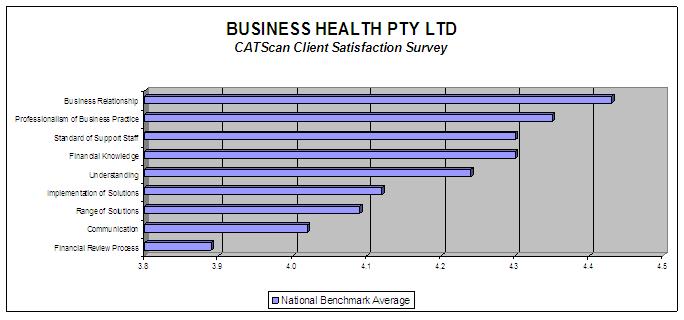
In particular, as the following table indicates, out of the nine key performance areas covered by CATScan, the key area of client communication ranks relatively poorly. And it’s not only the ratings that suggest improvement is very much needed in this area – the written comments that clients make support this conclusion. Clients expect to receive more meaningful information about their advisers and their practices, and they want that information communicated to them in a meaningful and timely way.
Meaningful and timely communication
Your clients have entrusted their financial well being to you and your practice, so it’s likely that they have confidence in your technical ability and expertise. Otherwise they would not be your client! So they certainly expect you to communicate issues that affect their financial plan – changes to regulation, the investment market and so on.
But CATScan feedback also tells us that they’re looking for their trusted adviser to provide constant reassurance of the relationship. They’re interested in being kept informed as to what else is happening within their adviser’s business; what changes are occurring and why.
A sale or merger of one practice to another is a key trigger we’ve noted that can result in negative client feedback. Even something as simple as a change of name (without any change whatsoever to the practice itself) can still create bad vibes, while a change in personnel (especially a key client relationship person) can certainly set off alarm bells in the client’s mind.
As to the issue of timeliness… it will be commonsense to all of us, that the client should be told of any change before they hear of it elsewhere. There is nothing worse for a client than to ring their adviser’s office and be informed after the event that there has been a change of company name or, worse still, that their favorite client service person has left the practice! Yet it is not uncommon for a CATScan report to contain a number of such comments from clients when these changes have occurred.
With modern technology, surely it isn’t too difficult to send an email advising of a change – it’s quick, efficient and cost effective. And with over 80% of clients using the internet, email has fast become an acceptable form of communication for most. Further, why wouldn’t you place a change communication on your website for all to see?
Finally, your very best (“A” class) clients merit a phone call, if not from their adviser directly, then at least from the practice, advising of a change. What a great opportunity to further build on the relationship!
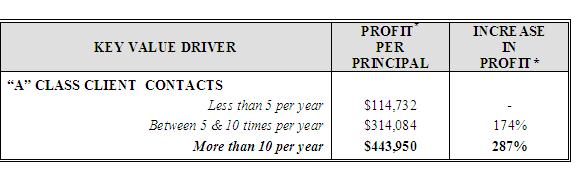
By communicating in a timely (proactive) fashion, you should be able to turn any potentially negative situation into a positive. And, as the following table indicates, the more points of client contact, the better the commercial result!
Regularly seeking feedback from your clients is always desirable, but it is particularly important to check client attitudes before and after changes of ownership and at times of extreme market volatility.
Mergers and acquisitions
Recent announcements by several major institutions indicate that the appetite of the past several years’ for acquisition, merger and consolidation is set to continue unabated. And while we’ve no doubt that such initiatives are always intended to be in the best interests of the shareholders, feedback from client satisfaction surveys (CATScan*) would suggest that the change process could often be handled more effectively from the client’s perspective.
It’s important to appreciate the golden rule of client services – the client’s perception is your reality! At the end of the day, it’s what the client thinks that matters ……professional relationships are developed and maintained on trust. Your technical expertise is expected and, in our view, is the “ticket to the game”.
Volatile markets
Good communications are vital in times of increased market volatility and poor investment returns. So, if your clients truly are your most valuable asset, why is it that over two thirds of all Australian advisory practices have no structured approach to actively seeking feedback, in good times or bad, but approach the job in an ad hoc and frequently amateurish way?
Given the tumultuous investment markets of late, why haven’t the 70% of practices taken any action? Could it be that:
- principals don’t know how to construct and implement a survey capability (or don’t know who can help them do it)?
- it simply doesn’t rate as highly as other pressing work priorities?
- it all gets down to cost at the end of the day – can a practice afford the cost of implementing a client survey?
- principals assume they already know what their clients think?
- “ignorance is bliss” and some principals just don’t want to know?
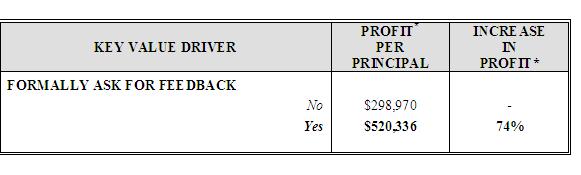
These are all commonly expressed reasons and (except for the last one) and all have some degree of validity. However the following table clearly demonstrates that the practices that invest the time, effort and money to find out what their clients are thinking, not only strengthen their relationships, but also generate (on average) a 74% increase in bottom line profit.
Methods of discovering client attitudes
There are a number of different ways to seek feedback from your clients, each with its pros and cons. The main ones are summarised below.

Tips and traps when surveying clients
Regardless of the survey method adopted, here are 10 rules that will help to maximise the benefit of your survey.
- Don’t embark on this process unless you are serious about doing something with the results – client feedback that is ignored or discounted can do more harm than good.
- Only include clients whose opinion you value – then you will be compelled to act on the findings.
- Ensure you are able differentiate your “A” class (or very best) client responses from the others – these are your most valuable clients and it is vital to know how satisfied they are.
- Adopt a structured approach – it is hard for a client to give you an objective assessment (good or bad) when you have just bought them a drink at a Christmas function!
- Guarantee your clients confidentiality and anonymity – this will ensure completely honest (and sometimes brutally frank) feedback.
- Don’t just consider your findings in isolation – benchmark your results against your peers and colleagues, past results and, best of all, best in class practices.
- Ensure you thank your clients for taking the time to provide you with their feedback – no-one likes to think their efforts have been taken for granted. A little thank you goes a long way.
- Share your results with your clients, prospects, referral partners and of course your staff – post selected extracts to your website, include a summary in your next newsletter. Incorporate testimonials into your marketing/promotional material, but seek permission first!
- It is not set and forget – your first survey will create a baseline from which you will be able to measure your progress over time. We recommend that you conduct client surveys at least on an 18 month to two year cycle.
- When you act on the key findings always remind your clients that the changes are a direct result of their feedback.
Conclusion
Many business leaders have commented on the importance of putting customers first, and of really understanding what they like and how they think. The retailer Marshall Field said “Give the lady what she wants”, and the way to find out “what she wants” is not to assume, but to ask.
Rod Bertino is a partner and director of Business Health Pty Ltd, a consulting firm specialising in the financial services industry. Business Health develop and market a suite of unique and exclusive business diagnostic tools, including CATscan customised client surveys. To date, over 40,000 Australian financial planning clients have completed a CATScan survey.
Rod can be contacted at [email protected]
Note: The accreditation for this CPD article is no longer current. Please visit our CPD section for current CPD quizzes.


