
Oliver’s Insights: Outcome based investing – new ways of managing multi asset portfolios
Almost a decade ago I thought we had come into a world of lower and more volatile investment returns, after the well above average returns of the 1980s and 1990s. Ultimately the low return world view of earlier last decade was delayed for Australian investors by the cyclical rebound in growth assets into 2007.
However, it is now clear that a much tougher environment for investors is upon us. This, combined with a number of other developments, is likely to see the growth of funds focussed around delivering pre-determined outcomes for investors.
Conventional investment management
The investment management industry has periodically seen changes in the way clients’ funds are managed. Prior to the 1970s investment managers’ focussed on meeting absolute return targets, say 10% pa, over the long term. This reflected the long term nature of insurance and defined benefit superannuation schemes.
This changed radically in the late 1970s and 1980s, with the advent of market linked diversified funds (ie where fund values moved up and down with investment market values) and the shift to defined contribution superannuation funds. Heightened investor interest in the performance of their funds, increased regulation, more computing power and an expansion in the role of consultants all combined to result in the focus of investment managers becoming increasingly short term. Performance objectives were defined relative to benchmarks (such as the ASX 200 for Australian shares, or an aggregate of such benchmarks for a diversified mix of assets) and competitors via monthly performance tables.
In the 1980s this was focused on single manager diversified funds but morphed in the 1990s into assembling portfolios of different managers across and within asset classes. This in turn morphed into pre packaged multi manager funds.
While there have been iterations along the way, the conventional investment management model over the last 30 years has involved a diversified mix of assets, the key characteristics of which have been: assets split into growth and defensive with the proportion in each defining which age group of investors they are appropriate for; a heavy reliance on equities for growth funds; and risk and return measured against passive benchmarks and competitors. The focus on benchmarks and competitors led to a relatively narrow range within which asset allocations are moved around. In fact, the 1990s saw a decline in the importance of asset allocation as all assets provided pretty good returns together and under the sector specialist/multi manager model in many cases it just didn’t figure at all.
Challenges
Through the 1980s, 1990s and in Australia’s case up until 2007, the conventional model provided great returns for investors. Over the period 1983 to 2007, traditional Australian balanced funds provided an average return of 7.8% pa after inflation (or 11.9% pa before), compared to a very long term norm of 5.5% pa real. However, for a number of reasons we are likely to see growth in alternative approaches to managing diversified mixes of assets.
First and foremost is the change in the environment to one of lower and more volatile returns. The historical record tells us shares periodically go through periods where returns are poor such as the 1930s in the US, around the 1970s and over the last twenty years in Japan. After 25 years of well above average returns between 1983 and 2007 some sort of mean reverting slowdown was inevitable. The 1980s boost to asset values from falling inflation, deregulation and globalisation is long over. And now the aftermath of the global financial crisis in the form of extreme public and private debt levels in advanced countries, extreme monetary policy settings, greater government involvement in economies and markets and more twitchy investors who seem to see black swans around every corner, are resulting in lower returns and shorter, more volatile cycles.
Second, the role of benchmarks and competitors as performance objectives can be challenged when the benchmarks and competitors themselves are doing poorly. It’s also argued a focus on competitors can lead to a situation where fund managers fail to see the risks they are taking because they are so busy looking across at each other.
Third, the pigeon holing of assets into being either growth or defensive has the effect of limiting the assets managers can invest into and can prevent managers with skill from properly employing that skill.
Finally, conventional constraints around asset weights, the move to sector specialist models and/or the focus on picking managers has meant in many cases that there is too little focus on asset allocation. However, in a world of shorter and more extreme investment cycles, and more negative correlations between equities and bonds, asset allocation is becoming critically important.
New approaches
These forces are likely to result in the introduction and growth of funds using alternative approaches to managing multi asset funds. Critical aspects are likely to include:
- A move away from objectives defined around beating a benchmark and/or the competition to focussing on delivering required outcomes for clients. This could involve absolute return objectives, say inflation plus 5% pa for workers approaching retirement, or delivering a certain income yield, say 6% pa, for self funded retirees.
- Reducing the influence of equities in terms of their contribution to the risk of diversified portfolios. This of course is a bit like the holy grail of investment management and it needs to be recognised that listed alternatives to shares (such as commodities and credit) can often see their correlations to equities increase substantially in a crisis and unlisted alternatives (such as direct property, infrastructure and private equity) will always be constrained by their illiquidity. Nevertheless, if the return from equities remains constrained the pressure to reduce exposure to them and to focus on wider sources of return will likely continue to build.
- A move away from traditional notions of which assets are growth and which are defensive and using this as the primary determinant of risk to managing risk more actively, eg, by determining an acceptable level of risk and then assembling a combination of assets designed to meet that goal.
- Employing a more dynamic approach to asset allocation to move between assets with wider discretion to move the asset mix around. In a world of lower returns, greater cyclical volatility and a reduced correlation between shares and bonds, asset allocation will be of greater importance going forward. As opposed to focussing on short term market timing as undertaken by traditional Tactical Asset Allocation processes, this ideally should have more of a one to three year focus in order to take advantage of more extreme cyclical swings in investment markets. This is increasingly being referred to as Dynamic Asset Allocation, or DAA.
So in essence, the key elements of a multi asset fund managed along these lines would be an absolute return objective, say inflation plus 5%, a focus on overall risk rather than the simplistic growth/defensive categorisations, highly flexible Dynamic Asset Allocation capabilities and wide sources of market returns beyond just equities.
It’s early days yet, but it’s worth noting funds defined around meeting required client outcomes and absolute return objectives are seeing strong growth in the UK.
What does all this mean for investors?
None of this is to stay the conventional approach to managing diversified portfolios is wrong or that a high allocation to shares is not appropriate for long term investors. Managing funds to a pre-agreed benchmark has the key advantage that it makes it easy for investors to know what they will likely get over the long term in terms of risk and return. What’s more the growth/defensive categorisation is simple and easy to understand.
And there is no evidence that shares have lost their long term ability to deliver for investors. Over the very long term, shares have provided higher returns than cash or bonds.
This is illustrated in the next chart for Australia which shows the total returns from Australian shares, bonds and cash from 1900. Despite numerous disasters along the way, such as World Wars, the Great Depression, the stagflation of the 1970s, 10% plus unemployment and a major financial crisis in the 1990s in Australia, $1 invested in Australian shares in 1900 would have risen to $267,877 by last month with a compound return of 11.9% pa. By contrast, the compound returns of 4.6% pa and 6% pa for cash and bonds would have seen $1 invested in these assets rise to a fraction of this. It’s been a similar story in other comparable countries, although not quite as good for shares as it has been in Australia.
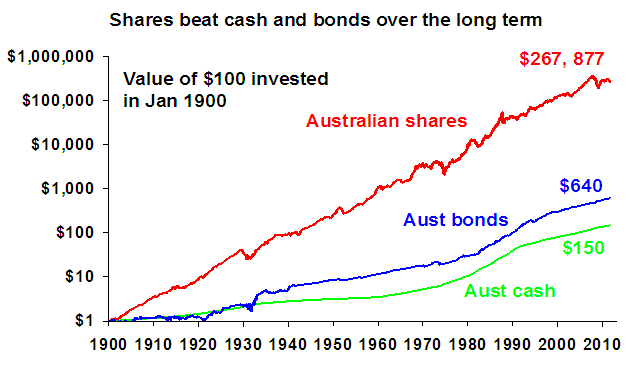
The current events in Europe and the US may seem unique, but the same was said of economic and political debacles of the past. If the past is any guide, we will get over it and in time shares will resume their long term upswing. History may not repeat itself but it does rhyme. So for long term investors – who are not affected by short term volatility and have sufficient capital to support their needs even in the event of market falls – then a bias to shares is the way to go and traditional diversified funds remain appropriate. And all the noise currently surrounding markets should be looked through as just that – albeit it seems a bit “noisier” than most have been used to.
However, for investors with a shorter term investment horizon, who want a smoother ride in their investment portfolio or have specific income needs then funds with an absolute outcome based focus are worth considering.


