
Oliver’s Insights: the Australian dollar and Europe
A year ago I thought the $A would head up to around $US1.10. Having done that, it has been messy since mid year with the $A falling just below $US0.94 in September before recovering back above parity in October.
Where to from here? Is the upswing from $US0.48 in 2001 now over?
The $A moves with other growth trades
In recent years short term swings in the Australian dollar have become highly correlated to other growth oriented risky assets like shares. This is clear in the chart below which shows the Australian dollar against the US share market.While the longer term trends in each differ (up for the $A, down for US shares) each time shares have taken a decent hit so too has the $A – falling 39% during the GFC, 13% during last year’s double dip worries and 14% recently.
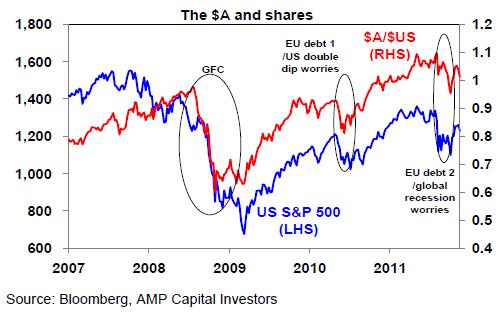
There are three key reasons for this sensitivity. First, because 70% of Australia’s exports are commodities the $A is seen as a commodity currency. Whenever there are concerns about global growth and shares take a hit, commodity prices also take a hit and so too does the $A.
Second, in times of economic uncertainty investors unwind so called ‘carry trades’. These involve borrowing in Yen or $US at near zero interest rates and parking the money in higher yielding currencies like the $A. When they are reversed during times of uncertainty, it pushes the $A down.
Third, the $US is seen as a safe haven currency (perversely given America’s debt problems). Since a big chunk of global trade and lending are conducted in US dollars, demand for them goes up in times of uncertainty. The $US strength in times of stress also pushes commodity prices down as most are priced in US dollars which in turn weakens the $A.
If anything this correlation with shares for the $A may intensify as more investors cotton on to the importance of macro economic issues in driving global investment markets and so see investing in terms of ‘risk on’ (buy shares, commodities and commodity currencies in good times) and ‘risk off’ (do the opposite).
Europe getting worse
It’s likely the $A’s vulnerability will remain high for some time. Europe looks terrible, with any relief provided by the EU’s latest policy response now being blown apart by political instability in Greece and Italy. While the EU’s latest response to its debt problems – of implemented – may help head off a worst case financial blow up it does nothing to break the vicious spiral of fiscal austerity, economic contraction, budget blowouts, market panic, more fiscal austerity, etc.
Current indications are that Europe is on track for recession. But it’s also driving social and political dislocation on an immense scale, as seen recently in Greece and Italy. Italy’s slide into the abyss since July is particularly worrying as it accounts for 17% of Euro-zone GDP and 23% of its public debt, and European banks have a near $US800bn exposure to it (as opposed to a $US130bn exposure to Greece). Italian elections will only lead to more uncertainty and delay. Italian bond yields have now reached levels that if sustained will turn its problems into a solvency crisis just like Greece. They have now surged past the levels that forced Ireland and Portugal to seek assistance.
The crisis is creeping further and further into the core of Europe with France also coming under pressure. The best way out of this would be for the ECB to commit to unlimited bond buying and significant monetary easing, but it is still not prepared to do this. What’s more there is increasing talk of a break up of the euro. All of which means continuing volatility out of Europe for some time to come, with an obvious threat to global growth, commodity prices and the $A.
From the short to the medium term
Pulling back from the myopic focus on the tragic soap opera unfolding in Europe and the short term vulnerability this implies for the $A, the medium term outlook for the Australian dollar remains strong. This reflects two key forces – long term commodity demand out of the emerging world and ultra easy monetary policy in the US, Europe and Japan.
Commodity story remains alive and well
While commodity prices have fallen sharply over the last few months the longer term trend remains up. Rising supply is likely to slow the uptrend in real commodity prices in the years ahead, but, abstracting from cyclical fluctuations, demand is likely to be strong, driven by rapid industrialisation in emerging countries.
Emerging countries are now passing through the $US3000-10,000 per capita income range that normally sees a sharp spike higher in demand for consumption goods. Last year, 50% of the population in emerging countries fell in this range.
Related to this, over the next few years around half a billion people in emerging countries will enter the middle class, adding to demand for consumer goods.
The potential raw material demand is highlighted in China. Despite massive investment, China still has a long way to catch up in terms of infrastructure and consumer goods. The following table compares China to the US.
On a per capita basis, roads, railways, phone lines, living space and cars are well below US levels. Indian levels are a fraction of China’s. This implies a huge catch up still ahead which is likely to continue to be driven by urbanisation, strong productivity growth and surging consumer demand – mainly in China, but increasingly in India.
As the catch up occurs it will result in increasing demand for commodities. The following table compares annual commodity consumption per person in China and India with that in Korea, Taiwan and the US.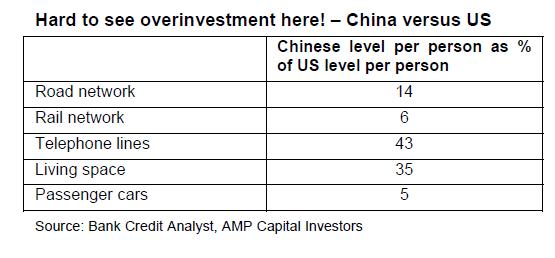
On a per capita basis, roads, railways, phone lines, living space and cars are well below US levels. Indian levels are a fraction of China’s. This implies a huge catch up still ahead which is likely to continue to be driven by urbanisation, strong productivity growth and surging consumer demand – mainly in China, but increasingly in India.
As the catch up occurs it will result in increasing demand for commodities. The following table compares annual commodity consumption per person in China and India with that in Korea, Taiwan and the US.
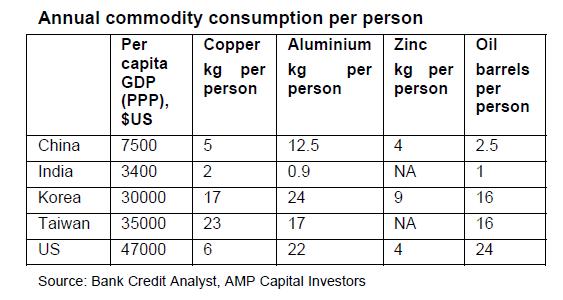
The historical experience suggests commodity consumption normally peaks once per capita income (adjusted for purchasing power parity) of $US25,000 is reached. However, China and India are well below this. So as per capita income in these countries continues to grow, it implies a further significant increase in global commodity demand, particularly so given their 2.5bn population. India is running around 10 years behind China in terms of commodity demand but it has a similar demand potential in the decades ahead.
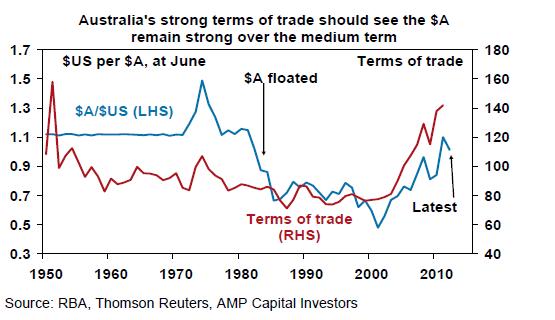
This all implies that, while Australia’s terms of trade may have peaked for this cycle following the recent fall in commodity prices, it is likely to remain at very high levels on a longer term basis, which in turn is likely to see the Australian dollar remain strong. In fact, even if the terms of trade just averages around current levels it implies the potential for more upside in the $A over the medium term.
Interest rates and monetary policy
While the RBA may be easing and may indeed ease further, other countries are also easing and likely by more. The public debt problems in Europe, the US and Japan – and resultant budget cutbacks and tax hikes – are likely to constrain growth in these countries for years to come.
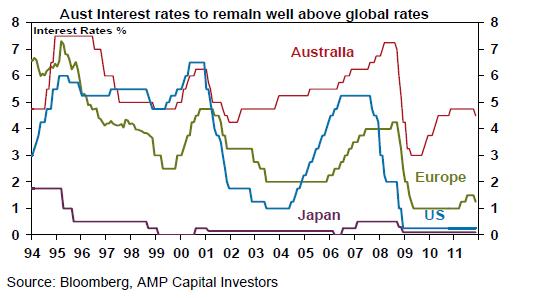
This is likely to see interest rates stay near zero for at least the next two or three years. It is also likely to see further quantitative easing (ie using printed money to buy up government and other debt in order to boost the money supply). The UK started another round last month, Japan is continuing on a modest scale, the US is likely to follow in the months ahead and while the ECB professes it won’t, it probably will have to as Europe slides deeper into recession. The net outworking of all this will be to put ongoing downwards pressure on the value of the $US, Yen, Euro and British pound against other currencies. On the flipside, monetary easing in Australia is likely to be limited, reflecting the relatively stronger Australian economy. The end result will be that Australian interest rates will remain well above those available in traditional advanced countries (providing an inducement to park funds in Australia) and the supply of US dollars, Yen, euros and pounds will rise relative to Australian dollars – all of which will result in long term upwards pressure on the $A.
 Conclusion
While the Australian dollar remains vulnerable to further weakness in the short term on worries about global growth, particularly on the back of Europe’s debt problems, on a medium term basis it is likely to remain strong on the back of emerging world commodity demand and relatively high interest rates and tight monetary conditions in Australia.


