
Worries about Europe have flared up again with Berlusconi gaining in the polls in Italy ahead of elections in two weeks and corruption allegations against the Spanish Prime Minister.
- However, it’s hard to see Berlusconi getting enough votes to return as PM with the most likely outcome being a Social Democrat led government relying on the support of Mario Monti and his party. In Spain the worst case outcome is likely to be a new PM, but the same Government. In other words, although the risks have gone up a bit the most likely outcome remains a continuation down the reformist path and gradual further settling of Euro-zone risks.
- In Australia, there were no surprises from the Reserve Bank which left interest rates on hold, but with downwards revisions to its growth forecasts and benign inflation forecasts indicating a clear easing bias. With global conditions improving, China looking stronger, share markets up, house prices starting to rise and the cash rate having fallen by 175 basis points we are likely nearing the end of the easing cycle. However, another couple of rate cuts taking the cash rate to 2.5% are still likely to be required.
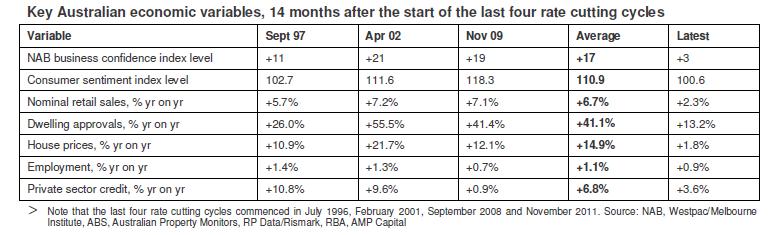
- The mining investment boom is slowing rapidly and most bank lending rates still look too high to drive a decent recovery in sectors like housing and retail at a time when the $A remains strong. As table below highlights, most economic indicators remain far weaker than they normally are this far into an interest rate easing cycle, suggesting monetary conditions are still too tight. Over the past week this was highlighted by poor readings for retail sales, dwelling approvals and job ads.
Major global economic events and implications
- Most US data releases remain consistent with reasonable growth. The ISM non-manufacturing conditions index remained strong in January, weekly mortgage applications are continuing to trend up, weekly consumer confidence readings are strong, the trade deficit fell sharply in December pointing to an upwards revision to December quarter GDP growth and banks are continuing to ease lending standards.
- US December quarter earnings remain reasonable. With 340 S&P 500 companies having reported 75% have beaten expectations on earnings and 67% have beaten on sales, both of which are above long term averages.
- Both the Bank of England and the ECB made no changes to monetary policy, but retained easing biases and ECB President Draghi expressed concern that strength in the Euro could hamper growth. The Euro’s recent strength reflects tighter monetary conditions in Europe than elsewhere and reduced risk that it will fall apart. While the ECB is unlikely to intervene to push the Euro lower, continued strength could be a trigger for further monetary easing. For now Draghi’s jawboning has helped cap it. Final European business conditions PMIs for January were revised reinforcing their rising trend and German factory orders also came in better than expected.
- Strong Chinese exports, imports and lending growth in January add to evidence of an upswing in China, but also need to be interpreted cautiously given distortions often caused by the Chinese New Year.
- A surge in Japanese economic confidence adds to evidence that policy reflation may be working. The Finance Minister wants to see a slower pace of Yen depreciation but it’s still likely on its way to 105 against the $US.
Australian economic events and implications
- While Australian house prices rose solidly in the December quarter and the trade deficit shrunk other data was pretty weak. Retail sales fell for the third month in a row in December with annual growth falling back to just 2.3%, building approvals unexpectedly fell, job ads fell again and part of the reason for the fall in the trade deficit was a sharp fall in capital goods imports.
- While employment surprisingly rose in January, full time employment actually fell and total employment growth is running at just 0.9% year on year. While unemployment was unchanged at 5.4%, its worth bearing in mind that if the participation rate had not fallen from its 2011 average of 65.5% to now 65%, unemployment would now be 6.1% highlighting the underlying weakness in the labour market. Weak job advertisements point to further softness in employment ahead.
- While December half profit results were ok with 61% beating expectations (against a norm of 44%) and most reporting profit gains, it’s too early to draw any conclusions as only a few companies have reported so far.
Major market moves
- While European shares fell over the past week on concerns regarding Spain and Italy, US shares rose another 0.3% and are now just 3% away from a record high. Chinese and Japanese shares rose but Asian shares were mixed. Australian shares rose 1% on the RBA’s easing bias, a lower $A and good news on China.
- Commodities were mixed and talk of more rate cuts weighed on the $A. The Euro fell on the back of ECB President Draghi’s concerns about Euro strength.
- Bond yields backed up in Spain and Italy, but fell a bit in the US, Germany and Australia on investor caution.
What to watch over the next week?
- In the US expect soft January retail sales (Wednesday) reflecting the increase in payroll tax but modest gains in industrial production, consumer sentiment and the New York Fed’s regional manufacturing index (Friday).
- Euro-zone GDP (Thursday) for the December quarter is likely to show a continued mild recession. Fortunately, PMI and confidence readings suggest the recession may be starting to be weaken.
- Japanese December quarter GDP (Thursday) is expected to show a return to modest growth with a 0.1% gain. The Bank of Japan also meets Thursday, but is unlikely to announce further quantitative easing until the new Governor takes over in April.
- In Australia, expect a modest gain in housing finance (Monday) continuing a gradually rising trend. Both the NAB’s business confidence survey (Tuesday) and Westpac’s consumer sentiment survey (Wednesday) will be watched for further signs as to whether interest rate cuts are starting to get more traction.
- December half profit results will start to flow in earnest in Australia with 30 major companies due to report. Overall, expect earnings to remain weak with conditions starting to stabilise.
- Resources sector earnings are expected to have fallen further as commodity prices fell to their lows during the December half, but financials and industrials are likely to see modest positive growth. After sharp downgrades to earnings expectations for 2012-13, to show near zero growth, the risk of another round of significant earnings disappointment is low.
Outlook for markets
- February is often a soft month for shares after January strength and several hurdles may constrain markets in the month ahead including negotiations around US spending cuts due to kick in on March 1, Italian elections, corruption allegations regarding Spain’s PM and uncertainty around the earnings reporting season in Australia.
- However, any short term set back in share markets should be seen as a buying opportunity as shares are likely to head much higher this year. The positive momentum seen in recent months in share markets is indicative of a bull market, during which corrections are usually short lived and mild. The global growth outlook is steadily improving which should result in better momentum for profits.
- Global monetary conditions are ultra easy and getting even easier. Shares are likely to benefit from investors switching out of low yielding cash & bonds. Share market valuations remain reasonable. Australian shares will also benefit from RBA rate cuts starting to drive a pick up in the key cyclical parts of the economy. So notwithstanding the usual bumps along the way this all adds up to a positive backdrop for share markets.
- Our year end target of 5000 for the ASX 200 is already within striking distance, and while it’s likely to provide some short term resistance, it’s looking too conservative and likely to be breached soon. 5200 to 5300 is looking more likely for year end. Similarly the US share market is likely to hit a new record high within the next few months.
- Sovereign bonds have been a great diversifier and a great investment in recent years but are now very vulnerable as the year ahead is likely to see a rising trend in bond yields as global economic growth improves which will result in capital losses for investors in sovereign bonds.
- The outlook for the Australian dollar remains messy. Softish Australian data is a negative but growing quantitative easing in the US and now Japan is a positive. The likely outcome is for a $US0.95 to $US1.10 range.


