
Investors concerned by falling interest rates on cash and bonds but wary of the volatility of the sharemarket should consider the benefits of Absolute Equities, van Eyk Research says.
After the Reserve Bank cut the cash rate to a record low last week of 2.75%, with the possibility of more rate cuts to come, many investors will be wondering whether to heed the call of some commentators and put more of their money into higher yielding stocks to boost their income.
van Eyk Head of Manager Research and Deputy CIO Matthew Olsen said many investors were still wary of the share market but also recognised that current rates on bank deposits and government bonds were not enough to provide them with an adequate income. “We see in our business that many financial advisers and their clients are still particularly sensitive to any further volatility in shares four years after the onset of the global financial crisis,” Mr Olsen said.
van Eyk recently highlighted that, despite the relatively healthy yields still available on “quality” yield stocks, the ratio of the performance of quality stocks to the “value” end of the Australian market was the highest for ten years, suggesting there was an elevated risk that the trend will reverse.
Mr Olsen said the Absolute Equities asset class was an alternative worthy of consideration for investors who wanted exposure to the higher returns on offer in equities but at a reduced level of volatility or risk. The volatility of returns over time is the standard way of measuring the riskiness of an investment (van Eyk also carefully considers asset valuations and the potential for capital losses).
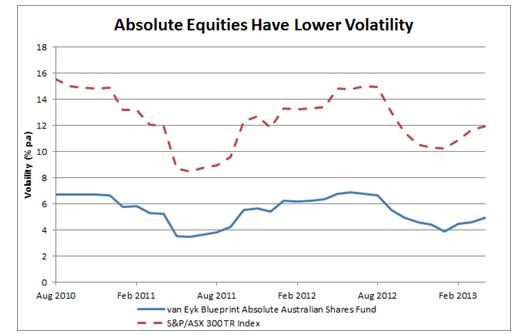
Fund managers in the Absolute Equities asset class aim to produce positive returns regardless of the direction of the share market, in part by adjusting their exposure to the market as conditions change.
“Absolute Equities have matured signicificantly as an asset class in Australia in the last five years and van Eyk’s highly rated managers in this sector have been producing healthy, positive absolute returns with lower volatility than pure shares,” Mr Olsen said.
Absolute Equities will almost always underperform a strongly rising share market but many investors will find that to be an acceptable trade off because they are significantly less risky than a fully invested or “long-only” position in shares.
van Eyk’s Blueprint Absolute Australian Shares Fund, for example, achieved a return (after fees) of 9.28% during the twelve months to March 2013 compared to cash (UBS 90 Day Bank Bills), which had a return of only 3.58% in the same period. While it had a lower return than equities, the Blueprint Absolute Australian Shares Fund delivered its gains with less than half the volatility of the share market return.
“That means the Fund is much less vulnerable to drawdowns than the share market, or a long-only Australian shares fund, when equities fall,” Mr Olsen said. “So it offers investors a degree of downside stability while allowing them to participate in the upside potential offered by shares.”
Absolute Equities come under the umbrella of “Alternative” investments. van Eyk recommends investors have an exposure to Absolute Equities as part of a well diversified investment portfolio.


