
Consumer spending perspective
-

What did Australians spend their money in last year?
Retail trade in 2013: Over 2013 as a whole, Australians spent $264.2 billion at retail outlets. Spending was up 3.2 per cent over 2012 – the strongest calendar-year growth in four years.
- “New normal?” The 3.2 per cent growth in spending was just below the 5-year-average growth rate of 3.4 per cent. In real (inflation-adjusted) terms, retail trade grew by 2.3 per cent in 2012, just above the 5-year average of 2.1 per cent.
What does it all mean?
- Over the past decade, retail spending has lifted on average by 4.6 per cent while average growth over the past five years has been 3.4 per cent. The same shift has occurred if we look just at real (inflation-adjusted) spending: down from 3.3 per cent decade-average growth to 2.1 per cent over the past five years. Is this the new normal? Perhaps. Or just an ongoing response to the GFC and its aftermath. Aussies are saving more and spending less – at least less at home. The higher Aussie dollar has also meant that Aussies are travelling more and buying more overseas. Whatever the effect, retailers have found it tougher in recent years.
- But late in 2013, there were signs of a thawing. Real spending rose 0.9 per cent in the December quarter after a 0.8 per cent rise in the September quarter – the best back-to-back gains in 18 months. And retailers benefitted from a bit more inflation – retail prices rose 1.1 per cent in the December quarter – equalling the highest quarterly rise in 4½ years.
- The biggest winners in 2013 appear to have been in recreational good retailing (sporting goods, toys etc); clothing; and specialised food (butchers, bakers, seafood etc). Certainly sporting goods, clothing and cafes/restaurants did well in the final quarter of the year, no doubt buoyed by warmer-than-normal weather in many regions.
- The losers in 2013 were in newspapers/books; liquor retailing; and footwear. Aussies continue to shift online for news. The newspapers/books category is now the smallest category in retail trade. Thirty years ago it was bigger than liquor retailing, footwear, recreational goods, cafes & restaurants and pharmacy items. The drop in liquor retailing reflects longer-run trends by Aussies to focus on quality, rather than quantity.
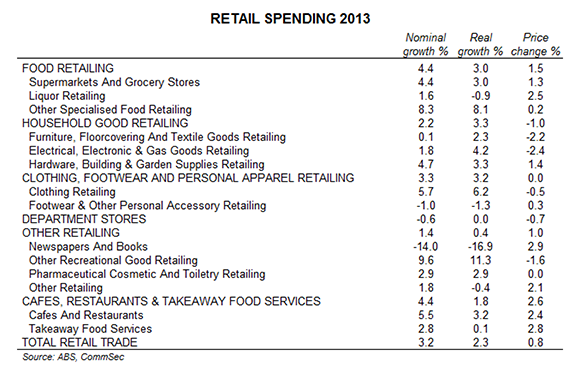
- In the December quarter, spending fell at hardware outlets, electrical good stores, newspapers & books and liquor retailers. No doubt the weather was so good, Aussies decided to get outside to beaches and parks as well as cafes & restaurants.
- Department stores had a tough 2013 with no real growth in sales and prices down by 0.7 per cent. But encouragingly in the December quarter, real spending at department stores rose by 2.4 per cent after falling in the two previous quarters.
- The lift in home purchase and construction translated to increased spending on furniture, carpets etc in the December quarter but at the expense of spending on renovations with hardware sales down in real terms. It is likely that these trends will extend into 2014.
- While retail prices were tame over much of the year, they did kick up in the December quarter – and not just in those areas affected by a weaker Aussie dollar. Prices at specialised retailers like butchers lifted 2.8 per cent, prices of newspapers & books rose 1.2 per cent despite weak sales; prices at liquor retailers rose by 1.2 per cent; and takeaway food prices rose by 1 per cent.
What are the implications for interest rates and investors?
- There is a bit more of a spring in the step of Aussie consumers. Spending has picked up, especially now that the election is out of the road. But warm spring and summer weather have also encouraged seasonal purchases. No doubt some home owners have been encouraged to spend via the wealth effect of higher home prices. Still renters and budding home buyers are probably less chipper and are saving more to pay the rent or housing deposit.
- The old adage is that a little bit of inflation is a good thing. Consumers are spending more and retailers are more confident to edge prices up. Provided it is only a little bit of inflation, the Reserve Bank won’t be worried, nor does it appear worried at present. But increased consumer spending and a bit more inflation support the Reserve Bank’s neutral monetary policy stance.
- Some retailers are toying with the prospect of passing on higher costs in terms of higher prices. But care will need to be taken as consumers are quick to switch affections on what they buy and where they spend their money.
- The soft job market and wage outcomes will keep a cap on spending early in 2014. But if the current momentum is maintained in the broader economy, then job growth and wages will lift over the year, offsetting some moderation in growth of home prices and thus wealth effects.
- Household goods retailers will continue to benefit from the increase in home purchase and construction with Aussies fitting out their new abodes with furniture, carpets and curtains. But hardware sales will be constrained. While paint sales may rise, demand for renovation materials and services will moderate.


