
Weekly petrol prices; Credit and debit card lending
-
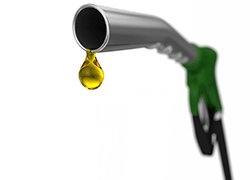
Petrol prices down but price volatility difficult for retailers.
Petrol prices ease: According to the Australian Institute of Petroleum, the national average Australian price of petrol fell by 3.2 cents per litre to 149.1 cents a litre in the week to April 13 – a four month low.
- The average credit card balance rebounded from a 4-year low in February, lifting by $58.70 (1.9 per cent) to $3,205.60. The average credit card balance was still 2.3 per cent below a year ago.
- The number of ATM withdrawals hit the lowest levels in almost 11 years in February (lowest since June 2003), falling by 5.2 per cent to 57.3 million. The number of withdrawals is down 4.5 per cent on a year ago. The value of ATM withdrawals fell by 7.9 per cent in February to a 7-year low of $10.8 billion.
What does it all mean?
- The volatility in petrol prices across capital cities doesn’t appear to be helping anyone, just confusing motorists and making life difficult for retailers. The good news is that pump prices fell to four-month lows last week and, thanks to the recent resurgence of the Australian dollar, it should hold steady around these levels.
- However the volatility of the discounting cycle is unfortunate for motorists in capital cities like Sydney, Melbourne and Brisbane as it likely to result in higher prices over the Easter Holiday period. Given the vagaries of the discounting cycle, petrol prices are likely to lift to peak levels in the next couple of days, and effectively hold at the higher levels over the Easter long weekend. If there is some consolation it is that the low point in the cycle is likely to be around mid-next week – in time for the Anzac day long weekend.
- The average Australian uses plastic to make their purchases almost 18 times a month, a 50 per cent increase over the past decade. While we are still using our credit cards more often than debit cards (10 times a month compared with around 7 times), the gap is closing. At the same time, fewer Aussies are taking less cash out of automatic telling machines. In fact ATM withdrawals have hit the lowest levels in almost 11 years in February, a trend that has been in place for more than a year.
- Aussies are showing no sign of ditching their new-found virtue of financial conservatism. Credit card debt is subdued, fees are being avoided and consumers are more likely to use technology to make price comparisons before parting with their hard-earned money. While we are using our credit cards more often, we are paying off the debt, with the average balance down by over 2 per cent on a year ago.
- According to the Australian Institute of Petroleum, the national average Australian price of unleaded petrol fell by 3.2 cents a litre to 149.1 c/l in the week to April 13. The metropolitan price fell by 4.3 c/l to 146.0 c/l, while the regional average price fell by 1.1 c/l to 155.4 c/l.
- Average unleaded petrol prices across states and territories over the past week were: Sydney (fell by 3.6 cents to 145.5 c/l), Melbourne (down by 5.5 cents to 142.1 c/l), Brisbane (down by 6.4 cents to 146.0 c/l), Adelaide (down 5.6 cents to 143.7 c/l), Perth (down 0.6 cents to 151.5 c/l), Darwin (unchanged at 173.0 c/l), Canberra (down 0.1 cents to 157.6 c/l) and Hobart (down 0.1 cents to 160.8 c/l).
- Today, the national average wholesale (terminal gate) unleaded petrol price stands at 142.2 c/l, up around 0.6 cents over the week.
- Last week the key Singapore unleaded petrol price rose by US$2.50 (2.1 per cent) to US$121.40 a barrel. In Australian dollar terms the Singapore gasoline price rose by 19 cents or 0.2 per cent last week to $128.96 a barrel or 81.10 cents a litre.
- Figures from MotorMouth show that petrol prices in Sydney, Melbourne, Brisbane and Adelaide eased to the low point over the weekend. Prices are likely to ratchet higher in the next couple of days, reflecting the usual discounting cycle. Based on a gross retail margin around 9 cents a litre, the national petrol price should hold around $1.50 a litre.
What do the figures show?
Credit & debit card lending:
- Figures released from the Reserve Bank show that the average credit card balance rebounded from a 4-year low in February, lifting by $58.70 (1.9 per cent) to $3,205.60. The average credit card balance was still 2.3 per cent below a year ago. In smoothed terms (12 month average) the average balance was down by 2.6 per cent, unchanged on January but slightly down from the 2.7 per cent fall recorded in November (the biggest fall in 19 years of records).
- Of credit cards attracting interest charges, the average outstanding balance rose by $1.40 in February to $2,246.90. The average balance accruing interest is down by 4.6 per cent on a year ago. In smoothed terms (12 month average) the average balance was down by a record 5.5 per cent.
- The average credit card limit fell by 30 cents to $9,126.60 in February. The average credit card limit rose by just 0.3 per cent in the year to February.
- The average number of transactions on credit cards in February was 9.8, down from 10.6 in January and 12.5 in December due to seasonal reasons. In smoothed terms the average number of credit card transactions was 10.44 in February – a record high. The average purchase on a credit card was $136.72 in smoothed terms (average for the year to February).
- The average number of transactions on debit cards in February was 7.1, down from 7.7 in January and 8.7 in December due to seasonal reasons. In smoothed terms the average number of credit card transactions was 7.69 in February – a record high. The average purchase on a debit card is $55.62.
- The number of credit card cash advances fell by 8.0 per cent in February (value down by 1.0 per cent). In smoothed terms, credit card advances are down 1.0 per cent on a year ago and have consistently fallen in the past five years.
- The number of ATM withdrawals hit the lowest levels in almost 11 years in February (lowest since June 2003), falling by 5.2 per cent to 57.3 million. The number of withdrawals is down 4.5 per cent on a year ago. The value of ATM withdrawals fell by 7.9 per cent in February to a 7-year low of $10.8 billion, The value of withdrawals is down 1.8 per cent on a year ago..
- Weekly figures on petrol prices are compiled by ORIMA Research on behalf of the Australian Institute of Petroleum (AIP). National average retail prices are calculated as the weighted average of each State/Territory’s metropolitan and non-metropolitan retail petrol prices, with the weights based on the number of registered petrol vehicles in each of these regions. AIP data for retail petrol prices is based on available market data supplied by MotorMouth.
What is the importance of the economic data?
- The Reserve Bank releases data on credit and debit card transactions each month. The credit card figures are useful in highlighting consumer borrowing and spending trends.
What are the implications?
- The Reserve Bank will be encouraged by consumer conservatism. If debt levels are cut and price comparisons are regularly made when shopping, then inflation has scope to stay lower for longer, as do interest rate settings.


