
As clients get older they may need help with our daily living activities. The frailty of older age or some illnesses may make it harder to live independently without help from a spouse, family or aged care service provider.
The government subsidises a range of aged care services. And clients do not necessarily have to move out of their home to receive help as the government now subsidises more home-care packages which provide care in the client’s own home.
From a financial planning point of view understanding the fees payable is important to ensure clients can generate sufficient cash flow and meet all living expenses.
What does care cost?
Before a client can apply for either subsidised home care or residential aged care, they need to be approved by an Aged Care Assessment Team/Service. Further information is available here.
The fees for aged care in a government subsidised service from 1 July 2014 are shown in the diagram below but prices may index on 1 July 2015.

Example:
Alice lives at home with her husband and has been approved for a home-care package after 1 July 2014. She is fully self-funded and does not qualify for any age pension. Together they have $80,000 a year of assessable income. On her share of the income ($40,000) it is estimated that Alice will be asked to pay:
- Basic fee – $3,493 per year, plus
- Care fee – $6,708 per year[1].
Note: This is based on rates estimated to 30 June 2014. At this date, a member of a couple (where both living at home) can have assessable income up to $19,172 before an income-tested care fee is payable.
Reducing the care fee
When calculating the fees, assessable income includes amounts received from Centrelink or Veterans’ Affairs as well as assessable income from assets and investments using Centrelink income test rules. For example, cash, term deposits and shares will be assessed under deeming rules.
Clients may be able to structure their investments in a way that reduces assessable income to reduce the fees they will be asked to pay. Before making a recommendation it is important to review the client’s full situation to ensure sufficient cash flow can be generated and to determine the impact on their net wealth.
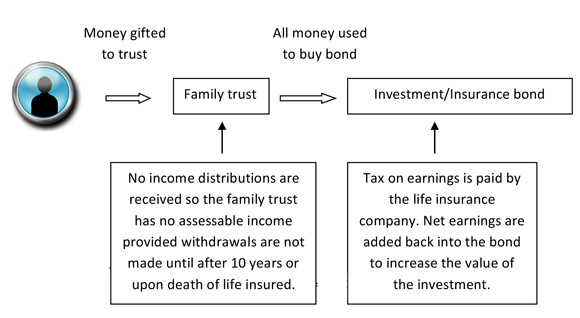
If a client is likely to pay a high care fee, you may wish to consider recommending that the client sets up a discretionary family trust and gifts money from their name into this trust. The trust can then invest this money into an investment/insurance bond which pays no income to the investor directly. All income is reinvested into the bond which is taxed at 30% under current tax law. This will not change level of the client’s assessable assets however it might help to reduce assessable income which is calculated as the actual taxable income generated by the family trust. As long as the client/trust does not make withdrawals from the bond within the first 10 years (or until death of the life insured) there is no taxable income for the trust.
This is shown in the diagram below.
Example:
Alice seeks advice on how to structure investments to pay the additional expenses for home care. The advice provided is to set up a family trust and transfer enough of their investments into the trust to reduce the income-tested care fee to nil.
This saves her $6,708 per year and she will now only pay the basic fee of $3,493 per year.
In the first year Alice will incur some expenses to set up the trust and investment strategy. She may also incur ongoing fees for reviews and operation of the family trust. The insurance company pays tax at 30% which may be higher than her personal tax rate but it is the after-tax return which is important to compare.
It is important for Alice and her husband to ensure this strategy leaves them enough cash flow (or cash reserves) to pay their living expenses because to benefit from these savings they are limited in their ability to make withdrawals from the family trust.
Alice and her husband also restructured their wills and estate planning due to this change in assets. Note that their Wills cannot dispose of assets held in the family trust so the trust must be structured with a mind to how the income and assets of the trust are to be distributed and to whom following the deaths of, in this example, Alice and her husband.
Note: This strategy may save a part-pensioner up to $5,000 per year and a self-funded retiree up to $10,000 per year. These amounts are per eligible person so savings could double if both members of a couple are accessing home care packages.
Developing an advice solution
Before clients make any changes to investments a review of their full financial situation is important. The savings in home-care fees needs to be considered in conjunction with cash flow, eligibility for Centrelink or concession cards, aged care fees, taxation and estate planning.
If a client is making a move into residential aged care, the same strategy may help to reduce the means-tested part of her care fees but as this fee is based on assets and income and the strategy only reduces assessable income the use is more limited. It will only provide a benefit if the means-tested part of the care fee can be reduced to below the annual cap and the savings outweigh any costs.
[1] Calculated as [(($40,000 – $36,624)/364) * 0.5] + $13.74 = $18.38 per day or $6,708 per year
——–


