
Much has been written about innovation and disruption. This article has been written by Jeffrey Cleveland, principal and chief economist at LA-based Payden & Rygel, manager of GSFM’s Payden Global Income Opportunities Fund. It discusses the notion of ‘Ubernomics’, the broader implications for economic progress and what the future might hold.
It’s Saturday night in Los Angeles. After dinner with friends, I find myself across town without a car, not a pleasant situation in the City of Angels. Unfazed, I pull out my smartphone, open an app, and see a cluster of cars—sedans, Suburbans, Escalades—idling nearby, awaiting my summons. With a few clicks, my problem is solved.
Minutes later a black sedan arrives. The driver hops out, greets me by name and opens the passenger door. I climb in eagerly. As I depart toward home, he offers bottles of fresh water, candy and mints, as well as news on what’s going on in the city.
Uber, a four-year old software platform that connects willing drivers with needy passengers via a smartphone app, is a startling success story in a sluggish economy. The fast-growing San Francisco-based company has attracted acclaim and become a verb in the process (as in, “I am Ubering over to your house right now”). Uber is available in 250 cities around the world, including Sydney and Melbourne, and boasts a private valuation of $40 billion.
As I settle back into the plush leather seats, I think to myself: a fleet of vehicles ready at a moment’s notice to ferry passengers anywhere they desire? It used to be such luxuries were reserved for Kings and American Presidents. Now an ordinary person like me enjoys the services.
What’s more, through an Uber trip, I gain a glimpse into the nature of economic progress and what the future might hold.
Taxis first
Getting a ride in Los Angeles wasn’t always so easy. I couldn’t hail a cab on the street. At the airport, I’d wait in a long taxi line regardless of where I was going. And, well, forget about trying to take a short trip within downtown Los Angeles—the cab drivers would become irate if my trip wasn’t a longer, Los Angeles International (LAX) airport ride.
Why was getting around so difficult? Experts blame a period of “privatisation” and “deregulation” that swept across the North American taxi markets in the 1970s and 1980s. A study of 43 American and Canadian cities showed that without local government “entry controls” (restricting the quantity of licensed cabs), the cab stand and hail market experienced an oversupply of cabs, leading to lower quality vehicles and drivers[1].
Meanwhile, dispatch services (where you call and request a ride from your home) were neglected by cabs. Why? It’s “capital intensive” to set up a dispatch company to answer calls from customers and send drivers to and fro to pick them up. One or two companies tended to dominate most cities due to the marketing advantage and name recognition. Wait times were extreme. Drivers often idled waiting for inconsiderate passengers. Trips were too short to make much money.
Yet Uber solves all of the above problems in an app on my phone. I can hail a cab from home, the restaurant or the airport. I can watch the car’s progress to my location. Even the pricing adjusts during peak hours or demand surges to entice more drivers to the area. Reading research published before 2008 drives home [pun intended] a key point: experts and insiders never anticipated the dramatic changes to an industry just over the horizon.
Software will replace regulation
It occurs to me on my ride home: should I be worried about the quality of my Uber driver? Shouldn’t a knowledgeable third-party (like a local transportation official) ensure quality and safety?
But then I realise, that’s the old way of doing business: apply for a license. In theory, by restricting supply with licensing leads to higher quality drivers and better service. Nice in theory, unfortunately it fails miserably in practice.
The new way: Uber requires a ranking of each driver after every trip and drivers receive an email with feedback each week from customers. Lower rated drivers are culled from the herd. Think about it: do you rely on a regulator when purchasing books or products from Amazon.com? No, you rely on friends, family and, most importantly, reviews. In particular, you depend on reviews from users of the products in which you have interest. The same is true for trips and hotels (think: TripAdvisor). Ratings replace regulators. Not only have regulators been replaced by software and ratings, the system is safer, fairer and more efficient.
When the car arrives at the door of my downtown apartment building, I bid my driver ‘goodnight’ and quickly jump out and head inside. Because Uber has already secured the payment information for both driver and passenger, no cash changes hands. No credit card swipes. No waiting for the payment hardware to connect to a faraway server. No paper receipts to sign. A receipt arrives via email moments later, including a map of our exact route and the opportunity to rate the driver and provide feedback on the trip and service.
I gave my driver 5 stars.
“The knowledge” problem
But my Uber ride was not perfect.
For starters, navigating Los Angeles was a challenge for my driver. He wasn’t familiar with downtown Los Angeles streets. Confusion about the address and cross-streets intruded in the otherwise smooth ride. Reluctance to rely on the GPS navigation required fumbling around to enter my address in a second phone.
But this isn’t a new problem. It’s age-old. In London, aspiring cabbies face years of learning “The Knowledge”—the codename for the maze of London streets and landmarks, with a particular premium placed on getting from A to B via the most efficient route[2]. To become a licensed cabbie, applicants must pass an oral examination including turn-by-turn navigation. To acquire such locational acuity, cabbies practice by zipping around London on scooter bikes until proficiency becomes second nature.
Mobile + maps = the new railroads
And, suddenly, I realised that it wasn’t just that the taxi experts’ lack of imagination or an absence of entrepreneurs that plagued the taxi market. Instead, it was the absence of two key ingredients that had yet to be discovered: maps and mobile.
Mobile computers in the form of smartphones are in the pockets of 3 billion Earthly inhabitants. The computing power of each embarrasses desktops processing speeds from just 2003, connecting us to the web and each other.
But mobile alone is not enough. Detailed maps and satellites that know my precise position must exist in order for services like Uber to work. How can you route a black car to a needy passenger without a GPS maps program guiding the way? By 2008, both ingredients were in place and that opened the door for a whole new way of doing business.
Is the phenomena described above new? In 1771, Arkwright’s mill opened in Britain, marking the start of the Industrial Revolution. By 1829, steam engines began running along the Liverpool-Manchester railway, as the railway age debuted. In 1875, the Carnegie Bessemer steel plant opening in Pittsburgh, Pennsylvania, signalled the dawn of the Steel Age. The Age of Oil and the Automobile dawned in 1908 with the Model-T. And, in 1971, in Santa Clara, California, the Information Age launched with the Intel microprocessor[3].
Each successive revolution created a new platform on which industry could flourish. Once railroads crisscrossed the United States and Great Britain during the 1800s, a whole new brand of industry sprung up on top – built as it were on the “platform.” Suddenly one could order merchandise from a catalogue and have it delivered over hundreds if not thousands of miles. And, of course, to consumers, it seemed like it could be no other way.
A new platform makes unforeseen businesses possible. It allows a market which did not exist before to bloom. A service which nobody predicted, built on a platform that did not exist just five years ago. This, ladies and gentleman, is the stuff of economic upheavals.
Have a car, will drive
In fact, the new platform allows more than just a town car to zip me home. Now that the platform exists, the “UberX” model became practical. Unlike Uber’s black car service, UberX allows any driver to become a provider of ride-sharing services. The development is astounding and goes further than you might imagine. It frees up time. It frees up resources. It frees up dead capital.
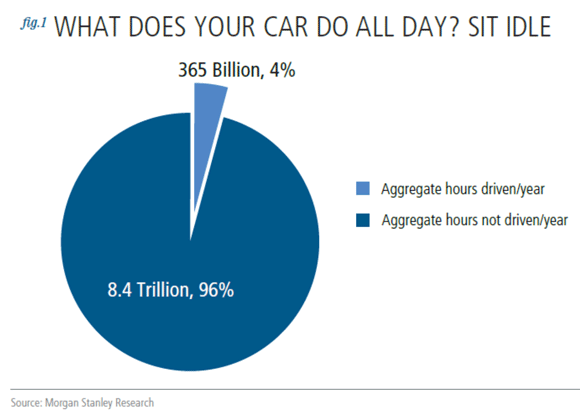
The average vehicle sits idle for 96% of the day—with the owner paying a car payment, insurance, maintenance, and parking fees (see Figure 1). Now, those vehicles are freed up to provide ride services. If anyone can be a driver, we no longer face a cartel of companies that operate in the town car space, anyone can apply. In 2014, drivers signed up at a rate of 50,000 per month.
Access more important than ownership
But why, I wondered, should I own a car at all when I can summon one more easily than ever? Could we be near “peak car” ownership (see Figure2)?
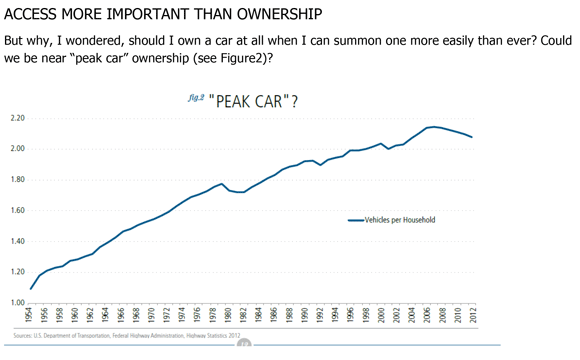
Access to a ride is more important than ownership. One way to think of the possible impact of ride-sharing on vehicle ownership is to compare it with the impact on bike sales in New York City after the adoption of the CitiBike bike sharing program. The CitiBike program allows you to easily borrow a bike from its convenient locations throughout Manhattan. While bike-sharing took off, bike retail sales suffered mightily. Bike sales are down at some retailers by 20-50% in the year since the program debuted, according to Bloomberg. Of course, even with Uber, cars are needed. But here’s the key: far fewer cars than when everyone drives themselves.
More importantly, access opens opportunity for all types of passengers. Cars can be shared by a group of car-poolers. The blind or disabled have more opportunities for mobility, without relying on others or public transport. Whereas before you had to own and operate a vehicle, now all you need is access to a smartphone to achieve mobility.
Lessons for thinking about the economy and the future
But, already critics have sprung up to opine on the negative impacts of sharing rather than owning on the economy. Some doomsayers have suggested Uber will reduce GDP[4]. In fact, to the extent that it frees up “dead capital” and ignites productivity, it will boost GDP.
The savings in my pocket from not owning, insuring, parking or maintaining a vehicle will be freed up to be spent elsewhere. Mapping and connecting services will supercharge efficiency and lead to lower prices for consumers across a broad range of services.
Imagine what an Uber-like function will do for other sectors, which many investors assumed were impervious to market forces. Uber-like software could unleash a bevy of new opportunities: from masseuses on demand to doctors on your doorstep. Any service you can imagine could now be connected, sans centralised authority. Call it the UberX model for the world economy: anyone can provide service X on demand. No longer do we need cartelised or centralised agency or third-party agency to provide service. Seek out service, contract person-to-person.
Think of the entire world economy as a knowledge problem—the same problem faced by our aspiring London cabbies. Information is dispersed. Resources and people are disconnected. But now software can help close that gap and bring the world together. I’m reminded of a quote by William Gibson: “The future is already here—it’s just not very evenly distributed.”
Prepare yourself for the Uber-future.
——-
Sources
- Bruce Schaller. “Entry Controls in Taxi Regulation: Implications for US and Canadian Experience for Taxi Regulation.” Transport Policy 14 (2007) 490-506.
- “The Knowledge, London’s Legendary Taxi-Drive Test, Puts Up a Fight in the Age of GPS.” The New York Times Style Magazine. November 10, 2014.
- Victor W. Hang. “Uber Will Lower GDP.” Forbes, October 21, 2014.
- Daniel M. Rothschild. “How Uber and Airbnb Resurrect Dead Capital.” The Umlaut, April 9, 2014.
Disclaimer: The information included in this article is provided for informational purposes only. The information contained in this article reflects, as of the date of publication, the current opinion of Payden & Rygel and is subject to change without notice. Sources for the material contained in this article are deemed reliable but cannot be guaranteed. We do not represent that this information is accurate and complete, and it should not be relied upon as such. Any opinions expressed in this material reflect our judgment at this date, are subject to change and should not be relied upon as the basis of your investment decisions. All reasonable care has been taken in producing the information set out in this article however subsequent changes in circumstances may occur at any time and may impact on the accuracy of the information. Neither Payden & Rygel, Grant Samuel Funds Management, their related bodies nor associates gives any warranty nor makes any representation nor accepts responsibility for the accuracy or completeness of the information contained in this article. ©2015 Payden & Rygel.


