
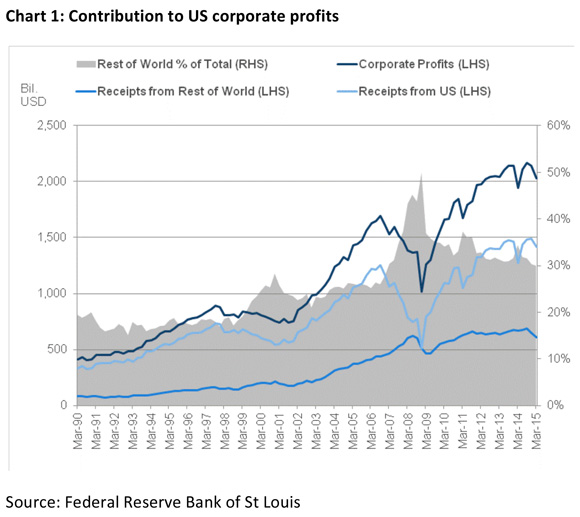
US corporate profits have been going sideways since 2013, with both domestic receipts (share of profits emanating from US) and foreign receipts (share of profits emanating from the rest of the world) struggling to make new highs. With the US Federal Reserve (Fed) likely to start an interest rate tightening cycle this year, it begs the question, will corporate profits in the US be able to rebound without a global recovery?
Foreign receipts have risen steadily since the 1990s, from roughly 19% of total corporate profits at that time to 30% in 2015, placing a greater reliance on international earnings for US companies (see chart 1). In our view, corporate profits may struggle to begin a sustainable increase without a global recovery that lifts foreign receipts. As a result, we are being cautious in terms of adding additional credit exposure to our fixed income portfolios until we see signs that corporate profits have begun to increase.
Why do corporate profits matter?
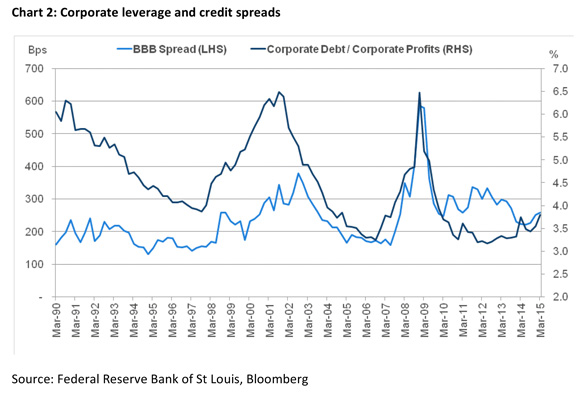
In the current environment, corporate profits are the key element keeping both leverage and debt serviceability in check. With corporate profits flat over the past two years, corporate leverage has increased since debt growth has remained robust. Chart 2 shows corporate debt divided by corporate profits, which has historically been a strong indicator of future spread performance. With no strong reason to assume a slowdown in debt growth, this demonstrates the importance of corporate profits. If corporate profits fail to increase at a sustainable rate, leverage will continue to rise and therefore bias spreads to widen. A large and sustained period of spread widening has historically been the precursor to a rise in corporate default rates. However, if corporate profits are able to sustainably grow, leverage will begin to fall, which would be positive for corporate spreads and reduce our concern over the potential for an increase in corporate defaults.
Main source of US corporate profits is the domestic component
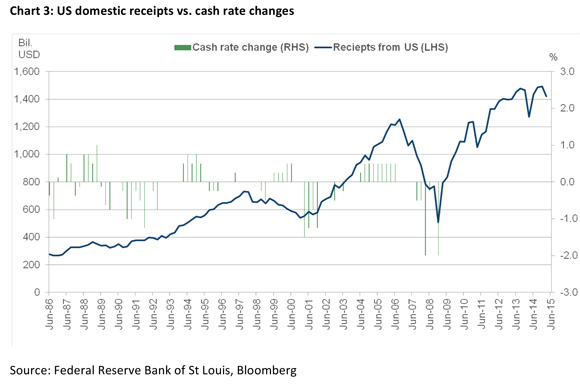
Although offshore economic growth is important, domestic activity remains the most important influence on the performance of US companies. Since the domestic outlook will have the greatest effect on the direction of overall corporate profits, we decided to analyse what effect a rate tightening cycle has had in the past on domestic receipts.
Historically, it is hard to determine if a Fed hiking cycle in and of itself is enough to slow domestic profits. There have been two periods since 1986 when a hiking cycle slowed domestic receipts (1987-1989 and 1999-2000) and two periods where domestic receipts have increased during the rate rises (1994-1995 and 2004-2006). While this gives mixed signals, a point to note is that usually the Fed has been increasing interest rates into a period of strong corporate profit growth, rather than an environment where profits have been stable for almost two years. The last period when we saw the Fed hiking into flat corporate profits was 1999 and this was one of the periods when domestic profits fell. So while domestic receipts won’t necessarily have to fall, rising interest rates will likely provide another headwind to already flat domestic profits.
US dollar is putting pressure on profits via overseas component
As shown in chart 4, corporate profits took a similar fall in the first quarter of 2014 as in the first quarter of 2015. While corporate profits subsequently rebounded quickly in 2014, the fall that occurred in 2015 may be highlighting larger problems. In the 2014 fall, the US Internal Revenue Service (IRS) made changes to depreciation allowances, which affected domestic receipts, but not foreign ones. The drop that occurred in the first quarter of 2015, however, saw a fall in both the domestic and foreign components.
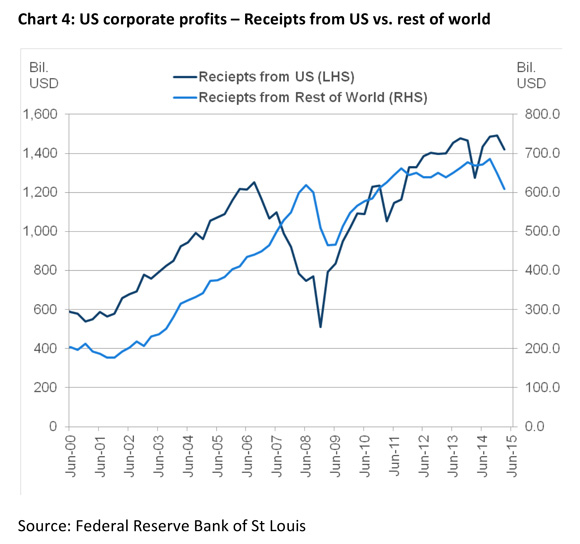
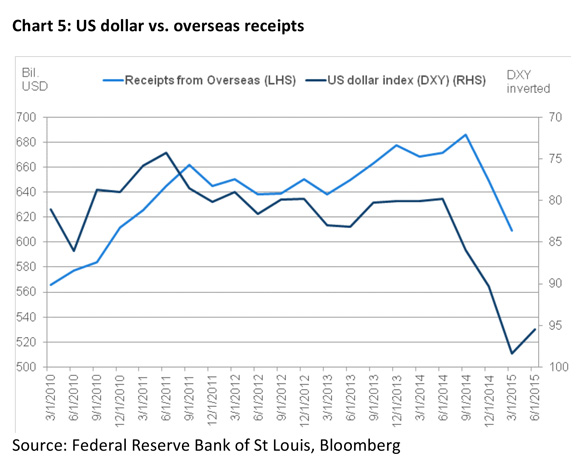
Over the past two quarters, receipts from the rest of the world have fallen back to 2010 levels and the driver of this is undoubtedly the stronger US dollar. Chart 5 shows receipts from the rest of the world compared with the US Dollar Index (inverted – a fall in the index line indicates that the US dollar is appreciating). As we can see, the foreign component began its decline as the US dollar strengthened, showing the effect of a rising dollar on corporate profitability. When the Fed begins its tightening cycle, the US dollar will be biased to rise. Without a return to growth globally, corporate profits will continue to be under pressure through this foreign component.
A further risk to corporate profits in the US would be emerging market (EM) weakness, which is highly correlated with oil and commodities. While this might not have been an issue in years gone by, we believe it is an area to watch in 2015 since US corporates have increased their exposure to the global economy.
There is a strong relationship between oil prices and EM sovereign and corporate credit spreads. As the oil price falls, the risk of these asset classes increases and with both oil and commodity prices down over 40% on the year, we can expect weakness in certain EM economies, which is likely to have a knock-on effect (to greater and lesser degrees) on US companies.
Conclusion
With one-third of US corporate profits coming from offshore, the path of global growth will be crucial for the performance of US companies. In our view, it seems questionable that corporate profits will be able to begin a sustainable increase without a global recovery that lifts foreign receipts. If the US dollar continues to rise without a global recovery, the domestic component will need to do all the heavy lifting in the face of headwinds imposed by the Fed’s tightening rate cycle.
This means that we are being cautious in terms of adding additional credit exposure to our fixed income portfolios until we see signs that corporate profits have begun to increase. While it is positive that corporate profits remain high by historical standards, they are lagging debt growth which is leading to increased corporate leverage. In this environment, we are looking to take a slightly defensive position by overweighting shorter-dated securities and being highly selective about going down the credit spectrum, seeking to find value names in lower-rated sectors through careful comparison of our fundamental credit view of an issuer and the pricing of its securities.
By Chris Rands, Fixed Income Portfolio Manager, Nikko AM
———–


