
“History doesn’t repeat itself, but it does rhyme” – often attributed to Mark Twain (1835-1910)
For investors outside China, whether they have holdings in Chinese shares or not, coming to a coherent investment view on the country has become imperative as it exerts an ever-increasing influence on global markets.
We believe that China’s economic riddle can only be explained as a once-in-a-century event – any shorter term perspective misses the wide-ranging and long-reaching implications. As Yngve Slyngstad, the CEO of the world’s largest sovereign wealth fund, has stated: “Every time I come back, my perception of China has changed…The uncertainty among investors is partially due to the very simple fact that it’s more difficult to know what’s happening in that large economy than in any other[1].” In our view, it is crucial that investors take a balanced and comprehensive long-term investment view on China, including the significant implications of the country’s current reform process.
Over the past few years, many investors have been concerned that deflation is taking hold in various regions of the globe (including China) and, as a result, that asset prices will fall. Although there is evidence that deflationary forces may be at work in Asia, investors should not conclude this will be negative for equity pricing. Such an environment can, in fact, be a positive for equity investing. We will present evidence for such an argument, drawing a parallel between the US’s emergence as an industrial powerhouse in the late 19th century and the current decade as China undertakes significant reforms in its attempts to take the economic lead. For investors that want to harness the unprecedented rise of Asia, with China at the forefront, we would suggest thinking like an entrepreneur in that gilded age of US history.
Is deflation necessarily negative for asset prices?
Deflation does not necessarily spell another Great Depression. According to a recent study by the Bank of International Settlements[2], “it is misleading to draw inferences about the costs of deflation from the Great Depression, as if it was the archetypal example. The episode was an outlier in terms of output losses”. According to their analysis, it depends on the driver of deflation. Deflation associated with a demand shortfall pushes down prices, incomes and output, whereas supply-driven deflations depress prices while raising incomes and output. The study notes that “in the postwar era, in which transitory deflations dominate, the growth rate has actually been higher during deflation years, at 3.2% versus 2.7%”. Evidence from Great Britain and the US during the second half of the 19th century shows that deflation driven by rapid technological advances can co-exist with economic growth.
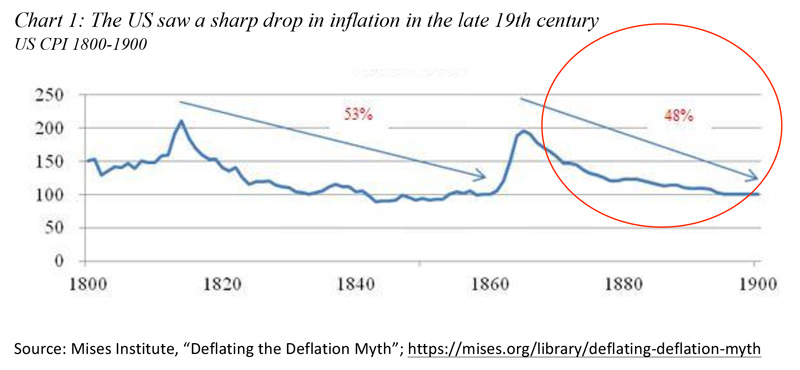
How does this link to Asia, and to China in particular? The answer is that China sits at the nexus of the deflationary argument. China’s rise as an economic superpower brings unprecedented manufacturing capacity into production, along with technological advances in energy and food production, communications and information industries. Together, these factors are conspiring to cause an oversupply of goods and excess capacity in many sectors. This is similar to the situation for the US when it rose as an industrial power in the late 1800s. Despite this period seeing a deflationary growth environment (see chart 1), US productivity rose due to the effects of technology, reform and increased competition. Equity investing in the key sectors at that time was, in fact, quite profitable (see chart 2).
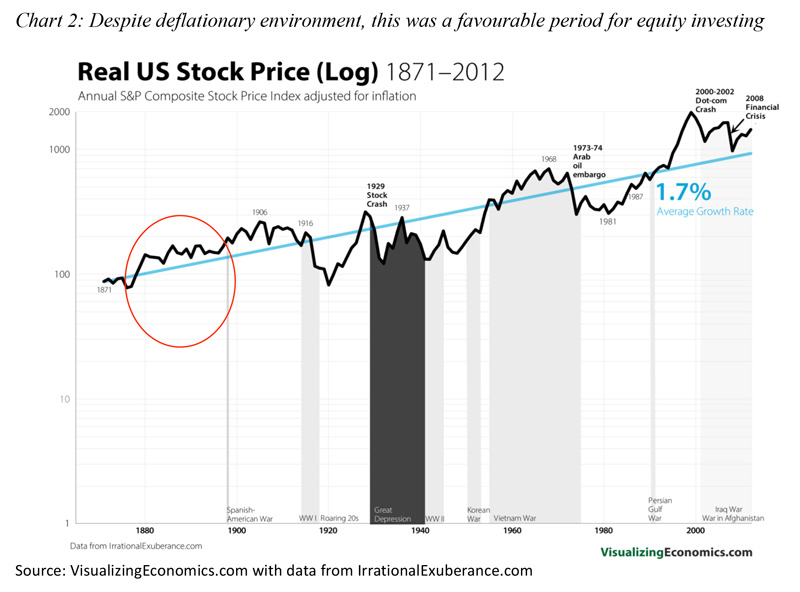
As chart 2 shows, while the period of the Great Depression was extremely poor for US equity prices, the period of deflationary growth between 1870 and 1900 (the era Mark Twain called the gilded age) was very favourable to equity investing. Deflation during the Great Depression was driven by the destruction of capacity due to a sharp fall in asset prices, bankruptcies and risk avoidance. We would argue that, similar to the late 19th century gilded age in the US, the factors that are currently driving a deflationary environment in many parts of the globe, including Asia, are supply-driven due to new industry capacity from China, as well as increased digitalisation in many industries, including manufacturing processes. Another driver of the global over-supply problem is the mispricing of many economic factor costs, such as interest rates and environmental protection costs. Interest rates have long been distorted by central bank actions and environmental costs have been largely ignored in economic decision-making.
Asia case-study: growth slowdown can spark a positive equity investing environment
More recent examples of supply-driven deflation can be found in Asia and they highlight that deflationary price trends can be positive for equity investing depending on the driver. Japan, Korea, and Taiwan all enjoyed episodes of economic success in the mid to late-20th century despite a deflationary environment.
The industrialisation experience of many Asian nations, including Japan, Korea, and Taiwan, follows a similar story, which is well documented in Joe Studwell’s book How Asia Works. Each of these countries, run by a strong government, pursues aggressive export-oriented economic policies, partially helped by a low exchange rate and fully exploiting its labour cost advantages. Successful industrialisation leads to years of extremely fast economic growth and high productivity gains. However, this success comes at the expense of subduing labour costs, interest rates, exchange rates and other industrial cost factors in favour of the exporting manufacturing sectors. The economic growth model, which encourages excess investment with a mercantilist mindset, becomes outdated as imbalances appear amid signs that economic growth is approaching an inflexion point. Factors pointing to a slowdown, or normalisation, of economic growth include higher wages, pollution factors, currency appreciation and increasing financial leverage from years of over-investing. To rebalance the economy, the government starts to liberalise the financial sectors by introducing free markets and lifting capital controls, while domestic consumption begins to pick up as industrial investment slows.
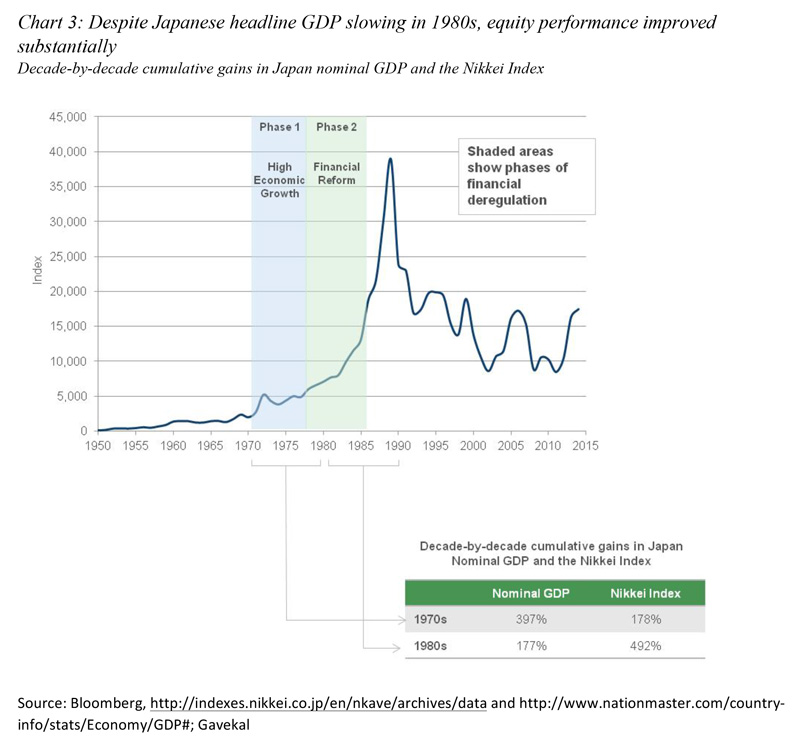
This scenario describes what occurred in Japan in the late 1970s to mid 1980s, and Korea and Taiwan in the late 1980s and early 1990s. It is also an accurate narrative of the economic environment in which Beijing has found itself in recent years. We can learn much about how to invest in China by analysing Japan, Korea and Taiwan in their transitional phases. While their best economic growth stories were written during a period of capital controls within a closed financial regime, all three countries actually saw some of their better equity market returns after GDP began to slow and financial reforms took hold as their governments worked to rebalance the economic model. The reform phase involves loosening capital controls, allowing exchange rates to free float and liberalising financial markets to enable more efficient allocation of capital. Despite headline GDP growth slowing considerably, it is during the second phase that equity performance improved substantially – in Japan during the 1980s (see chart 3), and Taiwan and Korea in the 1990s and 2000s.
Beijing has recently implemented a deposit insurance scheme and is about to liberalise interest rates to market forces. In addition, the Shanghai-Hong Kong Stock Connect (launched in November 2014) and talk of RMB full convertibility may be heralding a much more liberalised capital account. Domestically, we are seeing efforts to correct financial system vulnerabilities, promote market based risk-pricing and open up capital markets.
The introduction of the debt swap programme for local government financing vehicles is significant, representing one of the first steps in addressing more fundamental issues within China’s fiscal framework. The debt swaps should eventually give rise to more market discipline and more effective risk pricing, as well as improving financial markets’ perception of risk within the banking system. While the debt swap programme does not alter the trend for slower GDP growth, it should provide greater confidence in the country’s ability to deal with other well-documented issues and provides further evidence that China is entering the second transitional phase.
Conclusion: Understanding China requires a very long view
As with the US’s gilded age, China’s emergence as an economic superpower will distort many of the consensus economic conclusions drawn in recent decades. Particularly on the question of deflation, we think the outcome will be similar to America’s impact on the world economy in the late 19th century. China has and will continue to exert significant deflationary forces on the global economy, as well as key industries on which China focuses its industrialisation policies.
This deflationary scenario should not be interpreted as similar to the Great Depression, but as a positive backdrop to equity investing. To thrive in this environment, an entrepreneurial mindset (think of those industrial titans of the late 19th century US) of ruthlessly pursuing one’s own competitive edge in a deflationary pricing environment is crucial to survival. Thus, we favour a concentrated stock-picking investment style, echoing the famous quote from Andrew Carnegie, “Concentrate your energies, your thoughts and your capital”.
China’s current financial reforms echo the same efforts made by the Japanese, Korean and Taiwanese regimes in the late 20th century as they opened up their economy and financial markets to external participants. Their rebalancing acts occurred at a point when high growth normalised to a slower rate and the economic model badly needed a change. Historically, these types of financial reforms were often accompanied by higher returns in the local stock markets.
By Yu Ming Wang, Deputy President, Global Head of Investment, Nikko Asset Management
[1] Source: Bloomberg interview http://www.bloomberg.com/news/articles/2014-11-02/man-running-world-s-biggest-wealth-fund-takes-on-riddle-of-china
[2] “The costs of deflations: a historical perspective”, Bank of International Settlements Quarterly Review, March 2015. Authors: Claudio Borio, Magdalena Erdem, Andrew Filardo, and Boris Hofmann.
———-


