
Central banks pull victory back from the edge, says Principal Global Investors
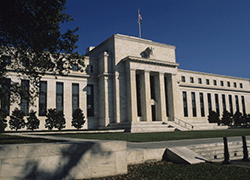
Federal Reserve building, Washington DC.
What a difference a year makes
“Last summer, developed market government bond yields collapsed. The U.S. ten-year Treasury yield dropped to 1.35% in early July, and the ten-year German bund had a negative yield through the late summer. At the same time, central banks developed new weapons to fight the scourge of falling prices and weak growth. The ECB and Bank of Japan had outsized asset-purchase programs, or quantitative easing programs, and slashed bank deposit rates well below zero. By the end of the 2016, both banks re-upped their programs. The ECB extended the time horizon of its asset purchases. The Bank of Japan switched to a yield peg, buying whatever bonds it could to keep the 10-year government bond, or JGB, yield at 0.0%. Post-Brexit, the Bank of England cut its policy rate to the bone. The Federal Reserve was on hold until year-end, worried about “global financial conditions” and deflationary pressures.
ECB lending standards increasing, Fed increased and EXB reconsiders
“Fast forward one year, long-dated government bond yields have picked up from ultra-low to low. Central banks are not pushing the boundaries of monetary policy out further. The Federal Reserve increased the fed funds rates two times so far this year, and is broadcasting loudly and clearly its intentions to start unwinding its balance sheet. The ECB’s latest policy meeting and press conference reaffirmed that the ECB will likely reconsider the size of its asset-purchase program in the fall. The Bank of Japan yet again reaffirmed its asset-purchase program, and, again, cut its inflation forecasts.”
Central banks and inflation
“Central banks have pulled back from the brink. But, have they declared victory too early? Global growth has improved significantly over the last 18 months or so. Europe has transitioned from tenuous recovery to a self-sustaining expansion. The U.S. manufacturing and investment cycles have recovered from the dollar-oil shock of late 2015 and early 2016. Even real growth is decent in Japan. But, inflation is not cooperating. Inflation reports have generally surprised to the downside this spring and summer. More broadly, core inflation remains below bank targets in many regions.
“Central bankers could be concerned about another type of inflation: asset price inflation. With deflationary risks down and growth reasonably okay, policy makers likely want to stop the price distortions coming from very low bond yields. But, they are in a bind.
“Market valuations are getting lofty. But, underlying inflation could be signaling something about weak demand, which if ignored, could lead to policy error.”
By Robin J. Anderson, Ph.D., Senior Global Economist, Principal Global Investors


