
Keep the engine tuned – How financial advisers protect Aussie businesses and make ownership transition smoother

How can advisers assess the commercial merits of business insurance as an offering, potentially opening up opportunities to assist both new and existing customers?
Australian business – a finely tuned Ferrari, or a ute blowing smoke?
Small businesses are – we are often told – the economic engine that powers Australia. Indeed, according to ABS figures[1], around 89% of Australia’s 2.6 million business entities (have 4 employees or less (60% have zero).
But the engine doesn’t always purr along luxuriously. It frequently splutters and sometimes even fails altogether; one Australian study[2] found the four-year survival rate to be just 56% for businesses with no employees, and 68% for those with 1-4.
Given the unique challenges faced by smaller businesses, we should perhaps be unsurprised that so many don’t survive for long. Smaller businesses are, after all, more prone to cash flow issues, and are far more reliant on key people. This can be especially problematic if that person is removed from the business, whether this is due to foreseen circumstances (retirement, career change, holiday), or an unforeseen event (accident, illness, or even death).
None of us are bulletproof
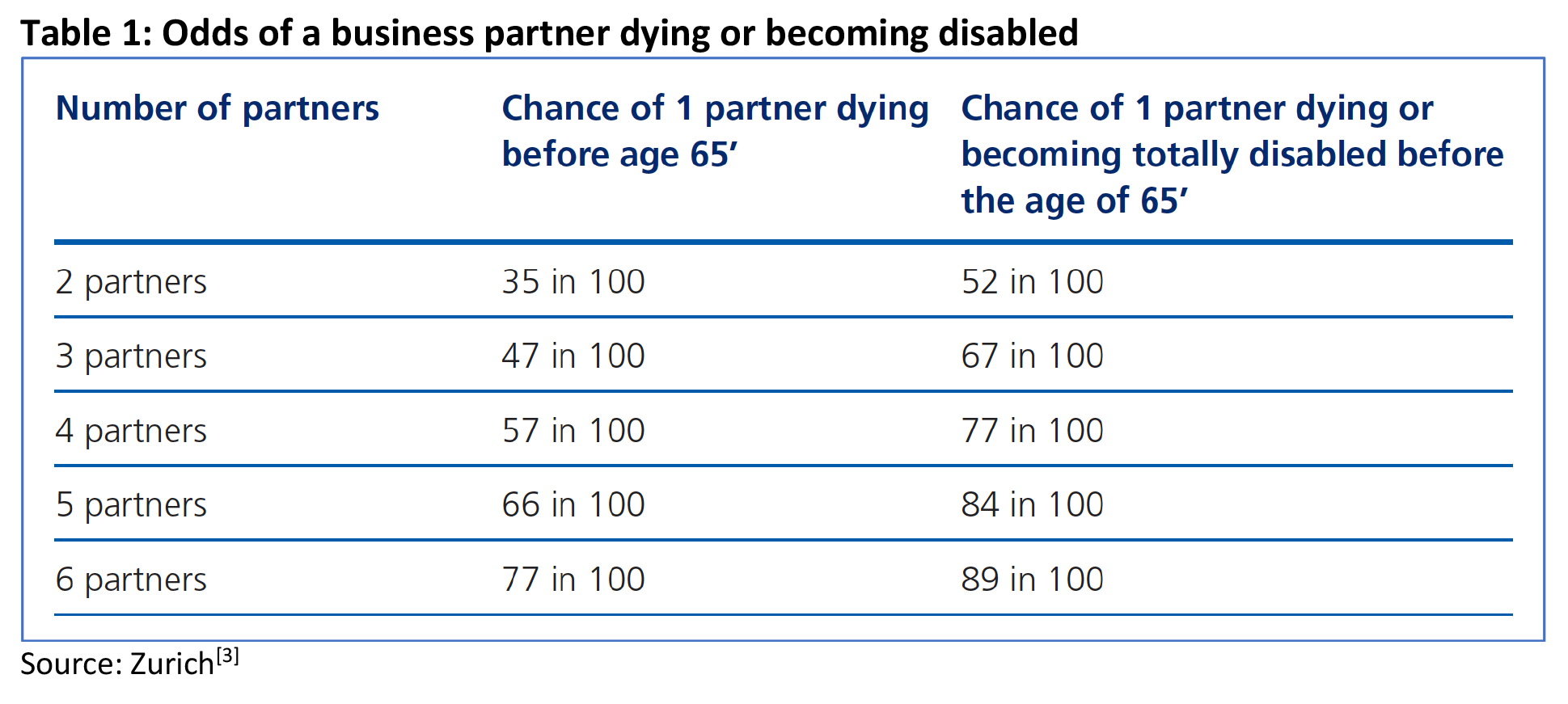
Small business owners – and employees – are just as susceptible to accidents and illness as the rest of the population (perhaps even more so given the associated stress levels), and the maths can be quite confronting. According to Zurich[3], a two-partner business has a 35% of chance of being disrupted by the death of one of those partners before they turn 65, and a 52% chance that a partner will die or become totally disabled (temporarily or permanently). For larger partnerships the odds skyrocket to more than 70% and 80% respectively.
So, what happens when a key person – either the business owner or a critical employee – is suddenly removed from the business?
As you would expect, the death of a business owner can often also prove fatal for the business itself, and most sole proprietor businesses would almost certainly cease to operate in these circumstances. But even for larger businesses the prospects are grim. A University of Warwick study4 found that sales dipped by 60%, on average, four years after the death of the founding entrepreneur, and employment at the firms was down 17%. The survival rate of these businesses was 20% lower than at similar firms where the owner was still living. At the same time the likelihood of bankruptcy rose at firms where the owner passed away.
Regardless of whether a business survives – or shuts down – in these circumstances, further complexity is likely to arise in terms of the decedent’s ownership stake, and its potential sale and/or transfer.
Even the disablement of a key person can cause havoc with the viability of a small business. Removing their skills and intellectual capacity will impede the capacity of the business to serve its customers, shrinking its revenue stream without necessarily shrinking its cost base, and at the same time increasing the risk those customers will defect to competitors.
What is at stake – in either scenario – is the entire value of the business
Business continuity and business succession
The preservation of the value of the business – and the management of risks that could erode that value – are the core objectives of business continuity and business succession planning.
Business continuity
Business continuity is about maintaining business functions, or quickly resuming them, in the event of a major disruption, such as fire or flood, a pandemic related shutdown, or the permanent or temporary loss of a key employee. Issues that would typically be covered off in a business continuity plan include:
- health and safety of staff
- securing of premises
- data security
- IT systems
- Ccustomer communication
- staff procedures and communication, and
- temporary or permanent replacement of equipment or staff.
Risk management is also a critical component of business continuity, and for simplicity sake this can be thought of as comprising two components – risk minimisation and risk mitigation.
Risk minimisation describes the steps taken to prevent or reduce the likelihood of a disruptive event occurring in the first place. Examples can include fire proofing premises (e.g. sprinkler systems) or making them more secure against physical or cyber intrusion.
Risk mitigation is about damage limitation. One of the most important forms of risk mitigation is to insure the assets that are at risk, so any loss from their reduced capacity is minimised, and this is where general insurance (machinery, premises etc) and life insurance (key people) play crucial roles.
Business succession
In a small business context, succession planning is a strategy for passing on leadership roles, and often a degree of ownership of a business—to others, whether they be family members, or other business partners. It preserves the value of the business by ensuring the business can continue to run smoothly after key people have moved on, retired, or passed away.
The benefits of an effective succession plan can include asset protection, business growth, harmonious structuring, and an optimised tax situation. Without a plan, the process of business succession can descend into conflict, and even litigation, dramatically eroding business value along the way.
Yet worryingly, research[5] undertaken in 2015 revealed that the majority of Australian business owners surveyed (66%) did not yet have a formal succession plan in place.
A business succession plan will typically address:
- business valuation
- identification and development of successors
- ownership versus control, and
- the alignment of family interests.
Business succession mechanisms can include formal instruments (e.g. partnership agreements and buy-sell agreements) and, of course, life insurance.
Life insurance in a business context – the ‘key person’ concept
Central to the role of life insurance within business succession and business continuity strategies is the concept of the ‘key person’.
Most businesses have one or more key persons whose skill, knowledge, experience and leadership ensures the success of the business. A key person in any business may generally be defined as one whose death, disablement or early retirement may have an adverse economic effect on the business.
It is important to identify these key people and to quantify the adverse outcomes that are likely to be suffered by the business in the event of their death, disablement or illness. Specifically, these adverse outcomes could include:
- loss of revenue in the period following a business owners’ death or disability
- suppliers who are concerned about credit risk and suspend the provision of goods/services
- banks and credit providers suspending credit and/or calling in debts, and
- lack of alignment and poor relationship between surviving family members and/or surviving co-owners/partners over control and future of business.
Life insurance – in conjunction with appropriate legal instruments and documentation – can thus become a crucial risk mitigant, minimising the adverse outcomes by providing protection across three broad risk categories:
- revenue
- assets
- ownership.
Revenue protection
The loss of a key person makes a decline in revenue almost inevitable, especially when that person is a revenue generator because of their skill set and role within the business.
But there can be indirect revenue impacts as well. Finding, recruiting and training a replacement can be very time consuming, – and very costly – taking other key people in the business away from their customer facing roles. The new recruit may take years to reach the capacity of the person they are replacing, so the revenue impact may last for a long time. Staff morale may be impacted, such that their ongoing capacity to serve and meet customer demand, and generate revenue, may be adversely affected.
A life insurance-based Revenue Protection strategy is designed to provide business with cash to compensate for this loss of revenue.
Asset protection
The death or disability of a business owner can put a significant strain on the ability to repay business borrowings, which can threaten the ongoing provision of credit and bring personal guarantees (for example, those secured against the business owner’s family home) into play.
A forced sale of assets may become necessary if creditors call in debts because they are worried about sustainability of the debt. Cash flow may need to be diverted away from day to day business expenses (wages, stock, rent) to repay debt, which can have unintended flow on effects.
Asset protection – sometimes also referred to as Debt Guarantor protection or Business Loan Protection – ensures that the business borrowings (and/or owners’ guarantees) can be extinguished or reduced in the event of death or disability, freeing up cash flow, and importantly, preserving a good credit rating.
Ownership protection
Ownership protection – also known as or buy/sell cover – is designed to help ensure the smooth succession of ownership between shareholders in the event of the death or disablement of a business owner.
The sudden and unexpected death of a business owner will often require surviving owners to negotiate with the deceased owner’s legal representative over the transfer of equity. Naturally the executor may be more concerned about the needs of the estate than the needs of the business. With appropriate formal buy/sell agreements in place, and the appropriate funding (via life insurance), an ownership protection strategy can provide the continuing owners with sufficient cash to purchase the outgoing owner’s equity. (A similar issue can occur when an owner suffers disablement or a health trauma and is no longer willing or able to continue in the business.)
Note that for this strategy to be effective, the life insurance (funding) and the formal legal agreements need to work hand in hand. Without this combination, it is possible such a situation can descend into acrimonious disputes, over the value of the ownership stake, and the ability of surviving family members to enter, and influence the direction of, the business.
Ownership protection – how it can go wrong
Under a partnership structure, partners are jointly and individually responsible for the debts of the business[6]. This means if a business partner is unable to pay a debt that they have incurred on behalf of the business, other partners may need to pay this debt themselves. This becomes particularly relevant in the event that a partner passes away.
In the absence of a written partnership agreement, the Partnership Act in each state or territory would generally apply[7], usually triggering the automatic dissolution of the partnership and leaving the surviving partner(s) liable for the entitlements of any laid off staff and the debts (including tax) of business. On top of this they must find a way to pay the deceased partner’s estate their share of the partnership value. Without the right agreements and funding in place, this could prove disastrous for everyone involved.
Taxation considerations for business insurance
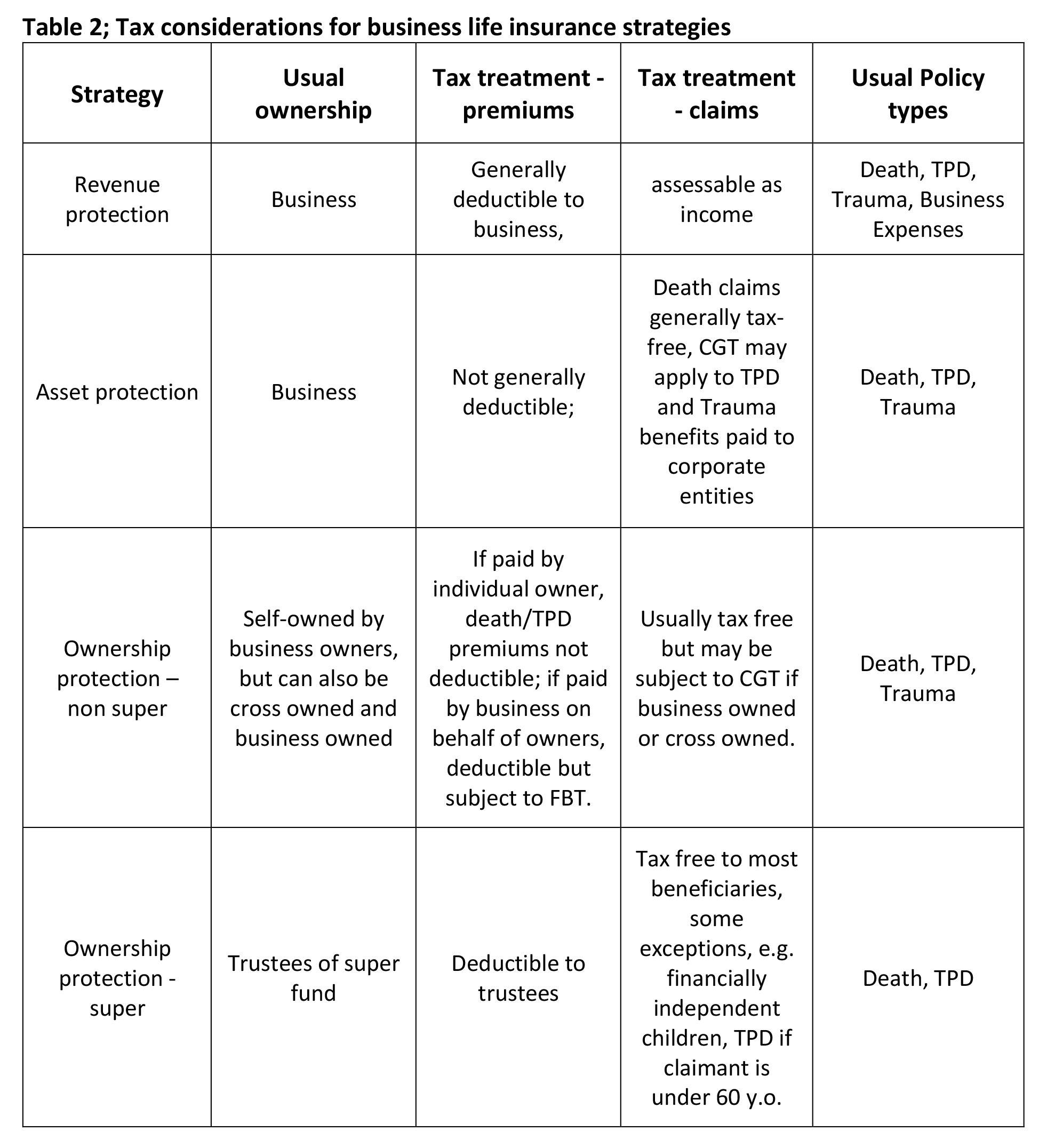
The tax treatment of business life insurance premiums and claims benefits can vary, depending on the ownership and funding of the relevant policies.
The table below provides a high-level summary of the likely tax treatment for different scenarios. (Naturally this list is not exhaustive and does not constitute tax advice!)
Put it in writing
The deductibility of revenue protection premiums requires the clear documentation of the cover purpose and sum-insured calculation methodology. This can be covered in business minutes, and then used for tax and auditing purposes.
Ownership and funding considerations
Decisions about policy ownership and how to fund premiums can have a significant impact on:
- the cost of cover
- the ease with which premiums can be paid, and
- the tax treatment of both premiums and claims proceeds.
Self-ownership, cross ownership, super fund ownership and business ownership all have their pros and cons. The structure of the business, if it has multiple entities, also has implications, as does the use of trusts by business and individuals. The optimal ownership solution will naturally vary on a case by case basis, depending on individual circumstances.
Insurance isn’t always the answer
It is worth remembering that in the context of ownership protection – life insurance is being used as a funding mechanism to support the ultimate transfer of the business interests in the event of the death, disablement, or critical illness of a business owner. There will naturally be succession events which are not insurable, or circumstances where the owners themselves are unable to obtain cover, perhaps because of health issues. For these reasons, Buy Sell agreements should generally outline alternative funding arrangements for the various succession events.
A massive opportunity for financial advisers
Australia has around 2.4 million actively operating businesses powering our economy, of which around 90% employ 4 people or less. They provide employment, are a source of innovation and help bring communities together. They also represent the hopes and dreams – and wealth – of business owners and their families.
Estimates[8] suggest 80% of Australian businesses will change hands in the coming decade, due to the planned retirement of their baby boomer owners. What is not estimated but just as certain is that many unplanned business exits will also occur, due to the untimely death or disablement of business owners and partners. Without the right planning and protection mechanisms in place, the value of these businesses may be shattered, the wealth of families destroyed, and the jobs of thousands of employees will be at risk.
Given the dire consequences of not planning, one would expect almost all businesses to have formal plans in place to cover these succession events. Sadly, it seems many business owners are just too focused on running their business to focus on broader issues, and some studies estimate that upwards of 66% of Australian businesses are without a formal succession strategy.
This substantial gap represents a meaningful opportunity for experts capable of providing appropriate advice. To the extent that life insurance can be a central component of business succession and business continuity strategies, it is an opportunity which financial advisers are perfectly placed to take advantage of.


