
The advent of benchmarking and the “Balanced Scorecard” have provided many Australian advisory businesses with some fabulous information over the last few years. However, the warning by Mark Twain that there are“lies, damned lies and statistics” should be borne in mind by practice principals who are considering using industry benchmarks as part of their planning process.
While there is no doubt that measuring your practice against the best of your peers can add enormous value, external benchmarking should only be one of the inputs into your decision making process. Building your business strategy solely around a comparative industry standing is fraught with danger. To help put your results in the right context, you may like to consider these top five benchmarking tips.
1. Quality of information
Traditionally in the financial services profession, many practices have struggled to produce an accurate, timely and detailed set of “real” numbers for their business. The outcome of some benchmarking processes can at times best be described as “dodgy”. Does the phrase, “Garbage in equals garbage out” ring any bells?
The key learning here may be the more detailed or complicated the financial benchmark, the more cautious you need to be in analysing the results. In our view, information or data should primarily be used as a guide. For example, information gained from a website which provides “free” analysis with little scrutiny of the data being entered or of the business actually providing it, might sound alarm bells for some.
2. Benchmarking in isolation
One of the major problems with benchmarking is looking at any metric in isolation – numbers in a vacuum are very dangerous! Drawing accurate conclusions purely from financial benchmarking can sometimes be very difficult.
For example, a practice gearing for significant growth and keen to employ the best available talent may well be investing significantly more in staff salaries than the marketplace average. In this case, the fact that they have fallen outside of the industry benchmark is probably a positive.
3. Qualitative versus the quantitative
While they are extremely important, in most business the numbers are “lag” indicators – they are the result of your strategies and actions. To get the best possible picture, your benchmarking analysis should include both qualitative and quantitative information.
Consider the areas of your practice that drive financial output, not just the results themselves. Client interaction, business planning, risk management, IT and staff development (to name just a few) are all critical drivers of success.
4. Long term or short term
To decide on the most appropriate benchmarks for your practice, you must first determine where your firm sits within the “business life cycle” – what are your time frames?
There are always trade-offs to be made between short term results and long term plans – short term profits can be maximised by carefully managing expenditure but by not investing in practice infrastructure, you may be jeopardising sustainable long term success.
It is unlikely a practice looking to sell in the immediate future would be investing heavily in new hardware and software and as such, an industry benchmark based around the average IT spend per staff member will be of little relevance and provide limited insight.
5. Fit with your strategy
Avoid the disconnect between measurement and strategy – make sure you are measuring “apples with apples”. If you have built your practice to attract and retain high net worth investors and you operate a deep relationship/high touch model, ensure you are comparing yourself against other similar firms in this space (or better still, the best in class providers in this market).
Specific target markets require unique value propositions and tailored business models. The key benchmarks will vary significantly between practices specialising in a narrow client demographic or offering a select service offer.
Conclusion
The benchmarking of a business will almost always produce interesting results. We all like to know how we stack up against others in our profession. Nevertheless, the time and effort involved can only be justified commercially if the insights that arise translate into real plans to improve the business and a commitment to steadily work towards improving scores over time.
The experience at Business Health shows that the firms that consistently score well on the hard numbers like revenues and profits share a number of attributes that can be hard to measure, but which seem to be critical for success. It will be in these areas that underperforming practices may need to be ruthlessly self-critical, and to concentrate their efforts to reform and improve. Here are five of these common attributes of great advisory firms.
1. Great leadership
All of the successful advice practices we have worked with are headed by a great leader. This person usually has an incredibly clear vision for the business and is able to articulate this vision and lead others on the journey into the future.
They welcome and embrace change and while they may also be talented financial advisers, they think like successful business owners. Without exception, they have a documented plan for their business and this plan provides the strategic blueprint for sustained success and a focus for all operational activities.
2. Talented & committed staff
With the competition for good people so intense, the successful firms are able to attract and retain the best available talent. They invest heavily in the development of their team and offer not just a competitive remuneration package, but also flexible incentive plans and innovative equity programs.
To ensure they maximise their return on this investment, the best practices have sound performance management processes in place and continually encourage greater involvement in all aspects of the business.
3. Truly client centric
While the term “client centric” has become somewhat of a cliché, the best advisory practices truly do put their clients at the centre of everything they do. They have a compelling value proposition built around a thorough understanding of what their ideal clients want.
They treat every client fairly and with respect, but not equally – while no-one receives poor service, they fully appreciate that their best clients deserve their best service. They also are in constant contact with their clients (through all stages of the investment cycle) and proactively seek feedback on how they could further improve their offer.
4. Willingness to invest in the business
To deliver sustained results in any business, the owners must continually review and enhance their operational infrastructure. The most successful principals understand this and are always willing to make prudent investments for the future.
They also know that it is almost impossible to make quality business decisions without accurate and timely business information – the best firms really do know their numbers.
5. Readiness to actively seek help
And finally, the most successful practice principals surround themselves with people smarter than themselves and they are not afraid to ask for help. They are always willing to listen and learn and they consult widely, and not just from within the financial services profession.
They usually meet regularly with a mentor or coach (or in many cases an advisory board) for objective advice and guidance about their business and most importantly, this external input also provides an additional layer of accountability for the owners.
Average Practice Dimensions
Derived from the Business Health HealthCheck database which contains detailed information collected from over 2,000 Australian advisory practices in 2009 – 2011.
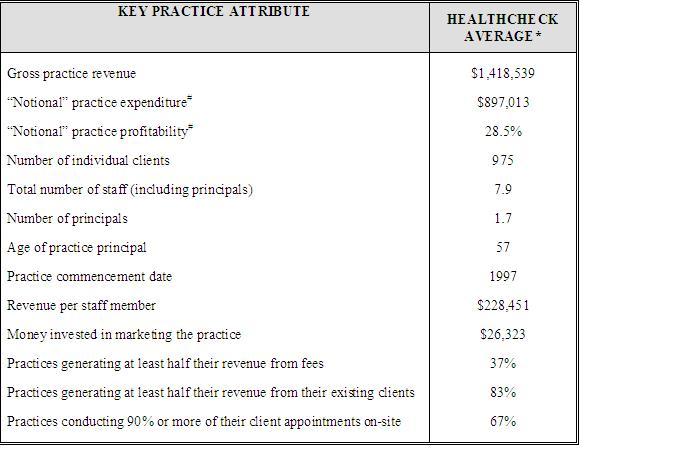 * The above results have been calculated using the averages at an individual practice level and then averaging these across the data group. This approach produces a far more meaningful result and explains the apparent “discrepancy” if some of the key practice attributes are simply multiplied or subtracted from each other.
# All of the “notional” profit and salary calculations contained in this report assume a notional $100,000 salary for each principal working in the practice.
Summary
Benchmarking provides a very useful comparison of any business with its peers, but if the time and effort spent is to be worthwhile, it will be important to ensure that the right information is collected in the right way, that the correct lessons are drawn from the analysis of the results, and that a program of continuous improvement is undertaken to ensure that the firm’s performance relative to its peers grows over time.
Rod Bertino is a partner and director of Business Health Pty Ltd. Business Health is a consulting firm specialising in the financial services industry. Business Health develop and market a suite of unique and exclusive business diagnostic tools which are supported by a range of specialised consultancy services. Rod can be contacted at [email protected].
Note: The accreditation for this CPD article is no longer current. Please visit our CPD section for current CPD quizzes.


