After the Reserve Bank of Australia’s rate cut a month ago, the general consensus was there was little urgency for the RBA to move again.
The most likely outcome seemed to be that rates would remain on hold until the February meeting at least and the easing cycle would be mild. A somewhat stronger tone to domestic economic activity releases over the last month would support this. However, with global uncertainties increasing, our assessment is the RBA should cut again next week and more rate cuts are likely to be required next year.
Better domestic economic activity data
The past month or so has seen somewhat stronger economic activity releases in Australia.
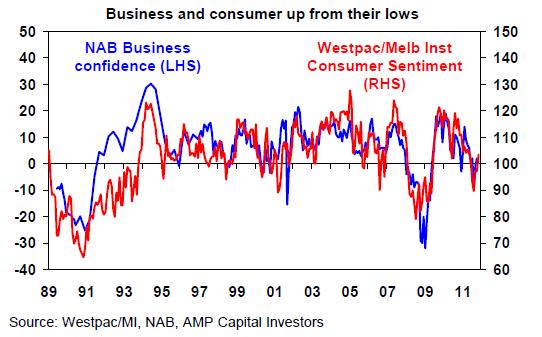
- Consumer sentiment has bounced back from its August low
- Similarly business confidence has also improved
- Housing finance and building approvals appear to be stabilising after earlier falls
- Private credit growth appears to have picked up pace slightly
- Retail sales are up solidly for three months in a row
- After rising to 5.3%, the unemployment rate has fallen back to 5.2%
- And of course, mining related activity remains strong, being the main factor driving a 12.5% surge in construction activity in the September quarter.
Reflecting this, early estimates suggest September quarter GDP growth (which is due for release on 7 December) could be a solid 1.2% or so.
The case for lower rates
However, while the flow of economic activity indicators in Australia over the last month suggests a pick-up in underlying economic growth, several considerations justify another rate cut now and more next year.
First, the situation in Europe has continued to deteriorate posing an increasing threat to global growth next year. Europe looks to be back in recession and signs that sovereign debt woes are now affecting core countries such as France, Belgium, the Netherlands and Germany as indicated by higher bond yields are increasing the risks that it will be deep. With core Euro zone (EZ) countries now being affected and recession deepening there is of course now rising pressure on Europe to take decisive action to deal with the problem. There is now talk of moving towards a fiscal union, which could supposedly provide cover for the European Central Bank to step up its bond buying in troubled countries, and along with reports of IMF involvement in a loan to Italy so financial markets have seen yet another relief rally over the last day or so. However, whether things have deteriorated far enough to prompt decisive action – ultimately requiring a commitment to unlimited bond buying and quantitative easing from the ECB – iss doubtful. So the risk is that it may prove to be just another relief rally on the continuing “revolt, response, relief” cycle in Europe.
But key for the RBA is that whereas a mild EZ recession (say a 1% GDP contraction) would still be consistent with 3% or so global GDP growth next year, an EZ blow up – involving a 5 to 10% GDP slump and a related financial crisis would threaten a return to global recession – the risk of which has increased. While Australia has only a small trade exposure to Europe – less than 10% of Australian exports go to the EZ – it’s still vulnerable via the impact on its major trading partners in Asia and via financial and confidence linkages.
Second, and related to this, as the situation in European and hence global credit markets has deteriorated, Australian banks have been warning their funding costs have been increasing. If this intensifies, then there is a risk that banks may actually increase their lending rates – both business rates and mortgage rates – independently of the RBA. Such a move would result in a tightening in monetary conditions at the worst possible time. The best way to prevent it from occurring in the short term would be for the RBA to reduce its cash rate.
Third, it would be dangerous to read too much into the recent improvement in economic activity indicators in Australia. It may simply reflect the tendency for economic data to go through hot and cold periods and there is little evidence of much trickle down from mining investment (eg even though mining related construction activity boomed in the September quarter there is not much meaningful evidence of any flow on to employment). Historically, it has required more than one rate cut to lead to a turnaround in household spending and housing activity. In terms of the latter it is noteworthy that the interest rate cut a month ago has had no discernible impact in boosting weekly auction clearance rates in the major capital cities.
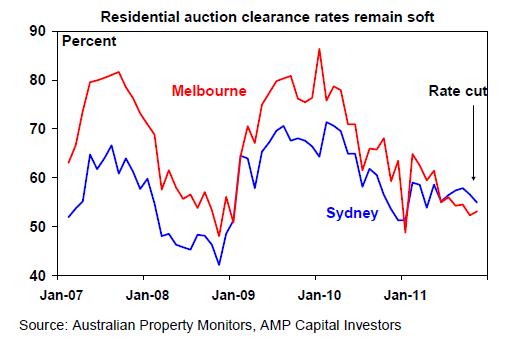
This would be consistent with the view that one rate cut is not enough, and more are required to have a significant impact on household demand in the economy.
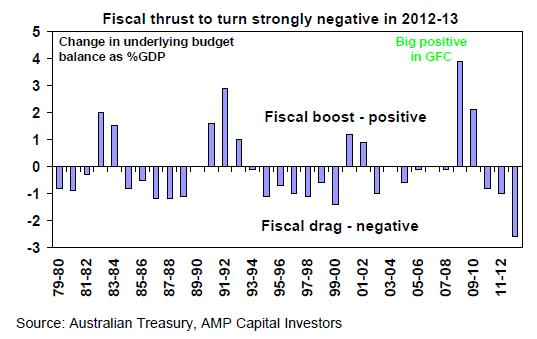
Fourth, the Federal Government has announced $11.5bn in budget cuts over four years in order to ensure that its commitment to bring the budget back to surplus by 2012-13 despite a slump in revenues and to cover increased spending associated with the carbon tax. In fact, the projected turnaround in the underlying budget deficit from 2011-12 to 2012-13 will now be equal to 2.6 percentage points of GDP, resulting in the most negative fiscal drag on record. This will likely dampen business and household spending. Of course there is no clear one for one relationship between fiscal and monetary policy but fiscal tightening in the current environment should provide more room for monetary easing all things being equal.
 Finally, all this is occurring at a time when inflationary pressures are benign – with recent underlying inflation readings running just below 2.5% and with recent wages data confirming that pressure from this source is receding.
This all suggests that downside risks to the growth outlook have increased. Waiting two months until the next RBA Board meeting in February could prove to be a big mistake given the deteriorating situation in Europe and the threat that banks may raise their lending rates and tighten lending standards. The RBA’s policy of ‘least regret’ would argue in favour of a precautionary cut next week.
While the November rate cut took interest rates back towards a ‘more neutral’ level (to paraphrase the RBA), it can be argued that they still have a bit further to go to actually be at neutral. Sure the cash rate is well below longer term average levels but bank lending rates – which are what matters – are not. The following chart shows the standard variable mortgage rate over the last decade.
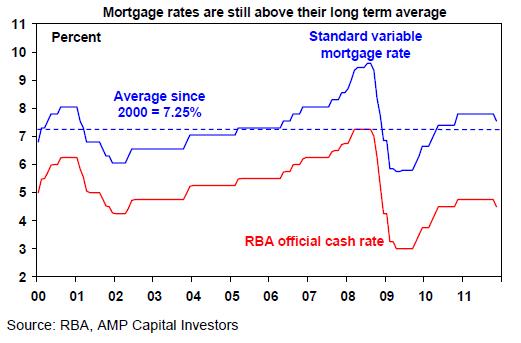 Averaging around 7.55% for the major banks at present, the standard variable mortgage rate is still just above its average over the last decade of 7.25%, suggesting current interest rate settings are still a bit above neutral. More cautious attitudes towards debt probably also suggest that the ‘neutral’ level may have even moved below the average of the last decade. This would be suggested by the negative impact on spending that the rate rises through 2009 and 2010 had. So a ‘neutral’ mortgage rate may actually be closer to 7%. Having lending rates still above neutral levels is probably not appropriate given the threat from Europe, rising bank funding costs and the risk this poses of rising lending rates going forward, fiscal austerity and a benign inflation backdrop.
A further 0.25% cut in the cash rate (taking it to 4.25%) at the December meeting is justified and further rate cuts will be required next year.
What about the bigger picture for Australia?
Assuming a mild recession in the Euro zone, Australian economic growth is likely to be around 3% next year. Our view remains that even in the event of a deep recession in Europe, Australia should be able to avoid a recession next year, getting by with growth of around 1 to 2%. This is because there is plenty of scope to cut interest rates, scope to provide further fiscal stimulus (albeit we are going in the other direction at the moment), a lower $A would provide a buffer, corporate gearing is low, household saving is high and mining investment is likely to remain strong. However, for this to be the case interest rates will need to fall further.

 CPD: Growth holds, risks widen
 CPD: Intergenerational wealth – When the responsibility transfers before the money
 CPD: Why market structure rewards active management in local currency EMD
 CPD: A practical system for building client confidence – Value of Advice (Part 1)
 CPD: When a little knowledge is dangerous – countering the financial ‘guidance’ your clients are getting from AI
Oliver’s Insights: why the RBA should cut rates again
After the Reserve Bank of Australia’s rate cut a month ago, the general consensus was there was little urgency for the RBA to move again.
The most likely outcome seemed to be that rates would remain on hold until the February meeting at least and the easing cycle would be mild. A somewhat stronger tone to domestic economic activity releases over the last month would support this. However, with global uncertainties increasing, our assessment is the RBA should cut again next week and more rate cuts are likely to be required next year.
Better domestic economic activity data
The past month or so has seen somewhat stronger economic activity releases in Australia.
Reflecting this, early estimates suggest September quarter GDP growth (which is due for release on 7 December) could be a solid 1.2% or so.
The case for lower rates
However, while the flow of economic activity indicators in Australia over the last month suggests a pick-up in underlying economic growth, several considerations justify another rate cut now and more next year.
First, the situation in Europe has continued to deteriorate posing an increasing threat to global growth next year. Europe looks to be back in recession and signs that sovereign debt woes are now affecting core countries such as France, Belgium, the Netherlands and Germany as indicated by higher bond yields are increasing the risks that it will be deep. With core Euro zone (EZ) countries now being affected and recession deepening there is of course now rising pressure on Europe to take decisive action to deal with the problem. There is now talk of moving towards a fiscal union, which could supposedly provide cover for the European Central Bank to step up its bond buying in troubled countries, and along with reports of IMF involvement in a loan to Italy so financial markets have seen yet another relief rally over the last day or so. However, whether things have deteriorated far enough to prompt decisive action – ultimately requiring a commitment to unlimited bond buying and quantitative easing from the ECB – iss doubtful. So the risk is that it may prove to be just another relief rally on the continuing “revolt, response, relief” cycle in Europe.
But key for the RBA is that whereas a mild EZ recession (say a 1% GDP contraction) would still be consistent with 3% or so global GDP growth next year, an EZ blow up – involving a 5 to 10% GDP slump and a related financial crisis would threaten a return to global recession – the risk of which has increased. While Australia has only a small trade exposure to Europe – less than 10% of Australian exports go to the EZ – it’s still vulnerable via the impact on its major trading partners in Asia and via financial and confidence linkages.
Second, and related to this, as the situation in European and hence global credit markets has deteriorated, Australian banks have been warning their funding costs have been increasing. If this intensifies, then there is a risk that banks may actually increase their lending rates – both business rates and mortgage rates – independently of the RBA. Such a move would result in a tightening in monetary conditions at the worst possible time. The best way to prevent it from occurring in the short term would be for the RBA to reduce its cash rate.
Third, it would be dangerous to read too much into the recent improvement in economic activity indicators in Australia. It may simply reflect the tendency for economic data to go through hot and cold periods and there is little evidence of much trickle down from mining investment (eg even though mining related construction activity boomed in the September quarter there is not much meaningful evidence of any flow on to employment). Historically, it has required more than one rate cut to lead to a turnaround in household spending and housing activity. In terms of the latter it is noteworthy that the interest rate cut a month ago has had no discernible impact in boosting weekly auction clearance rates in the major capital cities.
This would be consistent with the view that one rate cut is not enough, and more are required to have a significant impact on household demand in the economy.
Fourth, the Federal Government has announced $11.5bn in budget cuts over four years in order to ensure that its commitment to bring the budget back to surplus by 2012-13 despite a slump in revenues and to cover increased spending associated with the carbon tax. In fact, the projected turnaround in the underlying budget deficit from 2011-12 to 2012-13 will now be equal to 2.6 percentage points of GDP, resulting in the most negative fiscal drag on record. This will likely dampen business and household spending. Of course there is no clear one for one relationship between fiscal and monetary policy but fiscal tightening in the current environment should provide more room for monetary easing all things being equal.
This all suggests that downside risks to the growth outlook have increased. Waiting two months until the next RBA Board meeting in February could prove to be a big mistake given the deteriorating situation in Europe and the threat that banks may raise their lending rates and tighten lending standards. The RBA’s policy of ‘least regret’ would argue in favour of a precautionary cut next week.
While the November rate cut took interest rates back towards a ‘more neutral’ level (to paraphrase the RBA), it can be argued that they still have a bit further to go to actually be at neutral. Sure the cash rate is well below longer term average levels but bank lending rates – which are what matters – are not. The following chart shows the standard variable mortgage rate over the last decade.
A further 0.25% cut in the cash rate (taking it to 4.25%) at the December meeting is justified and further rate cuts will be required next year.
What about the bigger picture for Australia?
Assuming a mild recession in the Euro zone, Australian economic growth is likely to be around 3% next year. Our view remains that even in the event of a deep recession in Europe, Australia should be able to avoid a recession next year, getting by with growth of around 1 to 2%. This is because there is plenty of scope to cut interest rates, scope to provide further fiscal stimulus (albeit we are going in the other direction at the moment), a lower $A would provide a buffer, corporate gearing is low, household saving is high and mining investment is likely to remain strong. However, for this to be the case interest rates will need to fall further.
Print
email
Tags:AMP Capital economic commentary Europe RBA Shane Oliver
Latest Articles