The “yes we have a deal no we don’t” regarding Greece’s latest bailout negotiations raged on again over the last week, resulting in a volatile ride for risk assets like shares.
- Greece looks to have fulfilled the conditions required off it to get another bailout but European reluctance to grant the bailout ahead of elections in April is causing the process to be dragged out.
- Our assessment is that a deal is more likely than not as both sides have potentially too much to lose, but the risks are high and in any case it could drag on a bit. An interim outcome could well be bridging finance to cover the upcoming March 20 €14.5bn bond payment ahead of a finalisation of the bailout package post the election along with tougher monitoring of Greece.
- In a broader sense there was mostly good news regarding the European debt issue over the last week. Moody’s played catch up in downgrading various European countries. Against this, the ECB appears to be moving closer to forgoing profits on its Greek bond holdings in order to help ensure Greece’s debt falls to 120% of GDP by 2020, Spain is now a third of the way through its planned bond issuance for this year, China gave its strongest assurance yet that it would help out and German officials signalled a willingness to provide more assistance to Portugal. Most importantly bond yields in Spain, Italy, France and Portugal were little affected by the Greece debacle of the last week, suggesting investors are becoming less concerned about contagion.
- Meanwhile, global reflation remains an ongoing theme with the Bank of Japan announcing extra quantitative easing, a short term inflation target of 1% and a medium term target of 2%. This is very significant. If Japan is serious about meeting its inflation targets it means more monetary easing in order to break the psychology of deflation and it could mean a fundamental turn in the Yen (down) and the relative performance of Japanese shares (up). Such a move adds to quantitative easing by the US, UK and ECB and is ultimately positive for financial assets generally.
Major global economic releases and implications
- US data releases remained mostly upbeat. January retail sales and industrial production were a little softer than expected, but against this there was a slight rise in small business optimism, solid gains in manufacturing conditions in the New York and Philadelphia regions, a further fall in unemployment claims, another fall in mortgage delinquency, further gains in housing starts and permits and a further recovery in home builders’ conditions. The latter is very positive and adds to evidence the US housing sector is recovering.. And finally GM, the maker of my favourite cars, posted a record annual profit adding to the renaissance now underway in US manufacturing, and a deal to extend payroll tax relief for the remainder of this year is looking highly likely.
- The Euro-zone contracted 0.3% in the December quarter, likely signalling the start of a recession. Fortunately, the decline was less than feared and recent indicators suggest it will be a mild recession.
- Japan’s economy also contracted in the December quarter. Gains in industrial production, a tertiary activity index and a likely rebound in public demand point to a return to positive growth in the current quarter.
- Growth in Malaysia remained strong in the December quarter boosted by robust domestic demand. Slowing exports are likely to see growth slow to a still reasonable 4% this year, ahead of renewed strength next year.
Australian economic releases and implications
- Australian data was refreshingly strong over the last week with gains in housing finance, business confidence, consumer sentiment and employment. However, there are some grounds for caution. The strength in housing finance is likely to have been distorted by the pending expiration of home buyer support in NSW and Queensland. The business and consumer surveys were largely undertaken before recent bank rate hikes.
- And there are several reasons for caution regarding the January employment report. First, the labour force report is volatile at the best of times but seasonal adjustment problems are at their worst in January. Secondly, hours worked actually fell significantly. Finally, the pace of job layoff announcements has picked up. So we continue to see unemployment rising in response to tough conditions outside the mining sector.
- Given this along with the de facto monetary tightening being delivered by the strong $A and recent bank mortgage rate hikes, we still think there is a strong case to cut official interest rates further but the strong January jobs data and the RBA’s relatively relaxed stance suggest the next cut may be several months away.
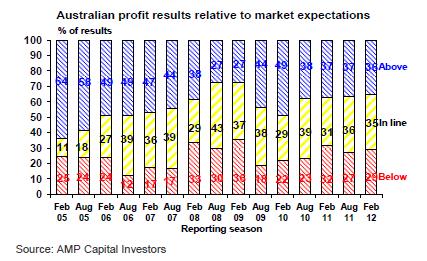
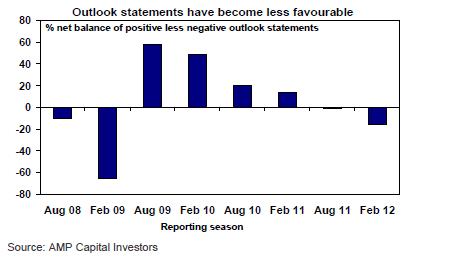
- Roughly a third of companies have reported, so its still early days in the December half profit reporting season, but the results are soft. So far only 36% of companies have exceeded expectations (versus a norm of 45%) and 29% have come in worse than expected (versus a norm of 25%). 64% of companies have reported positive year on year profit growth but outlook statements are cautious and investors have greeted the results negatively with the majority of stocks seeing their share prices fall after results were released.
Major market moves
- Most major global share markets moved slightly higher over the last week thanks to strong US data and optimism Greece won’t default next month. The stand out was the US share market which is flirting with last year’s highs. By contrast Australian shares fell and are struggling on the back of much tougher monetary conditions as rate cut expectations have been dampened, mortgage rate have risen and the $A remains strong.
- The Australian dollar rose on the back of stronger than expected jobs data and improved global confidence.
What to watch over the week ahead?
- In the US, expect modest further gains in existing home sales data (due Wednesday) and new home sales (Friday) and flat December house prices (due Thursday). Data for consumer sentiment will be released Friday.
- In Europe, the focus will stay on Greece with finance ministers to consider the bailout package Monday. PMI business conditions indicators (Tuesday) and the German IFO index (Thursday) will be watched closely.
- In Australia the focus is likely to remain firmly on interest rates with the minutes from the RBA’s last Board meeting (Tuesday), and a speech (Tuesday) and Parliamentary testimony by Governor Stevens (Friday) all likely to be watched closely in order to gain guidance as to the RBA’s inclinations on interest rates. Wages data will be released on Wednesday and is likely to show wages growth remaining pretty benign at around 3.5% pa. Its also peak week in the profit reporting season with over 100 major companies due to report.
Outlook for markets
- Shares are vulnerable to further consolidation or correction in the short term given high levels of investor sentiment, strong gains year to date and Greek worries. However, any pullback globally is likely to be mild and the broader trend is likely to remain up. Valuations are attractive particularly against very low bond yields, the risk of a Euro-zone meltdown has receded, momentum in global economic indicators is positive, global monetary conditions are getting easier and easier and there is lots of cash on the sidelines. We continue to see the ASX 200 pushing up to 4800 by year end, but thanks to tougher monetary conditions in Australia and the strong $A the Australian share market is likely to remain a relative laggard.
- Low global bond yields in major countries suggest low returns unless Europe’s debt crisis intensifies. Australian corporate debt is a better investment proposition if one needs income or is worried about shares.
- Beyond the current consolidation/correction the broad trend in the $A is likely to remain up helped by more global quantitative easing, solid commodity prices and improving global confidence. A retest of $US1.10 is likely.

 CPD: Growth holds, risks widen
 CPD: Intergenerational wealth – When the responsibility transfers before the money
 CPD: Why market structure rewards active management in local currency EMD
 CPD: A practical system for building client confidence – Value of Advice (Part 1)
 CPD: When a little knowledge is dangerous – countering the financial ‘guidance’ your clients are getting from AI
Weekly economic & market update
The “yes we have a deal no we don’t” regarding Greece’s latest bailout negotiations raged on again over the last week, resulting in a volatile ride for risk assets like shares.
Major global economic releases and implications
Australian economic releases and implications
Major market moves
What to watch over the week ahead?
Outlook for markets
Print
email
Tags:AMP Capital economic commentary market commentary Shane Oliver
Latest Articles