
The past week saw the rally in shares and commodities continue with fiscal cliff worries causing occasional swings but reasonable economic data and good news on Greece boosting confidence.
- Not a lot of progress was to be expected on the US fiscal cliff front by this stage and the argy bargy of negotiations will likely continue to cause occasional gyrations in markets over the next few weeks. While the risks are high we remain of the view that a compromise will be reached by year end that cuts the combination of tax hikes and spending cuts from a currently scheduled 4.3% of GDP for next year down to around 1 to 2% of GDP. Neither side would want to be blamed for tipping the US back into recession.
- In Spain, the success of secessionists in Catalonian elections obviously complicates life for the Spanish Government. However, it may not change things that much. The secessionist vote in Catalonia was very fragmented and in any case the path to independence for Catalonia could be long and drawn out. That Spanish shares and bonds rallied over the last week despite the vote suggests it’s really just a political sideshow.
- While Moody’s downgrades to the ratings of the European bailout funds may create some nervousness, it was foreshadowed after it downgraded France and is really just a catch up to similar moves by S&P in January.
- The news on Greece was good with European finance ministers and the IMF granting Greece more time to reach its budget targets and reducing its debt burden by about 20% of GDP by a range of measures including interest rate reductions, deferring interest payments, maturity extensions and a debt buyback. This is probably not the last of the matter but the reduction in Greece’s debt burden will put it closer to solvency and it highlights the extent to which Europe will go to ensure Greece stays in the euro. Draghi’s “irreversibility” rules!
Major global economic releases and implications
- US economic data remained consistent with moderate growth. September quarter GDP growth was revised up to 2.7% annualised, but this was mainly due to inventories and personal income and consumption was softer than expected in October. Against this though, underlying capital goods orders rose in October, consumer confidence rose in November (despite Sandy and cliff!), house prices continued to gain, unemployment claims continue to fall and weekly mortgage applications and pending home sales rose. What’s more weekly retail sales rose solidly last week, indications suggest an ok post Thanksgiving start to holiday sales and the Fed’s Beige book reported “measured” growth. So overall not to bad, assuming the fiscal cliff is resolved.
- European economic sentiment surprisingly improved slightly in November, albeit remaining at levels consistent with an ongoing mild recession. But unemployment rose to 11.7% in October and will keep rising as long the recession remains. With inflation falling in November, the ECB still needs to provide more stimulus.
- Japanese data was mixed with manufacturing conditions weakening, retail sales weaker than expected and ongoing deflation in core consumer prices but industrial production bouncing back in October and unemployment remaining unchanged at 4.2%. The Bank of Japan still needs to implement far more aggressive monetary easing.
- In China, a pick up in profits, a leading indicator and the official PMI added to signs growth is bottoming.
- 7.2% growth in GDP in the Philippines over the year to the September quarter highlights how South East Asia, ex Singapore, has held up well. It comes on top of 6.2% growth in Indonesia, 5.3% growth in Malaysia and 3.3% growth in Thailand. South Korean industrial production is also now up two months in a row.
Australian economic releases and implications
- Australian economic data was messy. Private credit almost stalled in October led by a fall in business credit but with growth in housing credit remaining at a record low. While business investment rose in the September quarter, there has been a big loss of momentum in investment and the survey of investment intentions is pointing to a sharp downwards revision in investment growth for 2012-13 from 21% last quarter to now 11%. Downwards revisions to mining investment plans were the main driver but other sectors are showing no signs of a pick-up and if anything are worsening. New home sales rose 3.4% in October, but this is just a flick off the bottom.
- Faltering credit growth, rapidly slowing investment and a soft housing sector at a time when the $A remains strong highlight the need for much lower household & business borrowing rates. And the only way to achieve this for the RBA to keep cutting rates.
Major market moves
- Global shares generally rose over the past week supported by reasonable economic data, despite fiscal cliff worries. Chinese shares remain a disappointing exception but with value getting better and better.
- Commodity prices also rose, but the $A slipped as soft capex plans reinforced rate cut expectations.
What to watch over the week ahead?
- In the US, expect the ISM manufacturing conditions index (Monday) to fall slightly and payroll growth (Friday) to slow to around 100,000 as a result of Hurricane Sandy.
- In the Euro zone, final business conditions PMIs (due Monday and Wednesday) are likely to remain soft. On Thursday the ECB should be cutting interest rates to help boost growth, but is more likely to remain on hold.
- In China, key November data for inflation, retail sales, investment and industrial production, scheduled to be released on Sunday December 9 (so much for the sanctity of the weekend?), is likely to provide further evidence that growth has bottomed. Due to base effects inflation is likely to rise a bit but remain low at around 2.1%.
- In Australia, the focus will be on the Reserve Bank. We expect another 0.25% rate cut taking the cash rate back to its post GFC low of 3%. Our assessment is that interest rates have not been cut enough to ensure that non-mining sources of demand will be strong enough next year to take over from a diminishing contribution to growth from mining investment.
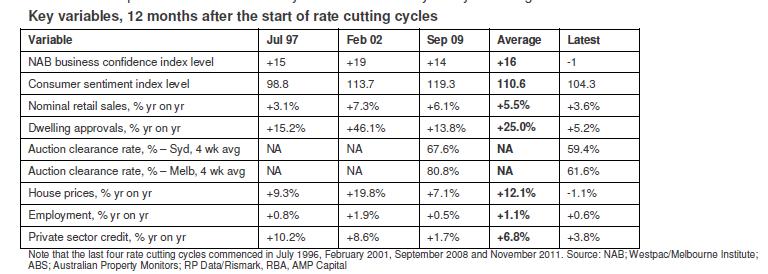
- The current interest rate cutting cycle is now more than a year old & yet a range of indicators this time around are well below the average levels attained after a year into the previous three rate cutting cycles (see table). In other words the economic response to rate cuts is proving more muted this time, in part thanks to post GFC household and business caution. To overcome this rates will need to fall further. While the cash rate is near its post GFC low of 3%, standard variable mortgage rates are well above (averaging around 6.6% now versus a GFC low of 5.8%).
- And with inflation remaining benign there is plenty of scope for the RBA to cut more. Expect 0.25% cut on Tuesday with more cuts early next year taking the cash rate down to 2.5%.
Key variables, 12 months after the start of rate cutting cycles
- In Australia, it will also be a big week for data. Expect soft readings for ANZ job ads (Monday), a slight rise in retail sales (Monday), a slight fall in building approvals (Tuesday), September quarter GDP growth of around 0.5% quarter on quarter or 3% year on year (Wednesday), a 5000 gain in jobs resulting in a rise in the unemployment rate (Thursday) to 5.5% and a continuing $1bn plus trade deficit (Friday).
Outlook for markets
- Although fiscal cliff uncertainties will no doubt be with us for a few more weeks and could cause further occasional gyrations in share markets our assessment is that shares are likely to see their normal seasonal strength into year end.
- Shares remain cheap, monetary conditions are ultra easy and a slight pick-up in global growth on the back of easing by the Fed, a likely solution to the US fiscal cliff, the ECB’s bond-buying program and improving momentum in China should support profit growth in 2013. Australian shares are being given an added impetus by lower RBA interest rates which should help boost profit growth in 2013. As a result we see further gains in share markets by year end and through 2013.
- Sovereign bonds in safe countries are a good diversifier most of the time, but bond yields are very low and point to low medium-term bond returns.
- The outlook for the Australian dollar remains messy. Uncertainties regarding global growth and ongoing RBA rate cuts are negatives. But quantitative easing in the US (QE3), central bank buying and prospects for improved global growth are positives. The likely outcome is for a US$0.95 to US$1.10 range, with the risk on the downside.


