Shares had a volatile ride, getting hit earlier in the week following the poor outcome from the Italian election only to then rebound to varying degrees as worries about Italy and renewed contagion in Europe settled down and US economic data surprised on the upside.
- The inconclusive Italian election result with the centre left winning the lower house but not the Senate clearly spooked investors fearful that it would trigger a renewed escalation of the Euro-zone crisis. However, while political uncertainty is the last thing Italy needs right now there is a danger in over-reacting. Most Italian politicians would prefer to avoid another election so the most likely outcome for now would appear to be a coalition government led by the centre left’s Bersani. While there may be a slowing in the pace of austerity (probably not a bad thing) and economic reform might be harder to achieve at least Italy should be able to hold the line on previous PM Monti’s reforms. Secondly, with the ECB’s “whatever it takes” commitment to defend the euro now in place the risk of contagion threatening other countries is far less than it was at the time of the similarly poor Greek elections in May last year. Reflecting this, Spanish bond yields fell over the past week. So while Italy will remain a source of risk, its unlikely to be enough to derail the gradual improvement in Europe.
- In Japan, further monetary easing looks to be certain with the Government nominating well known dove Haruhiko Kuroda as the next Bank of Japan Governor. He has long advocated more aggressive quantitative easing from the BoJ and largely blames it for Japan’s two lost decades. So while the BoJ has already eased a lot over the past three months it looks set to become much more aggressive. This will likely see the Yen fall to around ¥105 against the $US by year end and around ¥110 against the $A which in turn will likely underpin a further 20% or so gain in Japanese shares this year.
- In the US, Fed Chairman Bernanke put to rest any concerns that the Fed was about to slow or end quantitative easing with the view that the benefits of QE in terms of stronger growth and job creation still far outweigh the costs in the form of achieving a smooth exit, potential losses and the risk of inflation and financial instability. Our assessment remains that the current pace of QE will continue at least until mid year before any tapering starts to occur.
- The sequester spending cuts in the US amounting to around $US85bn this year are now kicking in, but are unlikely to pose a major threat to US growth. While they will be a dampener on growth, owing to lags and some of the belt tightening in defence having already occurred the impact is likely to be less than 0.5% of GDP and is manageable given the uptick in housing and capital spending that appears to be underway in the US. Over 10 years they will cut another $US1.2 trillion from the US budget deficit.
Major global economic events and implications
- US economic data was impressive with strong gains in the ISM manufacturing conditions index, house prices, home sales, underlying capital goods orders and consumer confidence and a fall in unemployment claims. So while payroll and high income tax hikes along with the sequester will be a drag, fortunately the US appears to be maintaining reasonable momentum in key growth indicators.
- Euro-zone unemployment rose to 11.9% in January from 11.8%, which is not surprising given the continuing recession, but more importantly economic confidence indicators rose further in February. This amounts to the fourth monthly improvement in a row and is consistent overall with a moderating recession in Europe. Meanwhile, core inflation fell to 1.3% in January suggesting plenty of scope for further monetary easing.
- Japanese industrial production rose less than expected in January, but measures of manufacturing conditions and small business confidence both improved further in February suggesting Japan is exiting from its latest recession. Deflation remained entrenched in January highlighting the need for more BoJ easing.
- A fall in China’s manufacturing PMIs for February were clearly disappointing but may owe to the timing of the Chinese New Year and bring the PMIs into line with the modest growth uptick we are anticipating.
Australian economic events and implications
- Australian data was mixed with another rise in new home sales and a continuing gradual rise in house prices suggesting that rate cuts are getting some traction, but credit growth remaining soft and capital spending data looking very weak. Capital spending unexpectedly fell 1.2% in the December quarter providing a weak lead for December quarter GDP growth. More importantly though, the first estimate of capital spending for the coming financial year fell 8% from the first estimate for the current financial year from a year ago led by weakness in mining and manufacturing with other industries only up 5%. This marks the first decline between first estimates in three years and only the fourth in the last 25 years. While the capex plans weren’t quite as bad as feared and are always open to interpretation, it nevertheless confirms that the peak in mining investment is near and that it’s still unclear that non-mining investment will fill much of the gap left by the mining sector.
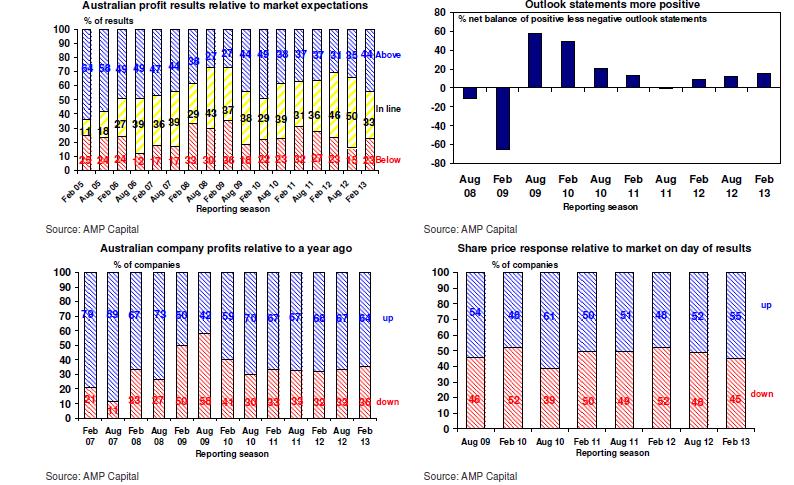
- The December half profit reporting season has now wrapped up, and while overall profits were down the outcome was far better than feared and there’s now some light at the end of the profit tunnel. Total profits for the December half have come in around 10% down on a year ago driven by a 35% slump in resources profits but with banks up 2% and industrials up around 10%. The key themes were that: the results were much better than feared with upside surprises running at their highest in three years; soft sales growth but an aggressive focus on cost control to manage margins; good jumps in cyclical value stocks like Harvey Norman, JB HiFi, Qantas and Bluescope Steel; and a further improvement in outlook comments backed up by rising dividends suggesting that companies are confident that there will be an upturn in the profit cycle. Reflecting this, analyst earnings estimates have been upgraded slightly for the first time in two years. While shares have run ahead of earnings, this is usually the case during the early stages of share market recoveries. Moreover, the profit reporting season combined with signs that interest rate cuts are starting to get traction in driving stronger demand in the economy are consistent with the profit cycle having bottomed.
- 44% of companies have exceeded expectations, which is the best in three years; 53% of companies have increased their dividends from a year ago and only 22% have cut them; 40% have exceeded expectations on dividends with only 26% delivering dividends worse than expected; and there have been more positive outlook comments than negative. Reflecting the better than feared results, 55% of companies have seen their share price outperform the market on the day their results were released.
Major market moves
- Share markets mostly rose over the past week with good US and European data offsetting Italy’s election result and worries about sequestration in the US. European shares fell 0.2%, but US shares rose 0.2%, Japanese shares rose 1.9%, Australian shares rose 1.4% and Chinese shares rose 2%.
- However, investor nervousness saw the $US rise & commodities prices fall and this contributed to a fall in the $A.
- While Italian bond yields rose following its messy election outcome, bonds rallied elsewhere. Even Spanish bond yields fell suggesting little fear of contagion from Italy.
What to watch over the next week?
- In Australia, the RBA is expected to leave interest rates on hold again on the grounds that there is tentative evidence that rate cuts are getting traction and that there is plenty of monetary stimulus still in the pipeline. The December quarter capex survey was probably not soft enough to convince the RBA to ease again just yet. However, the RBA is likely to signal that it retains an easing bias with the benign inflation outlook providing scope to ease if needed. My view is that although green shoots are starting to appear in the Australian economy, they are still very fragile and to ensure they don’t whither the RBA should be cutting rates again.
- On the data front expect a 2% rebound in building approvals (Monday), a 0.4% bounce in retail sales (Tuesday) and a 0.3% rise in December quarter GDP (Wednesday) resulting in year ended growth falling to 2.7%. While net exports and dwelling investment are expected to add to December quarter GDP growth, consumer spending and capex will be drags. Data for business indicators (Monday) and trade (Thursday) will also be released.
- In China, the National People’s Congress will get underway Tuesday and will likely adopt a 7.5% growth target for this year (the same as in 2012) and a 3.5% inflation target. Economic activity data for February (Saturday) is likely to have remained strong, but growth in lending, exports and imports are all likely to have slowed after the New Year related surge in January. Inflation is likely to have bounced back to 3% thanks to a surge in food prices, but should prove temporary as food prices have since fallen again.
- In the US the focus will be on employment data (Friday) which is expected to show February jobs growth of 150,000, which is good but not so strong as to invite talk of the Fed ending monetary stimulus. Unemployment is likely to have remained around 7.9%. The ISM non-manufacturing conditions index (Friday) is expected to remain solid and the Fed’s Beige Book (Wednesday) and the trade balance (Thursday) will also be released.
- On the global central bank front on Thursday, the Bank of England may announce more quantitative easing but both the ECB and BoJ are likely to remain on hold, with the latter awaiting the arrival of the new Governor.
Outlook for markets
- Shares appear have entered a correction or consolidation phase which may still have a bit further to go in the short term given risks around Italy, Spain, the budget sequester in the US and Chinese property tightening measures. However, any further set back is likely to be mild and the broad trend in share markets is likely to remain up. Equity valuations remain reasonable, the strengthening growth outlook points to stronger profits ahead and investors are likely to increasingly switch from low yielding cash and bonds into shares as confidence continues to build. A pick up in M&A activity is also likely to be positive for shares. So notwithstanding the usual bumps along the way this all adds up to a positive backdrop for share markets.
- While sovereign bonds have been a great diversifier and a great investment in recent years they are becoming more vulnerable as the improving global growth outlook will likely see bond yields move higher over the year ahead resulting in capital losses for investors in sovereign bonds.
- The outlook for the Australian dollar remains messy. Mixed Australian economic data is a negative but quantitative easing in the US and now Japan is a positive. The likely outcome is for a $US0.95 to $US1.10 range.

 CPD: Growth holds, risks widen
 CPD: Intergenerational wealth – When the responsibility transfers before the money
 CPD: Why market structure rewards active management in local currency EMD
 CPD: A practical system for building client confidence – Value of Advice (Part 1)
 CPD: When a little knowledge is dangerous – countering the financial ‘guidance’ your clients are getting from AI
Weekly economic and market update
Shares had a volatile ride, getting hit earlier in the week following the poor outcome from the Italian election only to then rebound to varying degrees as worries about Italy and renewed contagion in Europe settled down and US economic data surprised on the upside.
Major global economic events and implications
Australian economic events and implications
Major market moves
What to watch over the next week?
Outlook for markets
Print
email
Tags:AMP Capital economic commentary Shane Oliver
Latest Articles