
Weekly market update – week ending 5 February, 2016
Investment markets and key developments over the past week
The past week has seen most share markets give up much or all of their Fed and Bank of Japan inspired gains of the previous week as some soft US data added to concerns about the US and global growth outlook. Bond yields generally declined except in peripheral Eurozone countries. Commodity prices were mixed with metals up but oil down a bit, as a weaker $US provided some help. The weaker $US has also seen the $A push back up to around $US0.72.
Perhaps the big development over the last week was the decline in the $US. This was on the back of soft US economic data along with Fed Governor Brainard and NY Fed President Dudley reinforcing the view that the Fed is on hold. The strengthening $US in recent times has played a role in market turmoil to the extent that it added to the weakness in oil and commodity prices, put downwards pressure on emerging market currencies adding to the risk of a funding crisis, put pressure on China to depreciate the Renminbi and weighed heavily on US profits. So if the $US can stabilise then it could be positive for share markets and commodities.
Against this, concerns around global growth, particularly about China and the US, are likely to linger so it remains premature to say we have seen the low for shares. In particular, a weaker $US will be of no help if it’s due to a slumping US economy.
The key therefore remains whether we will see a US/global recession. If we do then share markets have much further to fall (eg, another 20% plus). But if recession is avoided and global growth continues to muddle along around 3% pa then further downside in markets is likely to be limited and they are likely to stage a decent recovery by year end. We see a recession as being unlikely because we have not seen the normal excesses – massive debt growth, over investment or inflation – along with aggressive monetary tightening that invariably precede them. In fact, we are still seeing aggressive global monetary easing. At this stage we see the probability of US/global recession as being around 25%.
While the RBA left interest rates on hold for the ninth month in a row the tone of its post meeting statement and its February Statement on Monetary Policy signals greater concern about the global growth outlook and a watching brief regrading recent financial turbulence suggesting that it has become a bit more dovish. Our view remains the RBA will cut interest rates again this year reflecting the risks around the global economy, weaker than expected commodity prices, still subdued growth in Australia at a time when the contribution from housing construction is slowing, a more dovish Fed threatening a higher Australian dollar and continued low inflation. However, this may not be till April or May.
Should investors worry about the Zika virus? No. While its implicated in birth defects, people usually don’t get sick enough to go to hospital and rarely die so it doesn’t compare to Bird Flu, Ebola or SARS for potential economic effects.
Major global economic events and implications
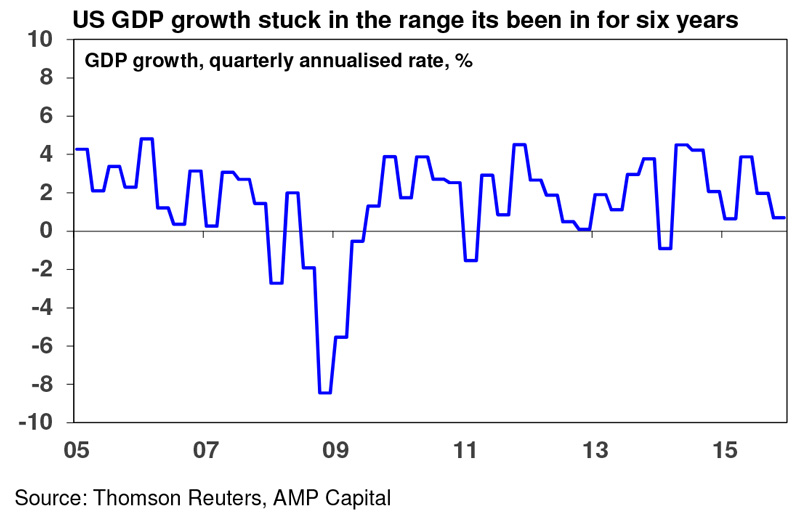
US economic news over the last week was a bit on the soft side adding to concern about a slowdown in US economic growth. While ISM manufacturing conditions index rose slightly it remains weak, the ISM non-manufacturing conditions index fell raising concerns that manufacturing weakness is affecting the services sector, construction activity was weaker than expected in December and the Fed’s bank lending officer survey showed tightening lending standards for business loans and reduced loan demand. However, all is not negative as the Markit manufacturing PMI is much stronger than the ISM, auto sales were stronger than expected in January, bank lending standards to households are not tightening and jobs data is okay. More broadly the US economy could be going through just another soft patch of which we have seen several over the last six years over which time annualised GDP growth has averaged 2% pa, but ranged from -1.5% to +4.5%.
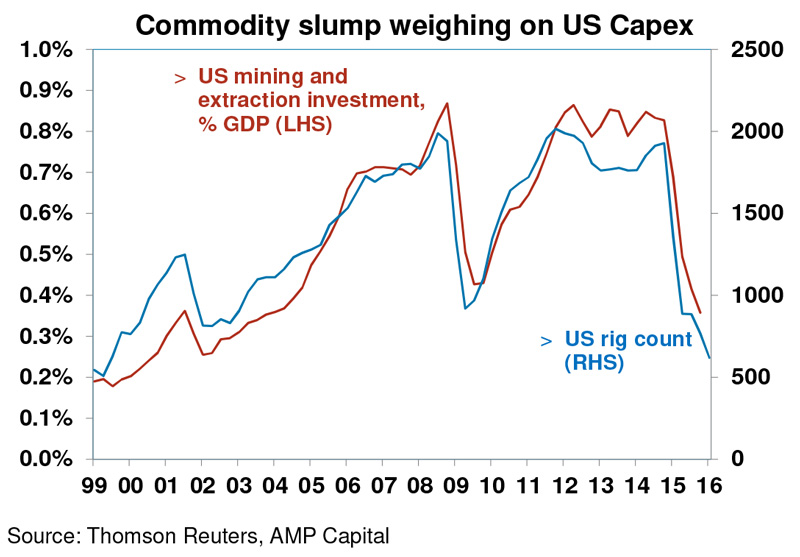
Sure there could be problems ahead for energy related debt and mining and energy related investment could fall further but with the latter having already fallen from 0.8% of US GDP to just 0.4% the bulk of the damage is arguably already behind us. So in the absence of a period of broad based excess and significant monetary tightening it remains hard to see a US recession. At this stage I attach about a 25% probability to the risk of a US recession.
So far the US December quarter earnings reporting season is about 62% complete. While 78% of results have beat on earnings, the size of positive surprises has been lower than in prior quarters and so earnings are still down 5.6% year on year. Sales revenue is down 4%, but up 0.9% if energy is excluded.
Eurozone unemployment fell 0.1% in December, but remains high at 10.4%. Meanwhile producer price inflation remains very negative at -3% year on year highlighting the risk of broader deflation.
Japan’s final manufacturing conditions PMI for January fell slightly to 52.3 but its services conditions PMI rose 0.9 points to 52.4 all of which is consistent with continuing growth.
Chinese business conditions PMIs painted a mixed picture for January with the official and Caixin manufacturing PMIs little changed and averaging a still soft 48.9, but the average of the services PMIs rose 0.6 points to a solid 53. Quite clearly manufacturing remains weak but services are solid. Meanwhile further help was provided for the housing sectors with another cut in minimum down payment rates for some cities.
India is doing well with manufacturing and services conditions PMIs rising solidly in January.
Australian economic events and implications
Australian economic data was mixed. The AIG’s business conditions indicators continue to meander around average levels, building approvals rebounded in December but continue to look like they have seen the best pointing to a declining contribution to economic growth from housing this year, retail sales were flat in December but saw moderate real growth in the December quarter and the trade deficit blew out again in December due to weak commodity prices. Home prices bounced back in January after falls in the December quarter but it continues to look like momentum is cooling in Sydney.
What to watch over the next week?
In the US, labour market indicators for job openings and hiring (Tuesday) will give a guide as to how the labour market is holding up and January retail sales data (Friday) are expected to show modest growth.
Eurozone data is expected to show modest growth is continuing with December quarter GDP (Friday) expected to show growth of 0.4% quarter on quarter or 1.6% year on year.
Chinese credit data will be watched for signs that monetary easing is continuing to support credit growth.
In Australia, the NAB business survey’s confidence reading (Tuesday) and consumer confidence (Wednesday) are vulnerable to slight falls reflecting ongoing share market turbulence and housing finance (Friday) is likely to show a slight pull back after a solid gain in November. ANZ job ads and data on new home sales will also be released.
The Australian December half profit reporting season will start to ramp up in the week ahead with 27 major companies reporting including JB HiFi, Cochlear, Commonwealth Bank, RIO and the ASX. Key themes are likely to be: ongoing horrific conditions for resources companies (where 2015-16 earnings are expected to fall another 61%); continued modest profit growth for the rest of the market (of around 5%) led by healthcare, building materials, general industrials and discretionary retail; help from the lower $A; and an ongoing focus on cost control. Given the significant downwards revision to earnings expectations and the fall in the share market so far this year there is some chance we will see upside surprise.
Outlook for markets
With global growth worries remaining it’s still premature to say that shares have bottomed. However, with shares having become technically oversold at their recent lows, sentiment readings at bearish extremes and central banks becoming more dovish there is a good chance that the rebound that has recently got underway has further to go. Beyond the near term uncertainties, we still see shares trending higher this year helped by a combination of relatively attractive valuations compared to bonds, further global monetary easing and continuing moderate economic growth. But expect volatility to remain high.
Very low bond yields point to a soft medium term return potential from sovereign bonds, but it’s hard to get bearish in a world of fragile growth, spare capacity, weak commodity prices and low inflation.
Commercial property and infrastructure are likely to continue benefitting from the ongoing search by investors for yield.
National capital city residential property price gains are expected to slow to around 3% this year, as the heat comes out of Sydney and Melbourne. Prices are likely to continue to fall in Perth and Darwin, but growth is likely to pick up in Brisbane.
Cash and bank deposits are likely to continue to provide poor returns, with term deposit rates running around 2.5% and the RBA expected to cut the cash rate to 1.75%.
New found dovishness from the Fed poses a short term upside risk for the $A to $US0.73-74. However, the broad trend is likely to remain down as the interest rate differential in favour of Australia narrows, commodity prices remain weak and the $A undertakes it’s usual undershoot of fair value. Expect a fall to around $US0.60 by year end.
By Shane Oliver, AMP Capital
———-


